
Digital Transformation in South Africa’s Local Government 2026: 257 Municipalities, POPIA-Compliant E-Government, and PMO Software
What is digital transformation in South Africa’s local government?
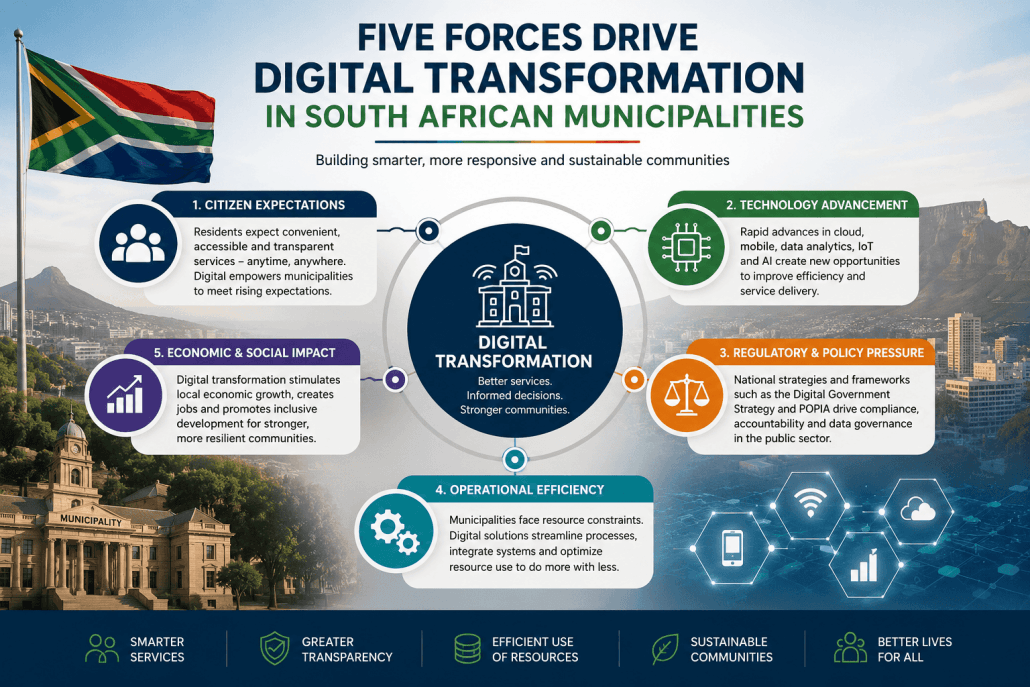
Digital transformation in South Africa’s local government is the conversion of municipal services — billing, indigent registers, service-delivery requests, infrastructure project portfolios, council meetings, and financial reporting — from paper-based and ad hoc IT processes into integrated digital workflows accountable under the MFMA, the Municipal Structures Act, and the Protection of Personal Information Act (POPIA). The Department of Communications and Digital Technologies (DCDT) leads the national agenda, while SALGA and COGTA mediate implementation across the 257 municipalities (DCDT Digital Transformation Roadmap).
Which 3 spheres of government does municipal digital transformation cover?
South African government operates across 3 distinct spheres — national, provincial, and local — each with assigned constitutional powers. Local government, the sphere closest to citizens, runs through 257 wall-to-wall municipalities split into 8 metropolitan, 44 district, and 205 local municipalities (SALGA official site). Municipal digital transformation is constrained by the upper spheres because budgets, policy frameworks, and audit standards flow downward from National Treasury and COGTA before reaching municipal IT departments.
How do COGTA, SALGA, DCDT, and SITA each shape municipal digital strategy?
Four statutory bodies shape municipal digital strategy in South Africa, each with a separate mandate:
- COGTA (Department of Cooperative Governance and Traditional Affairs): oversees and supports local government, coordinates intergovernmental relations, and runs municipal capacity programmes under Minister Velenkosini Hlabisa (COGTA official site).
- SALGA (South African Local Government Association): established in 1996 and recognised in 1998 under Government Notice R.175, SALGA is the autonomous national association of all 257 municipalities, registered as a Schedule 3A Public Entity under the PFMA (SALGA).
- DCDT (Department of Communications and Digital Technologies): leads the national digital transformation roadmap, with 4 priority areas — broadband connectivity, digital skills, data centre infrastructure, and productive technology use.
- SITA (State Information Technology Agency): enforces the technical and procurement frameworks under which municipalities may deploy IT systems, including the security baselines that the SmartGov platform in North West province uses.
How are South Africa’s 257 municipalities structured and why does it affect digitisation?
South Africa’s 257 municipalities are arranged in 3 categories defined by the Local Government: Municipal Structures Act, and the category determines budget, IT staffing, and digitisation capacity:
| Category | Count | Examples | Typical IT Capacity | Digital Maturity |
|---|---|---|---|---|
| Category A — Metropolitan | 8 | City of Johannesburg, Cape Town, eThekwini, Tshwane | Dedicated IT departments, CIOs | Smart-city pilots |
| Category C — District | 44 | Sedibeng, Capricorn, Cape Winelands | Shared IT services across constituent municipalities | Mixed |
| Category B — Local | 205 | Polokwane, Buffalo City, Mogale City, Thulamela | 1–5 IT staff per municipality on average | Largely paper-based |
The asymmetry matters: the 8 metros host the majority of provincial GDP and IT budgets, while the 205 local municipalities — especially in Limpopo, Eastern Cape, and KwaZulu-Natal rural districts — depend on shared infrastructure and grant funding from the Municipal Infrastructure Grant (MIG, in place since 2004) to digitise even basic citizen services.
Which 5 forces drive digital transformation in South Africa municipalities in 2026?
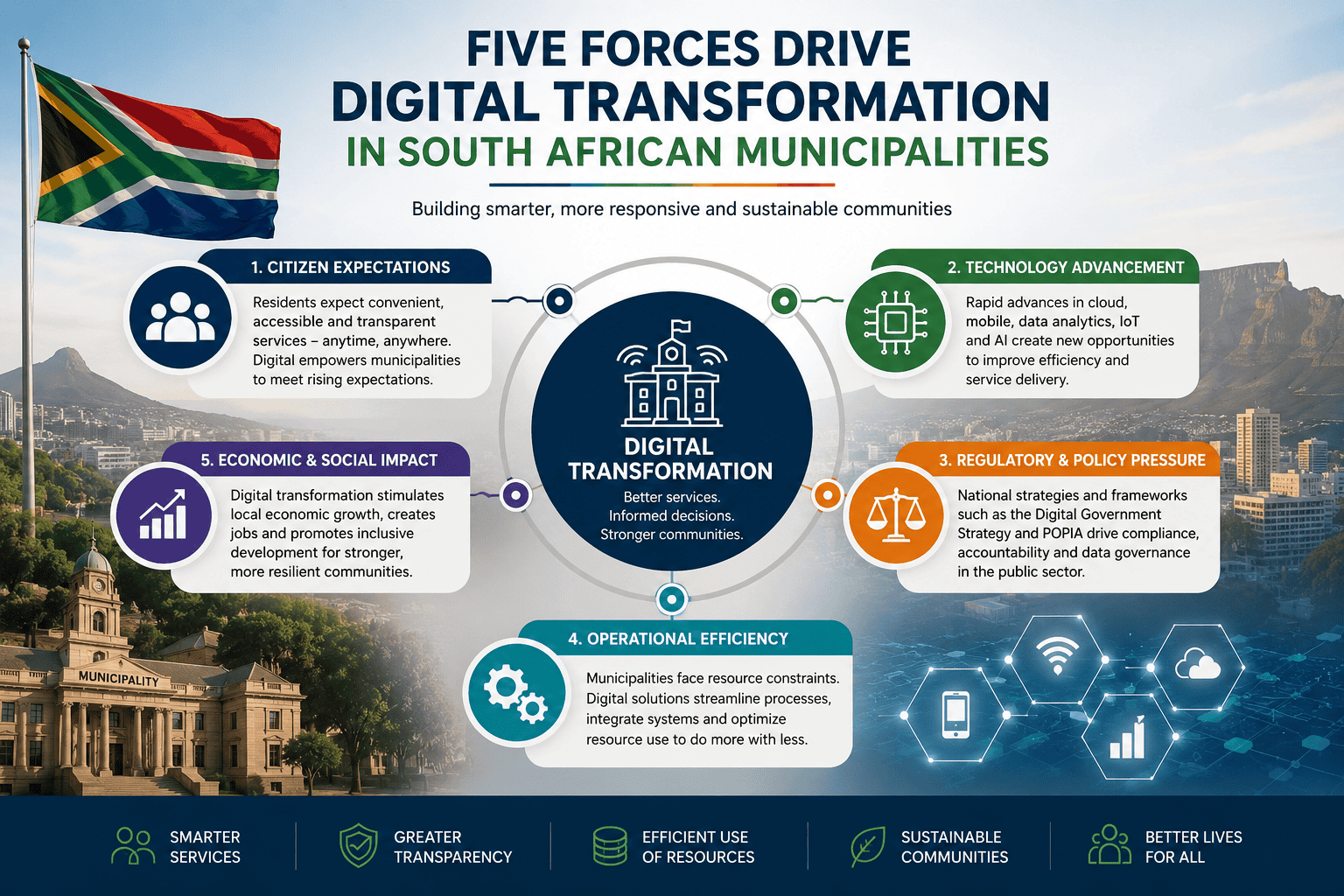
Five forces drive digital transformation in South African municipalities in 2026: legislative reform, citizen expectations, cyber-risk exposure, fiscal pressure, and national broadband roll-out. Each force shifts municipal IT spend toward specific categories — financial systems, citizen portals, on-premise hosting, project management discipline, and connectivity infrastructure.
How does the MFMA Amendment Bill 2026 strengthen financial digitisation?
The MFMA Amendment Bill 2026, scheduled for public comment in early 2026, requires funded budgets, stronger expenditure controls, consequence management for irregular expenditure, and clearer financial recovery measures (SAnews, 2026 Budget Review). Practical consequences for municipal CIOs include digital evidence trails for every procurement decision, real-time S71 financial reporting to National Treasury, and integration between project management systems and financial systems so capital expenditure can be matched to project milestones during audit.
Why does POPIA push municipalities toward on-premise data hosting?
POPIA — the Protection of Personal Information Act, fully enforceable since 1 July 2021 — makes the municipality the “responsible party” for every record of resident personal information and exposes officials to penalties of up to R10 million or 10 years imprisonment for serious breaches (POPIA official text). Three operational pressures push municipalities toward on-premise or SA-resident data hosting:
- Cross-border transfer restrictions under POPIA Sections 72–73 limit the use of SaaS tools hosted outside South Africa unless the receiving jurisdiction has adequate protection.
- Operator agreements under POPIA Section 21 require a written contract with any external processor — a procurement step many municipalities prefer to avoid.
- Information Regulator enforcement notices against bodies like Dis-Chem and the South African Police Service (SAPS) since 2022 demonstrate that POPIA penalties are now actively enforced.
Self-hosted municipal IT systems remove the operator-agreement burden and keep all personal information inside the municipality’s own infrastructure perimeter. Project management tools such as Kendo Manager install on a Windows Server, Windows 10/11 workstation, Windows VPS, ASP.NET hosting, or Microsoft Azure tenancy that the municipality already controls (Self-Hosted Project Management Software).
What did the City Power and City of Johannesburg ransomware attacks teach SA local government?
The 2019 ransomware attacks on City Power Johannesburg (July 2019) and the City of Johannesburg itself (October 2019, by the Shadow Kill Hackers group demanding 4 Bitcoin) taught SA municipal IT three operational lessons: legacy infrastructure is the dominant attack surface, refusal to pay requires verified offline backups, and digital service interruptions translate directly into citizen anger. The City of Johannesburg refused the ransom and restored 80% of services within four days. Since 2019, every metro CIO procurement specification mentions encryption-at-rest, offline backup rotation, and role-based access — which together raise the bar for any project management or financial system bought by a municipality.
How does the SmartGov platform in North West province show what’s possible?
The North West provincial government brought the SmartGov platform live across all provincial departments on 1 April 2026, replacing manual paper-based processes with an integrated automated administrative system (SAnews, April 2026). The rollout includes real-time monitoring and evaluation in the Office of the Premier, integrated reporting from departments, state-owned entities, and municipalities, migration from legacy platforms to Microsoft 365 and Azure, and endpoint protection deployed under SITA frameworks. The SmartGov example matters because it shows that the bottleneck is sequencing — training, change management, and procurement — rather than software availability.
Why is the SALGA-British High Commission Broadband Programme important?
The Broadband and Digital Skills Programme, a joint initiative of the DCDT, SALGA, and the British High Commission, trains municipal managers and councillors on smart-cities governance, broadband policy, deployment strategies, ownership models, and infrastructure financing. The programme addresses one of the documented failure modes in SA municipal digitisation: strong national policy combined with weak political and administrative will to execute at the municipal level — a pattern documented in a 2026 Frontiers systematic review of 20 peer-reviewed studies (Frontiers in Sustainable Cities, 2026).
What are 8 concrete digital transformation projects SA municipalities run in 2026?
SA municipalities run 8 recurring categories of digital transformation projects, each with its own delivery methodology, statutory anchor, and software requirement:
| # | Project Category | Example | Methodology | Statutory Anchor |
|---|---|---|---|---|
| 1 | e-Billing and prepaid utilities | Online municipal account portal | Waterfall + Agile | MFMA, POPIA |
| 2 | Citizen service request system | Polokwane fault-reporting portal | Agile sprint delivery | Batho Pele principles |
| 3 | Indigent register digitisation | Means-test workflow database | Waterfall | MFMA, POPIA |
| 4 | GIS and asset management | Pipe-network and pothole tracking | Phased delivery | Municipal Asset Management |
| 5 | Council meeting digitisation | Paperless agenda system | Waterfall | Municipal Structures Act |
| 6 | Capital project portfolio management | MIG-funded infrastructure tracking | Programme management | MIG, MFMA |
| 7 | e-Procurement and supply chain | Tender submission portal | Waterfall + workflow automation | PFMA, MFMA |
| 8 | Smart city pilots | Cape Town IoT streetlight programme | Agile + IoT integration | White Paper on STI 2019 |
Project categories 6 and 7 — capital project portfolio management and e-procurement — generate the most evidence for the Auditor-General South Africa (AGSA) and therefore benefit most from a single source of truth covering Gantt schedules, milestone payments, risk registers, and change logs. A self-hosted project management tool covers all 4 requirements without adding a new POPIA operator relationship (Enterprise Project Management Software modules).
Which 6 challenges block municipal digital transformation in South Africa?
Six challenges consistently block faster digital transformation across South Africa’s 257 municipalities, ranked by frequency of mention in academic and government sources:
- Skills shortage in 4IR technologies: COBOL-era IT staff cannot deploy cloud-native or AI-augmented workflows without retraining; the SALGA-British High Commission Broadband Programme addresses this gap at councillor level.
- Copper cable theft and broadband gaps: physical infrastructure theft repeatedly disrupts municipal connectivity, particularly in Limpopo, Eastern Cape, and Mpumalanga.
- Institutional inertia and patronage networks: peer-reviewed research finds that “digitalisation reproduces symbolic compliance rather than substantive accountability” when political will is absent (Ekurhuleni case study, Ncamphalala and Vyas-Doorgapersad, 2022).
- Rural–urban digital divide: Polokwane Local Municipality and similar Limpopo municipalities document that residents lack reliable internet access, limiting any digital service adoption beyond essential transactions.
- Cybersecurity capacity gap: the 2019 Johannesburg attacks remain the textbook case; municipalities of fewer than 100,000 residents rarely have a dedicated security officer.
- Weak change management: a 2026 OIDA International Journal study on the SA public sector finds that change management failures, not technology, drive most digital transformation underperformance.
None of these challenges are solved by software alone — but the right project management discipline reduces challenges 1, 5, and 6 because evidence-based milestone tracking removes ambiguity about which workstream is behind schedule.
How does project management software support municipal digital transformation in South Africa?
Project management software supports municipal digital transformation in South Africa by giving CIOs, programme managers, and the Auditor-General a single, time-stamped record of every task, cost line, risk, and change across the digitisation portfolio. The match between a municipality’s audit-readiness obligation and a PMO tool’s evidence-capture features is direct: every entry recorded against a Gantt task today becomes a defensible record during next year’s AGSA audit.

What POPIA and on-premise requirements should municipal PM software meet?
Municipal project management software in 2026 should meet 5 POPIA and on-premise requirements:
- SA-resident or on-premise hosting that keeps personal information inside the municipality’s own perimeter, avoiding cross-border transfer scrutiny.
- Role-based access controls with per-project permissions matching the municipal organogram from MM to interns.
- Audit logging with tamper-evident timestamps for every task update, comment, and document attachment.
- Backup and recovery options that the municipal IT team controls — the Johannesburg 2019 ransomware lesson.
- Operator-agreement avoidance: self-hosted deployment removes the POPIA Section 21 operator-agreement burden entirely.
How does Kendo Manager fit South African municipal project portfolios?
Kendo Manager fits South African municipal project portfolios because it installs on the municipality’s own Windows infrastructure or Microsoft Azure tenant under SITA-aligned compliance frameworks and ships with all 12 project management modules — Gantt charts, Kanban boards, task lists, time tracking, cost management, resource management, issue tracking, change management, risk management, document management, dashboards, and notifications — included in every licence tier (Kendo Manager features). The one-time perpetual licence model also fits municipal procurement: capital expenditure rather than recurring foreign-currency subscriptions (Kendo Manager pricing).
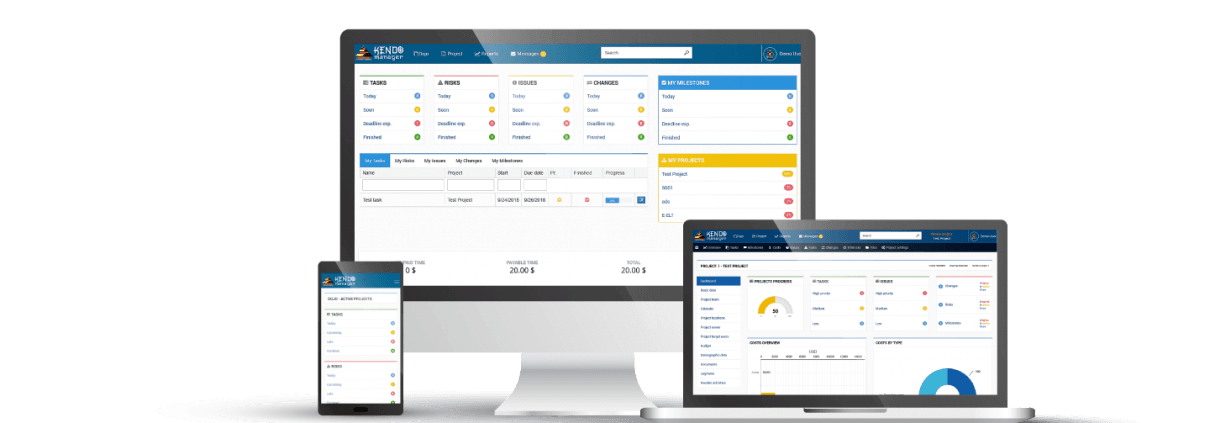
Three properties matter for municipal CIOs:
- POPIA-by-default deployment: every record stays inside the municipality, removing the operator-agreement requirement and supporting POPIA Section 19 security safeguards.
- Mobile access for field-based teams: water, electricity, and roads engineers update task status from site via smartphone or tablet (Mobile Project Management).
- Alignment with PMSA designations: project evidence captured in Kendo Manager supports applications for PMSA Project Manager and Senior Project Manager designations — relevant for municipal staff career progression — as covered in the related Project Management South Africa guide.
How do you run a municipal digital transformation project in 7 steps?
A municipal digital transformation project runs through 7 sequential steps that match the MFMA budget cycle and POPIA’s accountability conditions:
- Mandate confirmation: align the project with the Integrated Development Plan (IDP) and the Service Delivery and Budget Implementation Plan (SDBIP), and obtain Council resolution.
- Stakeholder mapping: identify the municipal manager, CFO, CIO, ward councillors, COGTA provincial liaison, and SALGA branch as the governance circle.
- POPIA impact assessment: document what personal information the project will process and confirm the lawful basis under POPIA Section 11.
- Procurement under SCM regulations: select software and implementation partners under MFMA Supply Chain Management rules — a single perpetual licence sometimes avoids competitive bidding thresholds.
- Implementation plan with Gantt and Kanban views: load the work breakdown structure into the project management tool, assign owners, and capture baselines for AGSA audit reference.
- Change management and citizen communication: brief the public via municipal channels, train staff under the SALGA capacity programmes, and run a parallel-operation period.
- Closure and post-implementation review: capture lessons learned, hand over to operations, and feed the next IDP cycle (Project Management Guide).
The 7-step model maps cleanly onto the 5 phases (Initiation, Planning, Execution, Monitoring and Control, Closure) recognised by PMI and PMSA, and onto the GAPPS competency framework that PMSA uses for its 4 designations.
Frequently asked questions about digital transformation in South Africa’s local government
How many municipalities exist in South Africa in 2026?
South Africa has 257 municipalities in 2026, divided into 8 metropolitan (Category A), 44 district (Category C), and 205 local (Category B) municipalities, as confirmed by SALGA’s official membership records. The structure is set by the Local Government: Municipal Structures Act and was last redrawn in the 2016 municipal demarcation cycle.
Which laws govern digital transformation in SA local government?
Digital transformation in SA local government is governed by 6 primary statutes: the Municipal Systems Act, Municipal Structures Act, Municipal Finance Management Act (MFMA), Public Finance Management Act (PFMA), Protection of Personal Information Act (POPIA), and the National Qualifications Framework Act (Act 67 of 2008). Together these statutes set the budget, procurement, data-protection, and skills-recognition rules every municipal digital project must follow.
What is POPIA’s impact on municipal IT systems?
POPIA’s impact on municipal IT systems is that every municipality must apply 8 lawful-processing conditions to resident personal data, appoint an Information Officer (usually the municipal manager) and a Deputy Information Officer, notify the Information Regulator and affected residents of any breach, and accept penalties of up to R10 million or 10 years imprisonment for serious violations.
What did the SmartGov rollout in North West achieve?
The SmartGov platform brought live in North West province on 1 April 2026 replaced manual paper-based processes with an integrated automated administrative system across all provincial departments, added real-time monitoring in the Office of the Premier, migrated workloads from legacy platforms to Microsoft 365 and Azure, and strengthened cybersecurity via endpoint protection under SITA frameworks.
How can SA municipalities prevent ransomware attacks like Johannesburg 2019?
SA municipalities can reduce ransomware risk by applying 6 controls: encryption at rest, offline backup rotation, role-based access controls, network segmentation, regular penetration testing, and incident response drills. Self-hosted systems with offline backups give municipalities the option to refuse ransom demands — the route the City of Johannesburg chose in October 2019 when restoring 80% of services within four days without paying the 4 Bitcoin demand.
Which project management software fits POPIA, MFMA and SITA requirements?
Project management software that fits POPIA, MFMA and SITA requirements satisfies four conditions: SA-resident or on-premise hosting, role-based access with audit logging, capital-expenditure licensing rather than foreign-currency subscriptions, and full-feature inclusion to avoid scope-creep procurement. Self-hosted tools such as Kendo Manager satisfy all four when deployed on a municipality’s own Windows Server or Microsoft Azure tenant.
Which sphere of government leads digital transformation in South Africa?
The national sphere leads digital transformation policy in South Africa through the Department of Communications and Digital Technologies (DCDT), with execution distributed across provincial governments and 257 municipalities. SALGA coordinates the municipal sphere as a Schedule 3A Public Entity under the PFMA; COGTA provides oversight and support; SITA enforces the technical compliance baseline.
What percentage of South African municipalities are in financial distress in 2026?
63% of South African municipalities are in financial distress according to the National Treasury 2026 Budget Review, and the proportion of clean audits among the 257 municipalities remains low. The MFMA Amendment Bill 2026 was introduced specifically to enforce funded budgets, tighten consequence management, and broaden financial recovery powers in response.
Key takeaways for South African municipal CIOs and project managers
Digital transformation in South Africa’s local government sits at the intersection of statutory reform, citizen expectations, POPIA accountability, and cyber-risk exposure. The 257 municipalities and the 4 statutory bodies that support them — COGTA, SALGA, DCDT, SITA — have the policy mandate; the gap remains in execution capacity at municipal level. Self-hosted project management software addresses three of the most cited execution barriers at once: POPIA compliance through on-premise hosting, AGSA audit-readiness through time-stamped evidence capture, and skills support through Gantt, Kanban, and risk-register views that match PMSA designation competency criteria. See the Self-Hosted Project Management Software page for SITA-aligned deployment paths, the Kendo Manager features page for the 12 included modules, the Kendo Manager pricing page for one-time perpetual licensing in ZAR-friendly terms, and the Free Self-Hosted Project Management Tools page for the no-cost evaluation edition that municipalities can pilot before committing CapEx.

