
Project Management in South Africa 2026: PMSA Designations, 4 Professional Levels, and POPIA-Compliant Software
What is Project Management South Africa (PMSA) and who recognises it?
Project Management South Africa is the not-for-gain, voluntary professional association that represents project, programme and portfolio management practitioners in South Africa and Southern Africa, operating under Section 21 of the previous Companies Act (PMSA official site). The South African Qualifications Authority (SAQA) officially recognised PMSA as the professional body for project management in 2013 under the National Qualifications Framework Act (Act 67 of 2008) (SAQA Professional Body listing).
When was PMSA founded and what is its legal structure?
PMSA was founded in 1997 as Project Management Institute of South Africa (PMISA) and was later renamed Project Management South Africa to reflect its independent national status, separate from any international body. Legally, PMSA operates as a Section 21 not-for-gain professional association, which gives it autonomy to recognise professional competencies and award designations without acting as a statutory regulator. The national office sits in Sandton and is reachable on +27 11 257 8003.
How did SAQA recognition in 2013 change PMSA’s authority?
SAQA recognition in 2013 elevated PMSA from a voluntary forum into the country’s official designation-awarding body for project management, anchored in the National Qualifications Framework Act (Act 67 of 2008). The change meant three things in practice: (1) PMSA designations are entered on the National Learners’ Records Database, (2) the assessment process is auditable by SAQA, and (3) employers and government tenders can require a PMSA designation as proof of competence on a legal basis.
Which 4 professional designations does PMSA award in 2026?
PMSA awards 4 professional designations along an experience-based career pathway: PM.Admin (Project Management Administrator), PM (Project Manager), Sr.PM (Senior Project Manager), and Pr.PM (Professional Project Manager) (PMSA PM Designations page). Each level evaluates qualifications, demonstrated competence, and project responsibility against PMSA’s professional standards.
| Designation | Acronym | NQF Level (typical) | Typical Experience | Project Scope |
|---|---|---|---|---|
| Project Management Administrator | PM.Admin | NQF 5 | 1–3 years | Project administration, scheduling support |
| Project Manager | PM | NQF 6–7 | 3–5 years | Full lifecycle delivery of single projects |
| Senior Project Manager | Sr.PM | NQF 7–8 | 5–10 years | Complex projects and small programmes |
| Professional Project Manager | Pr.PM | NQF 8+ | 10+ years | Programme and portfolio leadership |
Each designation requires a structured evaluation against PMSA competency criteria plus Continuing Professional Development (CPD) once awarded, in line with SAQA professional-body requirements.
How does PMSA differ from PMI South Africa Chapter and SACPCMP?
PMSA differs from PMI South Africa Chapter and SACPCMP on three axes: legal status, sector scope, and certification type. PMSA is a SAQA-recognised, cross-sector professional body awarding national designations; the PMI South Africa Chapter is a regional chapter of the U.S.-based Project Management Institute awarding international certifications like PMP; SACPCMP is a statutory council operating under the Project and Construction Management Professions Act (Act 48 of 2000), regulating built-environment practice only.
| Body | Status | Scope | Output | Legal Basis |
|---|---|---|---|---|
| PMSA | SAQA-recognised professional body | All sectors | PM.Admin, PM, Sr.PM, Pr.PM designations | NQF Act 67 of 2008 |
| PMI SA Chapter | Voluntary regional chapter | All sectors (global) | PMP, CAPM, PgMP certifications | PMI Inc. (USA) |
| SACPCMP | Statutory regulatory council | Built environment only | Pr.CPM, Pr.CM, Pr.CHSA registration | Act 48 of 2000 |
Which 6 PMSA branches cover Southern Africa in 2026?
PMSA operates 6 active branches across Southern Africa: Gauteng, KwaZulu-Natal, Western Cape, Eastern Cape, Namibia, and DRC/Lesotho regional events (PMSA Designations FAQs). Each branch hosts regional events, mentorship circles, and Special Interest Groups, including the Technology Users’ Group and the PMO Forum.
Branch density follows membership concentration:
- Gauteng branch: largest single concentration, currently coordinated by the National Office while volunteer leadership is recruited; key audience is corporate PMOs in Johannesburg, Sandton, Pretoria, and Centurion.
- KwaZulu-Natal branch: volunteer-run from Durban with strong utilities, logistics, and manufacturing membership.
- Western Cape branch: volunteer-run from Cape Town, with concentrations in fintech, public-sector, and tourism project portfolios. PMSA signed a partnership with the City of Cape Town in October 2025.
- Eastern Cape, Namibia, DRC, and Lesotho networks: smaller forums focused on cross-border events and regional CPD.
Why does GAPPS affiliation matter for South African project managers?
GAPPS affiliation matters because it maps PMSA designations to the Global Alliance for the Project Professions competency standards, which makes South African project managers’ qualifications transferable across borders without re-certification. GAPPS is an alliance of governments, professional associations, private industry, and academic institutions that publishes role-based competency standards (Project Manager, Programme Manager, Sponsor) used by national bodies worldwide.
The practical consequences for an SA-based project manager are three: (1) a Pr.PM holder can apply for recognition under equivalent overseas frameworks, (2) multinational employers in mining, energy, and telecoms accept PMSA designations during cross-border deployments, and (3) PMSA’s assessment criteria stay aligned with international best practice rather than drifting in isolation.
What project management software supports PMSA-aligned practice in South Africa?
Project management software that supports PMSA-aligned practice in South Africa must cover three local requirements: POPIA-compliant data handling, multi-currency including ZAR, and methodology flexibility for both private-sector agile and public-sector waterfall delivery. The South African Capterra directory currently lists more than 200 project management tools available to SA buyers (Capterra South Africa), but only a subset meet all three criteria without configuration workarounds.
How does POPIA compliance affect project management software choice in SA?
POPIA — the Protection of Personal Information Act, in full force since 1 July 2021 — requires every responsible party processing personal information in South Africa to apply 8 lawful-processing conditions and accept penalties up to R10 million or 10 years imprisonment for serious violations (POPIA official text). For project management software, this affects four buying criteria:
- Data residency: hosting data inside South Africa or in a jurisdiction with adequate protection avoids cross-border transfer scrutiny under POPIA Sections 72–73.
- Access controls: role-based permissions, audit logging, and password strength enforcement satisfy the “security safeguards” condition under Section 19.
- Information Officer support: the software vendor must provide records that an appointed Information Officer can present to the Information Regulator during an enforcement notice.
- Operator agreements: any SaaS vendor processing SA personal data on behalf of the customer needs a written operator agreement under POPIA Section 21.
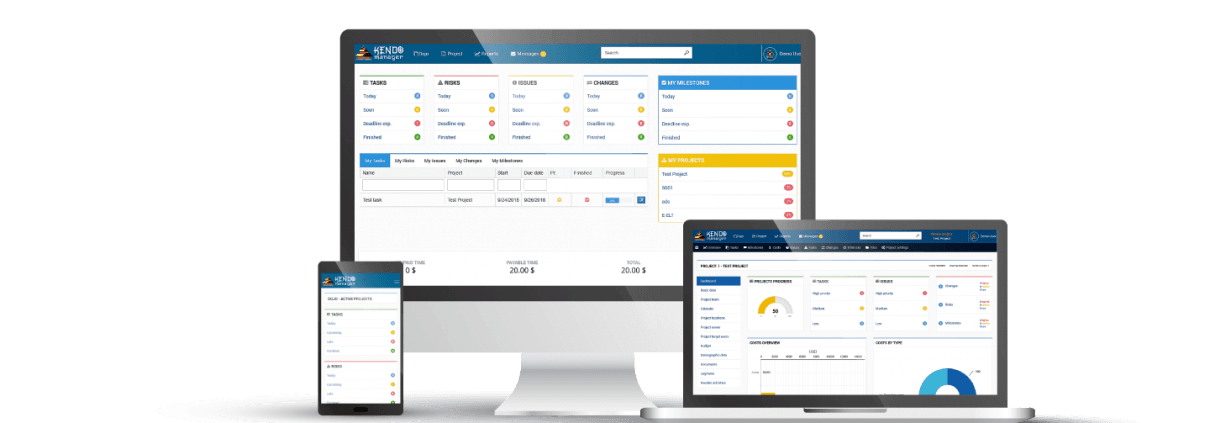
Self-hosted project management software resolves all four points by default, because the customer remains the sole responsible party and no operator agreement is required. Kendo Manager runs on the customer’s own Windows Server, Windows 10/11 PC, Windows VPS, ASP.NET hosting, or Microsoft Azure tenancy (Self-Hosted Project Management Software), which keeps SA personal data inside customer-controlled infrastructure.
Which 6 features do SA project managers need most from project management software in 2026?
South African project managers consistently report 6 features as decisive when buying project management software in 2026:
- Gantt charts with critical path and dependency visualisation for public-sector and infrastructure projects.
- Kanban and task boards for agile delivery in fintech, software, and telecoms.
- Resource management covering personnel, materials, and facilities, with ZAR-denominated cost calculations.
- Issue and risk tracking linked to tasks, with audit trails for tender-funded projects.
- Time tracking at task level for SARS-compliant billing and timesheet records.
- Document management with role-based access for POPIA Section 19 evidence.
Kendo Manager covers all 6 inside a single perpetual licence, with no module gated behind a higher pricing tier (Enterprise Project Management Software modules). The software was built by Spider Soft from 2010 onwards specifically to align with PMI and equivalent national standards while staying within SMB budgets (Kendo Manager about page).
How does Kendo Manager fit PMSA-aligned project workflows?
Kendo Manager fits PMSA-aligned workflows through three integrated views — Gantt chart, Kanban board, and task list — that together cover the planning, scheduling, control, and closure process groups recognised by GAPPS and reflected in PMSA competency criteria. Project managers assign role-level permissions per project, record actual hours per task, and compare planned cost against actual spend in real time (Kendo Manager features).
Three properties matter for SA practitioners pursuing PMSA designation upgrades:
- Evidence capture: every task, time entry, cost line, and risk note is timestamped — material PMSA assessors can review during designation evaluation.
- Mobile access: the application works on smartphones and tablets, useful for site-based construction and field-engineering projects across Gauteng, Western Cape, and KZN (Mobile Project Management).
- One-time licensing: a perpetual licence with optional annual support renewal suits SA buyers who prefer CapEx over recurring foreign-currency subscriptions (Kendo Manager pricing).
How do you apply for a PMSA designation in 2026? (5-step process)
Application for a PMSA designation follows 5 sequential steps that take 8–16 weeks end-to-end depending on portfolio complexity:
- Select the designation level: PM.Admin, PM, Sr.PM, or Pr.PM, based on years of experience and current project responsibility.
- Become a PMSA member: register and pay the annual membership fee through the PMSA member portal (PMSA membership levels).
- Prepare evidence portfolio: qualification certificates, work history with project roles, project documents demonstrating competence, and CPD records.
- Submit for evaluation: the PMSA Designation Committee assesses qualifications, experience, and competence against PMSA professional standards.
- Maintain through CPD: complete annual Continuing Professional Development activities and resubmit CPD evidence on the designation anniversary cycle.
Carrying project documentation inside a single tool — Gantt schedules, risk registers, change logs, cost variance reports — reduces evidence preparation from weeks to days. Self-hosted tools keep that evidence inside the applicant’s control even if they change employers between designation upgrades.
What does the South African project management profession look like in 2026?
The South African project management profession in 2026 shows three clear shifts compared with the pre-2020 period: POPIA-driven preference for local or self-hosted data, growth of agile delivery in financial services, and tighter alignment between PMSA designations and tender pre-qualification requirements. SAQA’s recognition of PMSA in 2013 has had a compounding effect: 12+ years later, both private and public-sector procurement increasingly list PMSA designation or PMP equivalent as a required bidder qualification.
Three sectors drive most new PMSA membership applications: infrastructure and built environment (often dual-registered with SACPCMP under Act 48 of 2000), financial services (Johannesburg and Cape Town fintech and banking PMOs), and energy and mining (where multi-year capital projects depend on rigorous portfolio governance).
Frequently asked questions about Project Management South Africa
What does PMSA stand for in South African project management?
PMSA stands for Project Management South Africa, the SAQA-recognised professional body that awards 4 project management designations — PM.Admin, PM, Sr.PM, and Pr.PM — across all industry sectors in South Africa and Southern Africa. It was formed in 1997 and operates as a Section 21 not-for-gain association.
Is PMSA designation equivalent to PMP certification?
PMSA designation is not technically equivalent to PMP certification, because PMSA awards SAQA-recognised national designations while PMP is an international examination-based credential from PMI Inc. (USA). The two coexist for many South African project managers, with PMSA providing local regulatory recognition and PMP providing global portability. PMSA’s GAPPS affiliation creates indirect mapping between the frameworks.
What are the membership fees for PMSA in 2026?
PMSA charges different annual membership fees depending on the membership level — Associate, Full Member, Student, Retiree, and Corporate. Exact 2026 fee schedules are published on the PMSA membership page; fees include access to events, the digital library, designation pathway support, and Special Interest Groups.
Which project management software is POPIA compliant for South African teams?
Project management software is POPIA compliant for South African teams when it satisfies four conditions: data hosted in SA or an adequate-protection jurisdiction, role-based access controls with audit logging, written operator agreement (for SaaS) or self-hosted deployment, and breach-notification support. Self-hosted tools like Kendo Manager satisfy all four by default because the SA customer remains the sole responsible party.
How long does it take to get a PMSA designation?
It typically takes 8–16 weeks to receive a PMSA designation after submitting the full application, including evidence portfolio review and PMSA Designation Committee evaluation. Preparation of the evidence portfolio itself often takes longer than the formal review, especially for first-time applicants gathering historical project documentation.
Does PMSA cover countries outside South Africa?
Yes, PMSA represents project, programme and portfolio practitioners across Southern Africa, with active branches and regional events in Namibia, the Democratic Republic of the Congo, and Lesotho in addition to its South African branches in Gauteng, KwaZulu-Natal, Western Cape, and Eastern Cape.
What is the difference between PMSA, SACPCMP, and SAQA?
PMSA is a SAQA-recognised cross-sector professional body for project management; SACPCMP is a statutory regulatory council for built-environment project and construction management under Act 48 of 2000; SAQA is the South African Qualifications Authority that recognises professional bodies and oversees the National Qualifications Framework. PMSA receives its authority from SAQA; SACPCMP receives its authority directly from Parliament.
Can self-hosted project management software handle multi-branch SA deployments?
Yes, self-hosted project management software handles multi-branch SA deployments — Gauteng, KZN, Western Cape, and Eastern Cape simultaneously — when the server is reachable over HTTPS through a VPN or zero-trust gateway. Kendo Manager runs as a web-based instance accessible over Firefox, Chrome, or Edge from any branch, with no per-branch software licensing.
Key takeaways for South African project managers in 2026
Project management in South Africa now sits on a clear professional foundation: PMSA holds SAQA recognition, awards 4 nationally recognised designations, partners with GAPPS for international portability, and operates 6+ regional branches. POPIA compliance has reshaped software selection across the country since July 2021, pushing buyers toward self-hosted or SA-resident hosting models. Kendo Manager addresses this market through perpetual licensing, on-premise or Azure deployment, full Gantt-Kanban-task views, and all PM modules included at every licence tier — see the Self-Hosted Project Management Software page for deployment paths, the Kendo Manager features page for the full module list, and the Kendo Manager pricing page for ZAR-friendly one-time licensing. South African project managers pursuing PMSA designation upgrades benefit most from a single tool that captures Gantt schedules, time entries, risk registers, and change logs in one auditable record — see the Project Management Guide for a process walk-through across the 5 project phases.

