
Self-Hosted Asana Alternative in 2026: Kendo Manager On-Premise License, ISO 27001 Compliance, and 7 Enterprise Features

Kendo Manager is a self-hosted Asana alternative that runs entirely on an organization’s own Windows Server and Free MariaDB infrastructure, removing the third-party processor from the project data flow. The global project management software market reached $11.27 billion in 2026 and is forecast to grow to $23.09 billion by 2031 at a CAGR above 15% [1]. For enterprise teams in banking, healthcare, government, and translation sectors — where data residency rules and audit obligations rule out multi-tenant SaaS — on-premise deployment keeps every record inside the organization’s network perimeter. This guide covers 5 security advantages, 7 enterprise features, the 5-year TCO comparison against Asana, deployment specifications for 50–500 users, and 10 FAQ entries.
What is Kendo Manager and how does it differ from cloud-based Asana?
Kendo Manager is on-premise project management software installed on the customer’s own server, which gives the organization full ownership of the database, source files, and access logs — Asana, by contrast, is a multi-tenant SaaS where Asana Inc. controls the storage layer. Cloud platforms place project records, resource allocations, and financial fields on third-party servers; Kendo Manager keeps the same data behind the customer’s firewall. According to 2026 enterprise software trend reports, the on-premise project management segment is growing at 4.9% annually in regulated sectors [2]. The deployment model defines the difference: with Asana the customer rents access to a hosted application, while with Kendo Manager the customer owns a perpetual license and decides every parameter of patching, backup cadence, and data residency.
What does data sovereignty mean in project management?
Data sovereignty in project management is the legal principle that digital project records are subject to the laws of the jurisdiction in which the storage server is physically located. Kendo Manager satisfies this requirement by keeping every byte on customer-controlled hardware in the customer’s chosen country.
How does 2026 market data support the shift to self-hosted tools?
Market data from 2026 shows that 62% of enterprise IT leaders cite data control as the primary reason for choosing on-premise project management over SaaS [2]. Procurement teams in EU and APAC markets increasingly require GDPR-aligned and country-of-origin storage as a contract precondition.
Why is digital independence critical for modern enterprises?
Digital independence protects the organization from three measurable risks: vendor lock-in, unannounced SaaS price hikes (Asana increased Business tier pricing twice between 2023 and 2025), and provider-side outages that the internal IT team cannot remediate. A self-hosted deployment removes all three risks at the architecture level.
What are the 5 core security advantages of self-hosted project management?
Self-hosted project management delivers 5 quantifiable security advantages over SaaS: full infrastructure control, ISO 27001:2022 alignment, SOC 2 Type II Trust Services Criteria coverage, NIST Cybersecurity Framework mapping, and the elimination of third-party data residency exposure. These advantages matter most in banking, healthcare, defense, and government sectors, where a single multi-tenant breach can trigger regulatory fines exceeding €20 million under GDPR Article 83.
How does Kendo Manager deliver full infrastructure control?
Kendo Manager hands the IT department the firewall rules, encryption-at-rest configuration, backup schedule, and role-based access matrix — none of which depend on a cloud vendor’s release calendar. Patches are applied during the customer’s own maintenance windows.
What does ISO 27001:2022 compliance mean for Kendo Manager users?
ISO 27001:2022 is the international standard for Information Security Management Systems, and its Annex A control 5.23 imposes specific security requirements on the use of cloud services [3]. On-premise tools like Kendo Manager bypass that control surface entirely by keeping the asset inside the certified perimeter the organization already maintains.
How does Kendo Manager align with the SOC 2 Type II Trust Services Criteria?
Kendo Manager supports the 5 SOC 2 Type II Trust Services Criteria — Security, Availability, Processing Integrity, Confidentiality, and Privacy — by exposing the technical controls (audit logs, access reviews, encrypted SQL backups) inside the customer’s own data center rather than abstracting them behind a SaaS interface [4].
Why does NIST Cybersecurity Framework alignment matter?
NIST CSF alignment lets organizations map Kendo Manager into their existing Identify, Protect, Detect, Respond, and Recover workflows [5]. Internal SIEM tools (Splunk, Wazuh, Microsoft Sentinel) already monitoring the customer network can ingest Kendo Manager logs the same day deployment completes.
How are third-party data residency risks eliminated?
Third-party data residency risk disappears when there is no third party. Kendo Manager removes the cloud vendor from the data path, which closes the attack surface created by provider employees with elevated privileges and by multi-tenant noisy-neighbor vulnerabilities documented in 2024–2025 cloud incident reports.
How does Kendo Manager reduce costs through one-time licensing?
Kendo Manager replaces Asana’s per-user monthly subscription with a one-time perpetual license, which lowers Total Cost of Ownership by up to 60% over a 3-year horizon for teams above 50 users [6]. Asana’s costs scale linearly with every new seat — at $24.99/user/month on the Business plan, a 100-user team pays roughly $30,000/year before add-ons. Kendo Manager charges a fixed license fee regardless of whether 20 or 200 users connect, and the recurring expense reduces to optional annual maintenance plus internal server costs.
Cost comparison: Asana vs Kendo Manager (5-year horizon)
| Cost factor | Asana (Cloud SaaS) | Kendo Manager (Self-Hosted) |
|---|---|---|
| Payment model | Recurring subscription | Perpetual license |
| 100-user year 1 cost | ~$30,000/year | One-time license + setup |
| Cost at 200 users | Doubles to ~$60,000/year | Same fixed license |
| Long-term trajectory | Compounds yearly | Front-loaded, then flat |
| Data ownership | Vendor-controlled | Customer-controlled |
| Hidden costs | API limits, premium add-ons | Server hardware, SQL Server license |
| Break-even vs SaaS | — | Reached at month 12–18 |
What does a 5-year Total Cost of Ownership analysis reveal?
A 5-year TCO analysis shows that SaaS tools start cheaper but cross the break-even point against on-premise around month 12–18 for 100-user deployments. After year 2, the cumulative subscription expense surpasses the one-time license plus maintenance, and the gap widens every following year.
How does Kendo Manager scale without incremental licensing fees?
Kendo Manager scales by adding users to the same license without additional per-seat charges, provided the underlying server hardware accommodates the load. A mid-range deployment (16 GB RAM, 8-core CPU) supports approximately 250 concurrent users.
What is the typical ROI timeline for enterprise deployments?
ROI timelines for enterprise Kendo Manager deployments fall between 12 and 18 months for organizations with 50+ users. After that point, every subsequent month operates at a fraction of the equivalent Asana subscription cost.
What are the 7 essential enterprise features Kendo Manager provides?
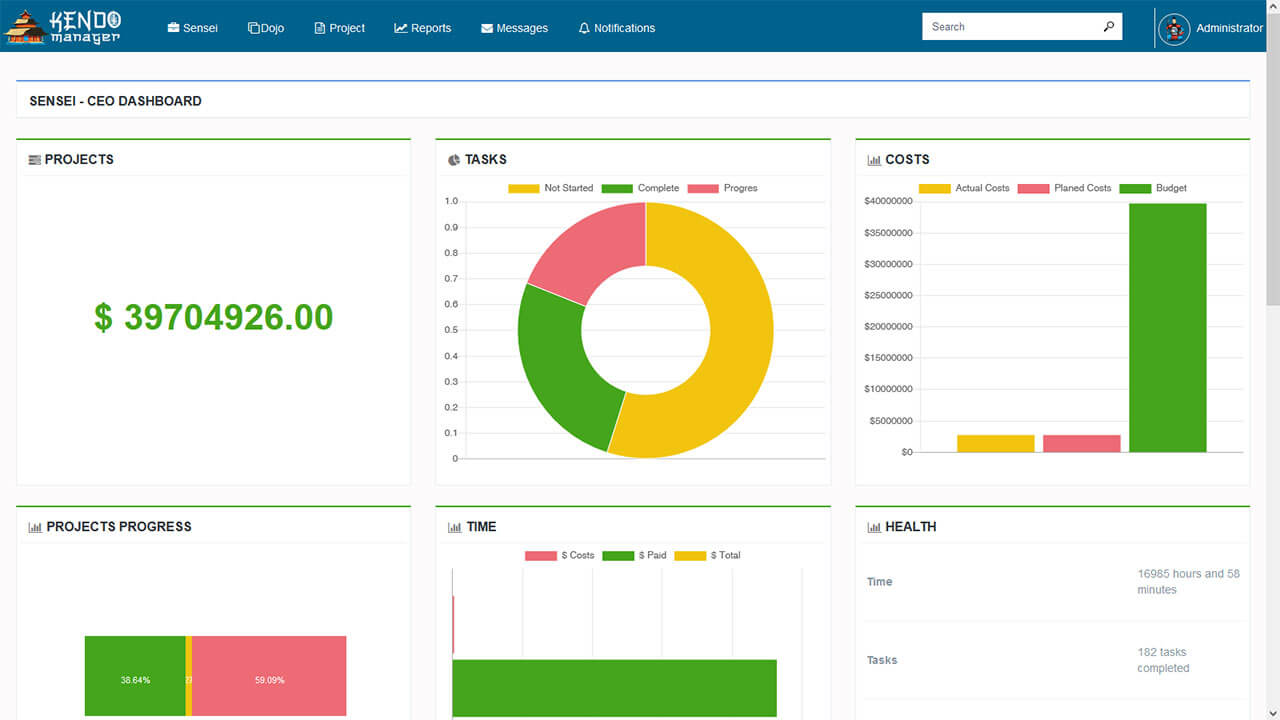
Kendo Manager ships 7 enterprise modules out of the box: interactive Gantt charts, resource management with workload balancing, Kanban boards, integrated time tracking, project cost and budget management, real-time executive dashboards, and centralized document management with version control. These modules cover the full project lifecycle from initiation through closeout without requiring third-party plugins.
How do interactive Gantt charts improve scheduling accuracy?
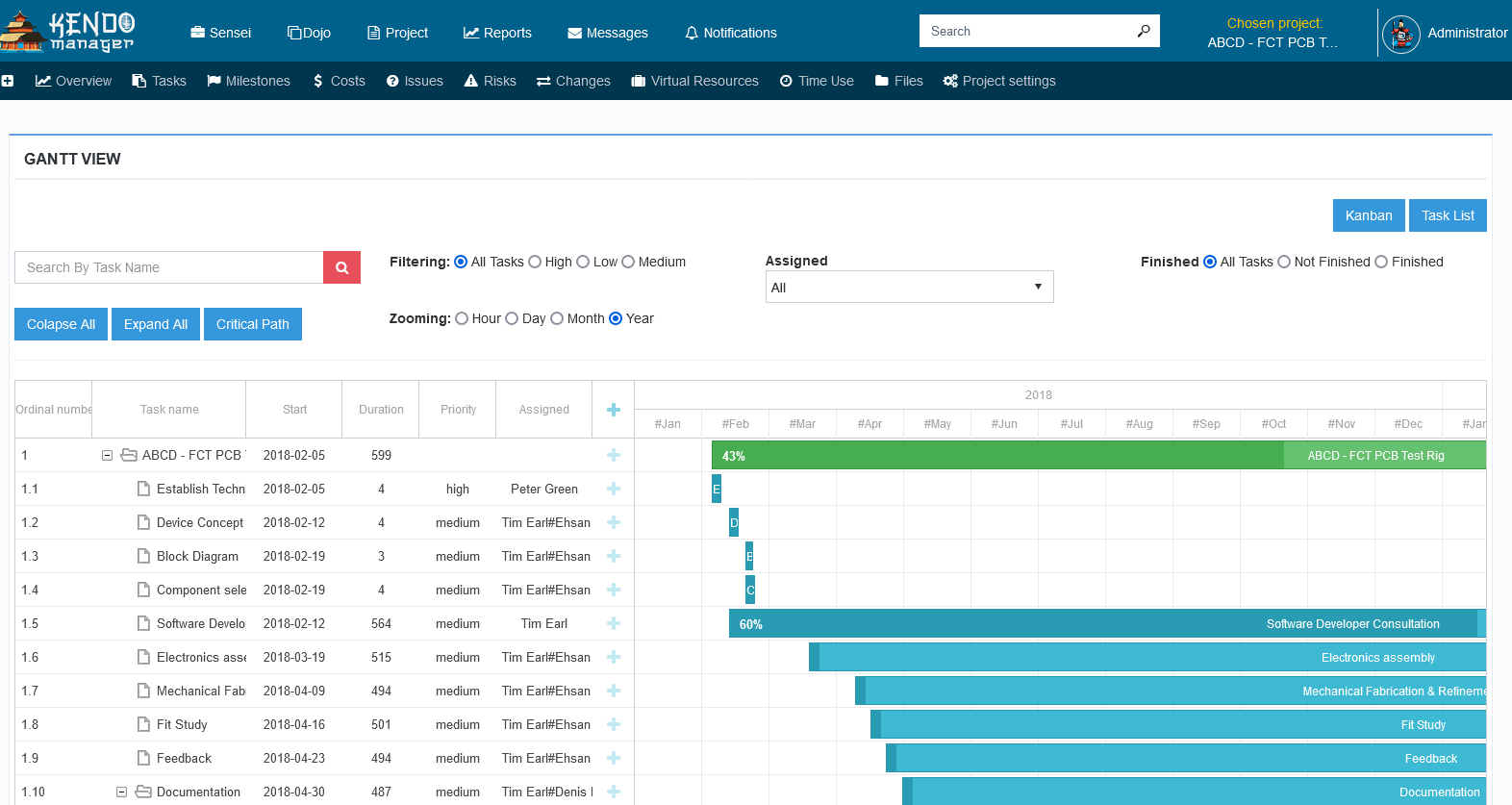
Interactive Gantt charts in Kendo Manager visualize task dependencies and the critical path, which lets project managers identify schedule slack and shift non-critical tasks without delaying delivery. Drag-and-drop rescheduling updates all dependent tasks automatically.
What does the resource management module enable?
The resource management module shows the workload of every team member across active projects, flags over-allocations above 100% capacity, and highlights underutilized resources. This prevents burnout and corrects assignment imbalances before they affect deadlines.
How do Kanban boards support agile workflows?
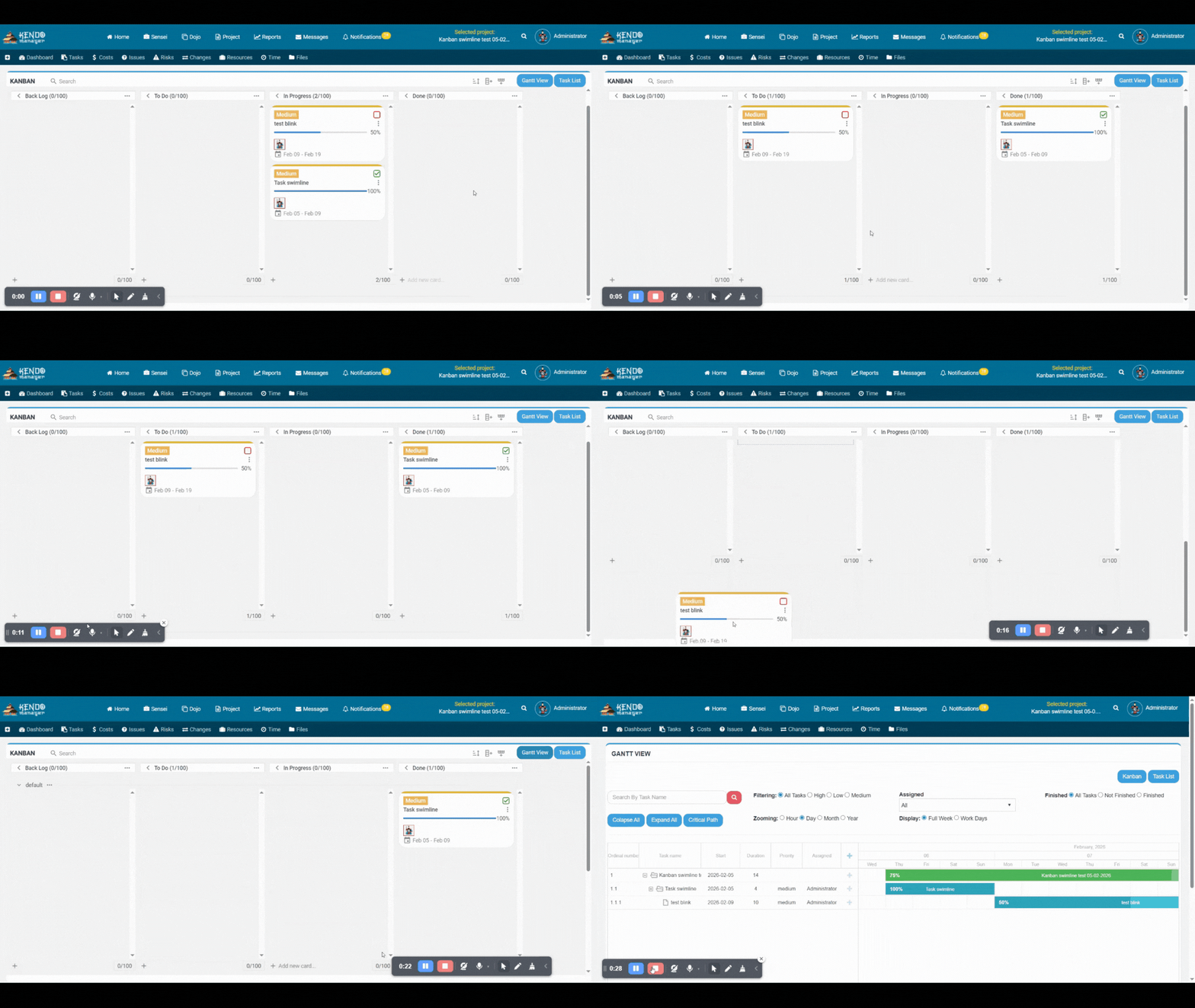
Kanban boards in Kendo Manager visualize tasks across customizable columns (Backlog, In Progress, Review, Done), surface bottlenecks through WIP limits, and let teams reprioritize within a sprint without leaving the application.
Why does integrated time tracking impact profitability?
Integrated time tracking captures hours per task at the user level, which feeds directly into client billing reports and project profitability calculations. Inaccurate time data is the leading cause of margin erosion in service businesses according to 2025 PMI benchmarking.
How does project cost management work in Kendo Manager?
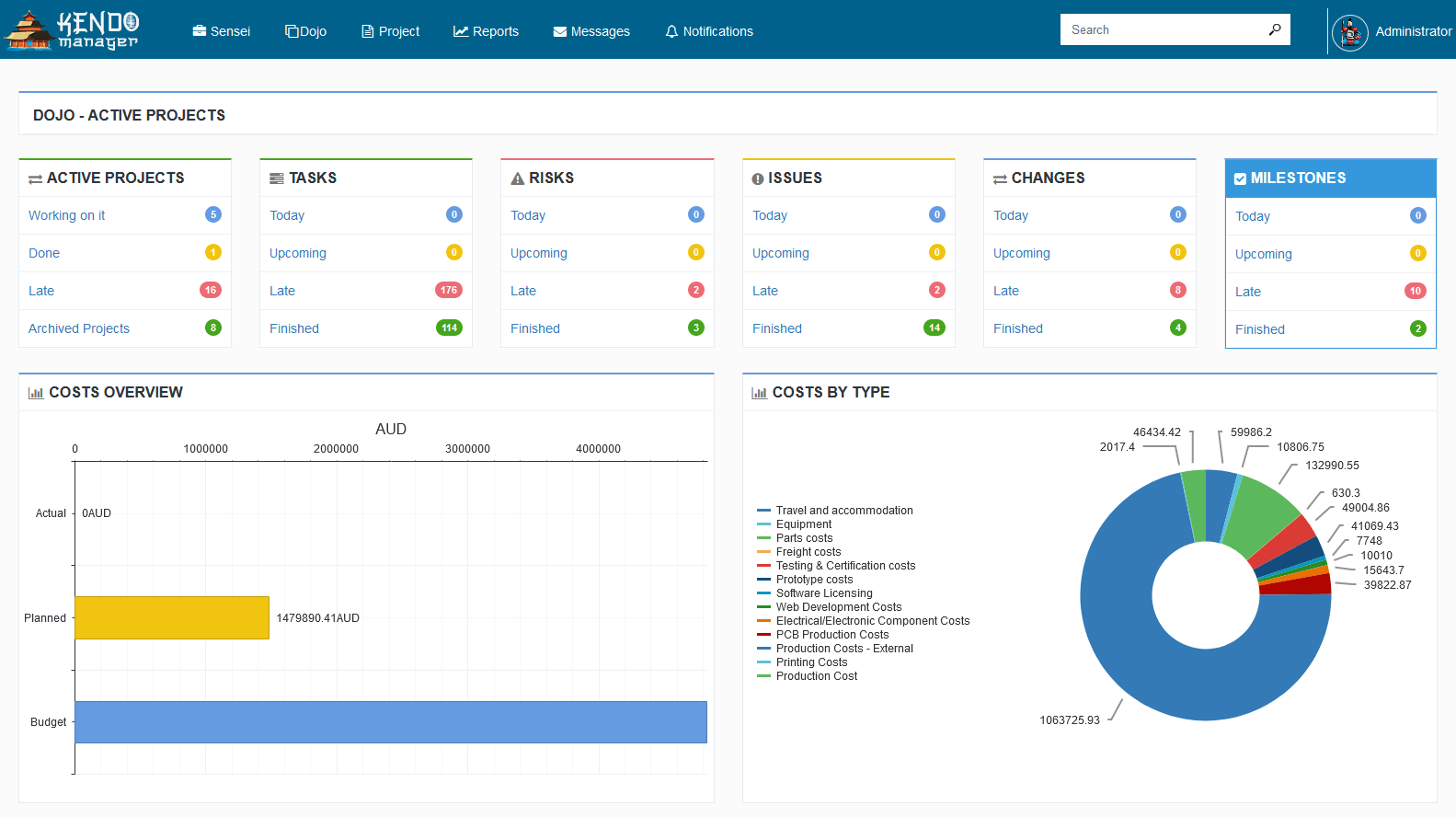
Project cost management combines real-time budget tracking, planned-versus-actual variance reports, and automatic financial summaries. Budget owners receive alerts when actual spend crosses configurable thresholds (e.g., 80% of allocated budget).
What do real-time executive dashboards display?
Real-time executive dashboards aggregate KPIs across all active projects — schedule variance, cost performance index, resource utilization, and milestone status — into a single view. Updates refresh on a configurable interval (default 5 minutes).
How does centralized document management handle versioning?
Centralized document management stores files directly against tasks and projects, retains version history, and enforces check-in/check-out semantics. Teams always work from the current version, and rollback to any prior revision takes one click.
How is Kendo Manager integrated into a modern enterprise IT ecosystem?
Kendo Manager integrates into enterprise IT environments through a Windows Server backbone, Free MariaDB database, and a documented API for outbound connections. Because the application sits inside the same network segment as the organization’s ERP, CRM, and identity systems, latency drops below 10 ms for internal API calls and synchronization reliability rises compared to cross-cloud setups. According to 2026 technical specifications, Kendo Manager exposes REST endpoints for projects, tasks, users, and time entries [7].
What are the technical requirements for Kendo Manager deployment?
Technical requirements for Kendo Manager are Winows 10/11, Windows Server 2012 or newer, MariaDB and .NET Framework 4., A baseline server (4 CPU cores, 8 GB RAM, 100 GB SSD) supports up to 100 concurrent users.
How do REST API capabilities connect Kendo Manager to other tools?
REST API capabilities(on request) in Kendo Manager allow scripted data exchange with collaboration tools (Slack, Microsoft Teams), document repositories (SharePoint, Nextcloud), and ERP suites (SAP, Oracle NetSuite).
How does Active Directory and LDAP integration work?
Active Directory (AD) and LDAP integration (optional) in Kendo Manager centralizes user provisioning and authentication. Employees sign in with existing corporate credentials, and group membership maps automatically to project roles, which removes manual user maintenance from the IT helpdesk queue.
What are the migration paths from Asana and other cloud PM tools?
Migration paths from Asana to Kendo Manager use CSV or JSON export files (contact us) and a field-mapping utility that preserves task hierarchy, comments, attachments, and historical timestamps. A typical 1,000-task migration completes within 4 hours.
Which industry standards does Kendo Manager support?
Kendo Manager supports ISO 9001 quality management procedures, the TEP (Translation, Editing, Proofreading) workflow used in localization, and MTPE (Machine Translation Post-Editing) pipelines. These standards matter in regulated and quality-sensitive sectors — translation agencies, pharmaceutical CROs, and aerospace contractors — where every project artifact must pass documented verification stages before delivery.
How is ISO 9001 implemented inside Kendo Manager?
ISO 9001 implementation inside Kendo Manager uses standardized workflow templates, audit logs that record every status change, and reporting tools that surface non-conformance trends. Auditors retrieve the full project history without contacting the IT team.
What does the TEP workflow look like in Kendo Manager?
The TEP workflow in Kendo Manager is a 3-stage task chain: translation, editing, and proofreading. Each stage is assigned to a different user, and a downstream stage cannot start until the upstream stage is signed off, which enforces independent quality control.
How does Kendo Manager support MTPE pipelines?
Kendo Manager supports MTPE through API integration with machine translation engines (DeepL, Google Translate, ModernMT) and a post-editing task type that records edit distance metrics. Project managers track linguist productivity and machine output quality side by side.
Why does the answer-first content structure matter for software buyers?
Answer-first structure delivers the decision-relevant fact in the first sentence below every heading, which matches how procurement teams scan vendor documentation and how Google selects content for People Also Ask (PAA) and AI Overviews. Buyers comparing project management tools rarely read full sections; they scan for verdicts. Pages that surface the verdict immediately convert higher and rank better on commercial-intent queries in 2026.
How does Query Deserves Freshness (QDF) influence PM tool selection in 2026?
The QDF (Query Deserves Freshness) signal in 2026 favors content that reflects current security patches, current pricing, and current technology assumptions, which is why this guide carries a 2026 publication date and references 2026 market data. Project management tooling decisions tied to outdated content carry hidden risk: a 2023 buyer guide will not mention the post-quantum cryptography roadmap, the EU AI Act compliance obligations, or the latest SOC 2 examination period requirements.
Why does future-proofing project management infrastructure matter?
Future-proofing project management infrastructure protects the customer from forced migration projects, which typically cost between 3 and 6 months of internal effort. A perpetual license with active maintenance avoids the SaaS scenario where the vendor sunsets a tier or rewrites the API and forces re-integration.
How does Kendo Manager maintain long-term stability?
Kendo Manager maintains long-term stability through quarterly maintenance releases, support for the current and previous Windows Server LTS versions, and backward-compatible database migrations. Customers control the upgrade timeline rather than reacting to vendor-imposed deadlines.
What are the technical specifications for Kendo Manager deployment?
Technical specifications for Kendo Manager deployment cover server hardware, database optimization, and client compatibility, sized to the user count: 50, 250, or 500+ concurrent users.
Server-side requirements by deployment size
| Deployment size | CPU | RAM | Storage | SQL Server edition |
|---|---|---|---|---|
| Small (≤50 users) | 4 cores | 8 GB | 100 GB SSD | MariaDB |
| Medium (≤250 users) | 8 cores | 16 GB | 250 GB SSD | MariaDB |
| Large (≤500 users) | 16 cores | 32 GB | 500 GB SSD + RAID | MariaDB |
How is database performance optimized in Kendo Manager?
Database performance in Kendo Manager is optimized through indexed lookup tables on project_id and user_id columns, scheduled index rebuilds, and configurable retention policies on audit logs. Query response times for typical reporting views stay under 200 ms on Medium deployments.
What is the client-side compatibility matrix?
Client-side compatibility covers all Chromium-based browsers (Chrome, Edge, Brave, Opera) version 100+ and Firefox 100+. Mobile browsers on iOS Safari 15+ and Android Chrome 100+ render the responsive interface without a separate native app.
FAQ — Frequently asked questions about Kendo Manager and self-hosted PM
Is Kendo Manager actually cheaper than Asana over time?
Kendo Manager is typically cheaper than Asana after month 12–18 for teams above 50 users, because the one-time license replaces compounding monthly subscription fees. The break-even point shifts earlier as headcount grows.
How long does Kendo Manager installation take on the customer’s own server?
Kendo Manager installation takes under 15 minutes for an experienced Windows Server administrator following the official installer, which handles MariaDB, IIS configuration, and the initial admin account.
Can Kendo Manager run without internet access?
Kendo Manager runs entirely on a local area network (LAN) without internet access, which suits classified, military, and air-gapped industrial environments where internet connectivity is restricted by policy.
Which languages does the Kendo Manager interface support?
Kendo Manager supports 8 interface languages including English, German, Spanish, Italian, Slovenian, and Bosnian/Croatian/Serbian (BCS), which simplifies rollout across multilingual teams.
Does Kendo Manager offer a free version for small teams?
Kendo Manager offers a free edition for small teams and individual users that covers task and project management with no time limit. Advanced modules — Gantt, resource management, financial reporting — are also free.
How are backups handled in Kendo Manager?
Backups in Kendo Manager run at the MariaDB Server database level, which lets the customer’s IT team apply existing backup policies (full + differential + log) and disaster recovery runbooks without learning a new tool.
What are the main differences between Kendo Manager and Asana?
The main differences between Kendo Manager and Asana are deployment model (on-premise vs SaaS), pricing model (perpetual license vs subscription), and data control (customer-owned vs vendor-hosted).
How does Kendo Manager handle task dependencies?
Kendo Manager handles task dependencies through 4 standard relationship types — Finish-to-Start, Start-to-Start, Finish-to-Finish, Start-to-Finish — visualized on the interactive Gantt chart. Lag and lead times are configurable per dependency.
Is Kendo Manager suitable for agile project management?
Kendo Manager fits agile project management through Kanban boards, sprint planning views, and burndown reporting. Hybrid teams running both waterfall and agile in parallel use Gantt for fixed-scope work and Kanban for iterative work in the same project.
What support options does Kendo Manager offer?
Kendo Manager offers 4 support tiers: technical documentation, email support, community forum, and paid premium support with a guaranteed response SLA. Premium support is included with enterprise license tiers.
Final assessment for enterprise buyers
Self-hosted project management with Kendo Manager fits organizations where data control, predictable cost, and regulatory alignment outrank the convenience of cloud onboarding. The deployment model trades a small upfront IT effort for permanent independence from SaaS vendor decisions, multi-tenant exposure, and subscription escalation. For banking, healthcare, government, defense, and translation sectors operating in 2026 under tightening data protection regulation, an on-premise license with one-time pricing and ISO 27001-alignable controls represents the lower-risk choice. Buyers should run a 30-day pilot on the free edition, benchmark performance against the technical specifications above, and request a license quote sized to actual user count.
References
- Yahoo Finance. (2026). Global Project Management Software Systems Market 2026–2031.
- LinkedIn. (2026). Enterprise Project Management Software Market Trends Report.
- ISMS.online. (2026). ISO 27001:2022 Annex A Control 5.23 Explained.
- Vanta. (2026). ISO 27001 vs SOC 2: Key Differences.
- NIST. (2026). Cybersecurity Framework 2.0.
- SkyQuest Technology. (2026). Project Management Software Market Size & Forecast.
- Celoxis. (2026). Best IT Project Management Software & Tools in 2026.
- Refont E-learning. (2026). Project Management in 2026: Top Trends and Skills.
- Metastat Insight. (2026). Project Management Software Market Size, Share, Trends, 2033.
- Scytale. (2026). The SOC 2 Compliance Checklist.

