
Project Management Software for South African Municipalities in 2026: LED Tracking, IDP Alignment, and MFMA Reporting Requirements
South African municipalities managed approximately ZAR 542 billion in capital project expenditure during the 2024/25 financial year, with the Auditor-General South Africa reporting material findings on project performance information at 78% of metros and 41% of district municipalities in the 2024-25 MFMA general report. Stats SA’s 2025 municipal capacity assessment recorded that only 23% of local municipalities operate dedicated project management systems aligned with both Municipal Finance Management Act section 71 reporting and Protection of Personal Information Act section 19 safeguards. Local Economic Development officers, municipal managers, and IT heads selecting project management software face overlapping compliance regimes from National Treasury, the Information Regulator, the Department of Cooperative Governance and Traditional Affairs, and the Auditor-General, alongside operational realities such as Stage 4-6 load shedding averaging 6-10 hours per day. This guide covers 8 compliance and operational requirements, 2 deployment models compared across 8 dimensions, the SCM procurement process from quotation threshold to contract award, and 7 evaluation criteria for selecting a fit-for-purpose system.
For the complete strategic overview of project management software for South African organizations including POPIA compliance, deployment models, and other sector use cases, see our pillar guide on project management software for South African organizations in 2026.
Why do South African municipalities need dedicated project management software for LED initiatives?
Dedicated project management software is needed for LED initiatives because Local Economic Development projects span multi-year IDP cycles, draw from at least 4 distinct funding streams (Municipal Infrastructure Grant, Urban Settlements Development Grant, private donor, own revenue), and produce performance evidence audited annually by the Auditor-General South Africa. Spreadsheets and email-based coordination fail to maintain the required audit trail when a single LED programme — for example a township SMME incubator — involves 200 or more beneficiaries, 4 government departments, and 60 months of expenditure tracking.
The legal foundation for LED activity sits in Chapter 7 of the Constitution and the Local Government: Municipal Systems Act 32 of 2000, which obliges municipalities to promote social and economic development within their jurisdictions. Operational expression comes through the Integrated Development Plan and the District Development Model, which since 2020 has required intergovernmental project synchronisation across national, provincial, and local spheres. CoGTA‘s One Plan principle means an LED project initiated by a local municipality must report into a district-level dashboard, then aggregate into provincial outcomes overseen by the Office of the Premier.
Three capability gaps appear consistently in SALGA‘s 2024 municipal barometer:
- 67% of municipalities cannot produce a real-time view of LED project status across departments
- 54% rely on manual consolidation for quarterly performance reporting
- 41% report missed AGSA audit evidence because supporting documents existed only in personal email archives
Dedicated software addresses each gap with version-controlled documents, role-based access aligned with delegations of authority, and audit-ready transaction logs that survive personnel changes — the typical scenario in LED units with rotating contract staff funded through donor programmes.
What POPIA requirements apply to municipal project management systems?
POPIA Section 19 requires municipal project management systems to implement appropriate technical and organisational measures to prevent loss, damage, and unauthorised access to personal information of project beneficiaries, employees, and contractors. The Information Regulator‘s 2023 Guidance Note on Security Safeguards specifies encryption at rest, access logs retained for 12 months, role-based access control, and breach notification to the Regulator and affected data subjects within 72 hours of detection.
Three additional POPIA sections carry direct operational impact for project management platforms:
- Section 22 mandates breach reporting and creates personal liability for the Information Officer when breaches result from inadequate safeguards.
- Section 56 designates the municipal manager as default Information Officer with non-delegable accountability for system compliance, although operational duties may be assigned to a Deputy Information Officer.
- Section 72 restricts cross-border transfer of personal information unless the foreign jurisdiction provides adequate protection or the data subject has consented.
The 2025 amendment to POPIA Regulations introduced a mandatory POPIA Compliance Register listing all systems processing personal information. Municipal project management software must appear in this register with documented evidence of the eight conditions for lawful processing. The Information Regulator levied ZAR 5 million in administrative fines between July 2023 and December 2025, with 78% of cases citing inadequate access control on third-party SaaS platforms.
For LED projects specifically, beneficiary data — SMME owner identity numbers, Expanded Public Works Programme worker bank details, training programme attendance records — meets POPIA’s definition of personal information under Section 1, triggering full compliance obligations regardless of whether the data subject is a vendor, employee, or beneficiary.
How does the MFMA require municipal project reporting?
The MFMA requires three reporting tiers on municipal projects: monthly under Section 71, mid-year under Section 72, and annual under Section 121, each with prescribed format and content. National Treasury’s MFMA Circular 88 sets the data structure that municipal project management software must support, including expenditure against budget, project milestones, and reasons for variance.

The Service Delivery and Budget Implementation Plan operationalises annual budget commitments into quarterly targets. Each capital project line in the SDBIP requires monthly status updates with these mandatory fields:
- Approved budget compared to actual expenditure to date
- Physical progress percentage against the milestone schedule
- Variance explanation when expenditure deviates more than 5% from milestone budget
- Forward expenditure projection for the remaining quarter
Since the 2017/18 financial year, all municipal data must conform to the Municipal Standard Chart of Accounts (mSCOA), which classifies every transaction across 7 segments — function, item, project, fund, region, costing, and municipal standard classification. Project management software that does not map cleanly to mSCOA segments, particularly the Project segment and the Function segment, creates manual reconciliation burden at month-end and triggers AGSA findings on data integrity.
The Auditor-General’s 2024-25 MFMA general report flagged 312 municipalities with material misstatements in performance information, with 41% of findings attributed to inadequate evidence systems rather than incorrect underlying performance. The implication for software selection is direct: better project management software measurably improves audit outcomes by closing evidence gaps that would otherwise produce qualified opinions.
How should LED projects align with IDP cycles and SDBIP targets?
LED projects align with IDP cycles through cascading 5-year strategic outcomes to annual SDBIP targets to quarterly performance evidence, with each layer producing a documented Portfolio of Evidence reviewed by Internal Audit and the AGSA. The Local Government: Municipal Planning and Performance Management Regulations 2001 prescribe this cascade, while the Municipal Systems Act Chapter 5 sets IDP review obligations on a 5-year cycle aligned with the local government electoral term.
Five-year IDP outcomes for LED typically read at outcome level — for example, “increased participation of historically disadvantaged groups in the township economy.” The SDBIP translates this into measurable annual KPIs such as “300 SMMEs registered with municipal supplier database by 30 June 2026.” Project plans within software platforms then track the operational tasks producing those KPIs, with each task linked back to source evidence.
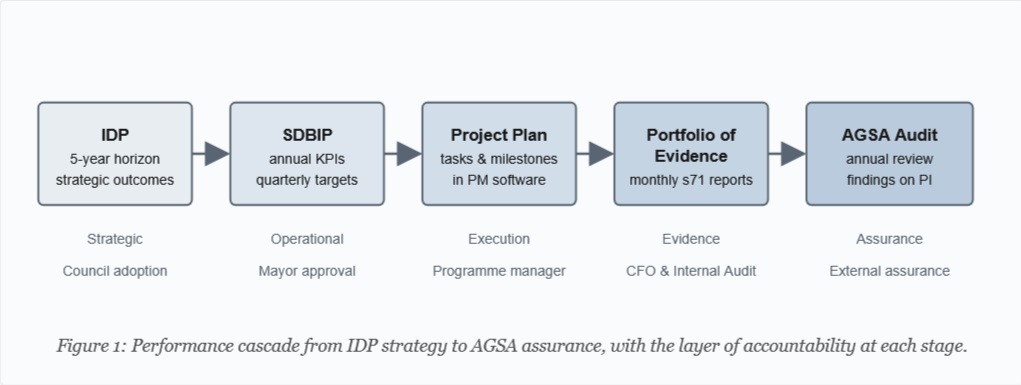
Two failure patterns appear in AGSA’s performance audit findings: target inflation, where SDBIP figures exceed any realistic delivery capacity, and evidence gaps, where reported numbers cannot be substantiated by underlying records. Project management software addresses the second pattern by linking every reported KPI to source transactions, attendance registers, and signed beneficiary records, converting performance reports from claims into audited assertions.
The District Development Model adds a horizontal layer to vertical reporting: LED projects must also map into the district’s One Plan, with progress visible to the district municipality, sector departments, and the provincial Office of the Premier. Software supporting this requires multi-tenant access with role separation between local and district users, an architecture rarely available in generic SaaS project tools.
Why does self-hosted deployment fit South African municipal IT environments?
Self-hosted deployment fits South African municipal IT environments because it resolves four overlapping pressures: POPIA cross-border transfer restrictions, SCM preference for capital expenditure procurement, mSCOA on-premise integration with financial systems, and operational continuity during load shedding events that frequently disrupt cloud connectivity. SaaS deployment remains workable for municipalities with verified local data centres and reliable connectivity, but introduces compliance and procurement complexity that self-hosted avoids.
| Dimension | Self-hosted | Cloud / SaaS |
|---|---|---|
| POPIA cross-border risk | Eliminated — data on local infrastructure | Requires Section 72 assessment per vendor |
| Load shedding resilience | Maintained on UPS-backed local servers | Dependent on ISP and cellular base stations |
| 5-year total cost of ownership | Higher year 1, lower years 2-5 | Lower year 1, escalating with user count |
| SCM procurement path | Asset acquisition, CAPEX vote | Recurring service contract, OPEX vote |
| mSCOA integration | Native database connection on LAN | API over internet, subject to outage |
| Scalability | Vertical, hardware-bound | Elastic, vendor-managed |
| Vendor lock-in risk | Lower — data on municipal hardware | Higher — data export terms apply |
| Support model | Vendor SLA plus internal IT capacity | Vendor SLA only |
POPIA Section 72 permits cross-border transfer only when the receiving jurisdiction provides protection substantially similar to POPIA. The Information Regulator has not issued an adequacy list comparable to the European Commission’s GDPR adequacy decisions, leaving each municipality to perform its own assessment per vendor. Self-hosted deployment on local infrastructure removes this analysis entirely because personal information never crosses the border. For a broader comparison across all sectors and deployment models, see our analysis of self-hosted vs cloud project management software, data sovereignty, and POPIA implications.
On procurement, the MFMA and Treasury Regulation 17 favour clear asset acquisition over recurring service contracts for budgeting and audit purposes. A perpetual licence with a one-time fee maps cleanly to a CAPEX vote on the budget. Monthly SaaS subscriptions in foreign currency complicate the budget cycle, require ongoing forex variance management, and create renewal risk in years when budgets are constrained.
Integration with mSCOA-compliant financial systems — typically Sage, SAP, Munsoft, ProMIS, or Coral — is materially simpler when the project management database can be queried directly on the municipal local area network than through an internet API subject to load shedding interruption. The State Information Technology Agency Act 88 of 1998 establishes SITA as the preferred ICT procurement channel, and SITA transversal contracts increasingly favour solutions deployable on government infrastructure.
How does load shedding affect municipal project management software choice?
Load shedding affects municipal project management software choice because Stage 4-6 events have produced 6-10 hours of daily power interruption across most municipalities in 2026, with concurrent failure of fibre exchanges, cellular base stations, and remote office connectivity during these periods. Cloud-only software becomes inaccessible during these windows; self-hosted software on UPS-backed local servers continues operating, with mobile sync resuming when individual devices reconnect.
| PM software function | Stage 2 (≤4h/day) | Stage 4 (≤8h/day) | Stage 6 (≤12h/day) |
|---|---|---|---|
| Task updates — full on-premise | Maintained | Maintained | Degraded |
| Task updates — cloud SaaS | Intermittent | Frequently unavailable | Unavailable |
| Document access — full on-premise | Maintained | Maintained | Maintained |
| Document access — cloud SaaS | Intermittent | Frequently unavailable | Unavailable |
| Section 71 report generation — on-premise | Maintained | Maintained | Degraded |
| Section 71 report generation — cloud SaaS | Intermittent | Frequently unavailable | Unavailable |
| External integrations (mSCOA, GIS) | Intermittent | Frequently unavailable | Unavailable |
NERSA’s 2025 annual performance report recorded an average national load shedding intensity of Stage 3.2 across the year, with rural municipalities in Eastern Cape, KwaZulu-Natal, and Limpopo experiencing extended Stage 5-6 windows during winter demand peaks. Eskom‘s published schedule treats Stage 6 as removing 6,000 megawatts from the grid, which translates operationally to four 2-hour outages per 24-hour cycle in most metro zones and more in non-metro grids.
Three architectural responses appear in municipal software deployments:
- Full on-premise — single server in the municipal data centre, no internet dependency, accessed via local area network and VPN. Most resilient, requires internal IT capacity.
- Hybrid sync — primary on-premise with optional sync to a secondary node for inter-site coordination. Internet-tolerant rather than internet-dependent.
- Cloud with local cache — SaaS primary with an offline-capable client that queues updates during outage. Least resilient because cache scope is limited to recently-accessed records.
What is the SCM procurement process for project management software in municipalities?
The SCM procurement process for project management software follows the Supply Chain Management Regulations 2005 and the Preferential Procurement Policy Framework Act Regulations 2022, with the procurement route determined by total contract value over the term. Below ZAR 30,000 a single quotation suffices; between ZAR 30,000 and ZAR 200,000 three written quotations are required; above ZAR 200,000 a formal competitive bid process applies under MFMA Section 111.
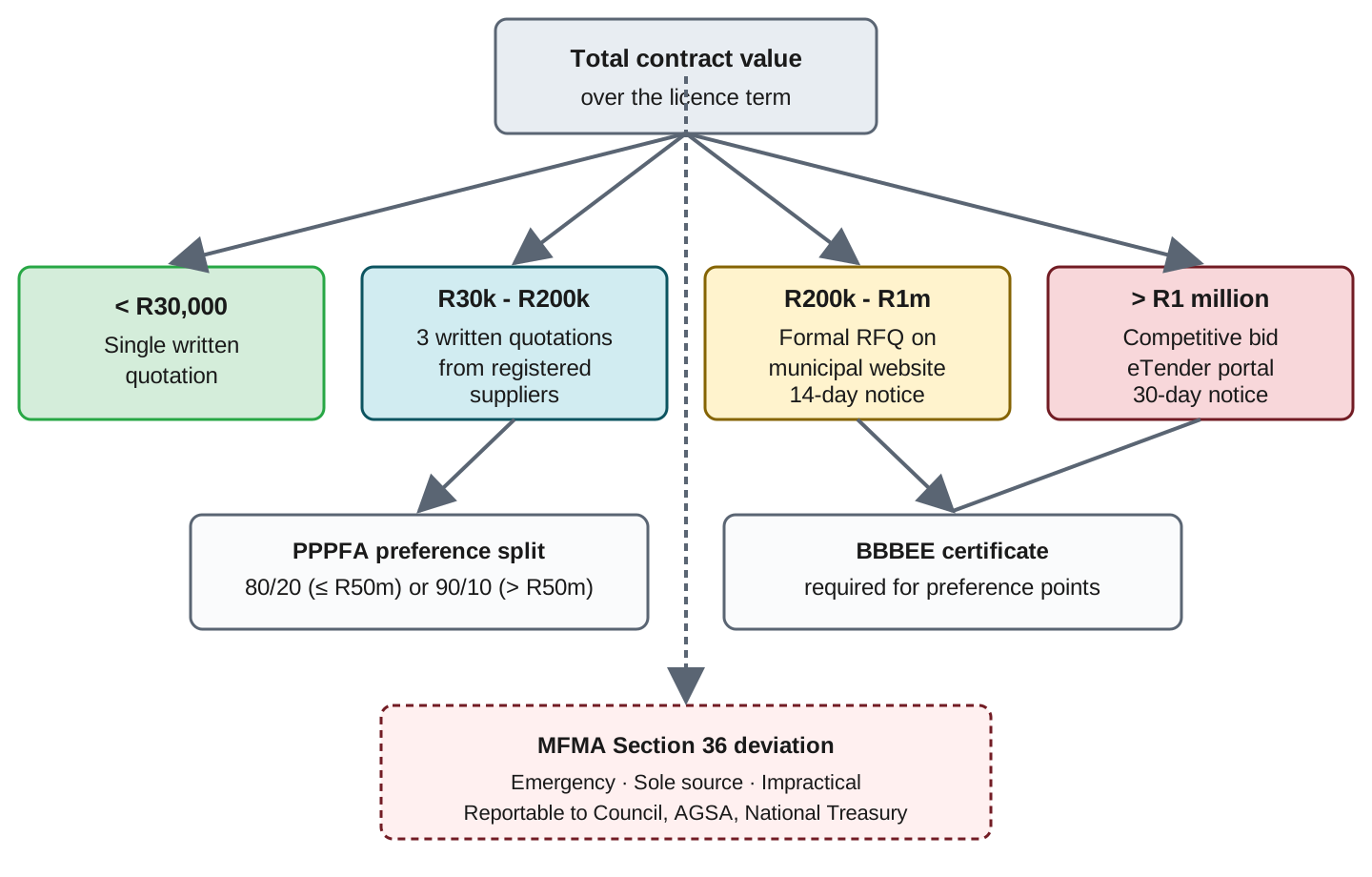
Figure 4: SCM procurement path by contract value, with PPPFA preference rules and Section 36 deviation conditions.
PPPFA Regulations 2022 prescribe two preference point splits: 80 price / 20 specific goals for contracts up to ZAR 50 million, and 90 price / 10 specific goals above that threshold. Municipalities define specific goals locally — common formulations award points for BBBEE level, local content, SMME status, or designated group ownership. Software vendors without a current BBBEE certificate score zero on the specific goals component, an effective disqualification in competitive bids.
A municipality may deviate from competitive bid under MFMA Section 36 in three documented circumstances: emergency where delay creates significant risk, sole source where only one supplier can supply the requirement, and impractical or impossible application of standard procurement. Section 36 deviations require formal reporting to the council, the AGSA, and National Treasury. The 2024-25 audit cycle recorded 1,847 irregular expenditure findings linked to undocumented or insufficiently justified deviations.
Contract management under MFMA Section 116 requires the accounting officer to maintain a contract register, monitor delivery against specification, and report material variations to the council. Project management software contracts typically run 3-5 years with renewal provisions; the procurement file must contain the business case, evaluation report, BBBEE verification certificate, and signed service level agreement.
Which 7 evaluation criteria matter most when selecting municipal project management software?
Load shedding affects municipal project management software choice because Stage 4-6 events have produced 6-10 hours of daily power interruption across most municipalities in 2026, with concurrent failure of fibre exchanges, cellular base stations, and remote office connectivity during these periods. Cloud-only software becomes inaccessible during these windows; self-hosted software on UPS-backed local servers continues operating, with mobile sync resuming when individual devices reconnect.
| Criterion | Weight | Pass threshold | Anchored in |
|---|---|---|---|
| POPIA Section 19 features | 20% | Audit logs, encryption at rest, role-based access control, breach detection | POPIA, Information Regulator guidance |
| MFMA reporting outputs | 18% | Section 71, 52, and 121 report templates with mSCOA mapping | MFMA, Treasury Circular 88 |
| IDP / SDBIP alignment | 15% | Multi-year strategic cascade, KPI tracking with evidence linking | Municipal Systems Act, Performance Regulations 2001 |
| Offline operation | 12% | Functional through 4-hour outage without data loss | Operational continuity, Eskom schedule |
| mSCOA chart integration | 12% | Native mapping to all 7 mSCOA segments | mSCOA Regulations |
| Vendor BBBEE status | 13% | Verified BBBEE Level 4 or better at time of bid | PPPFA Regulations 2022, BBBEE Codes |
| 5-year total cost of ownership | 10% | Including licences, support, infrastructure, and integration cost | Treasury Regulation 17 |
The scoring approach assigns weight per criterion based on municipal context. A water services authority running EPWP infrastructure projects may weight offline operation and mSCOA integration above 20% each. A metro running an LED programme with substantial beneficiary data may weight POPIA features as the primary gate. The starting weights above are anchored against governance risk and can be adjusted within a 5-percentage-point band per criterion without losing the underlying compliance logic.
A vendor scoring below 70% on any individual criterion fails the evaluation regardless of total score, because municipal compliance regimes do not tolerate single-point failures. A project management system that cannot produce a Section 71 report or maintain POPIA audit logs creates governance exposure that no other strengths can offset. The most common failure mode in vendor demonstrations is strong project workflow features paired with weak mSCOA mapping or absent BBBEE certification — a vendor mismatched to public sector requirements regardless of product quality.
Frequently asked questions
Does POPIA apply to municipal employee project data, not just citizen beneficiary data?
POPIA applies to all personal information held by municipalities, including employee records, vendor contact details, and councillor information. Section 1 defines personal information broadly enough to cover staff project assignments, leave records linked to project work, and performance evaluations stored within project management systems.
Can a South African municipality use cloud-based project management software if data stays in South African data centres?
A municipality can use cloud-based software hosted in South African data centres provided the vendor’s contract guarantees data localisation, the Information Officer documents the assessment, and the contract includes audit rights. Verify the actual hosting location in the contract because some vendors describe themselves as South African while operating infrastructure in Frankfurt or Dublin.
Which MFMA section requires monthly municipal project progress reporting?
MFMA Section 71 requires the accounting officer to submit a monthly budget statement to the mayor within 10 working days after month-end, including project expenditure against budget. Project management software supporting Section 71 must produce variance reports with explanatory commentary in the format prescribed by National Treasury Circular 88.
How long is the typical SCM procurement cycle for software in a South African metro?
A typical SCM procurement cycle for software in a metro runs 12-18 weeks from specification approval to contract signature for a competitive bid above ZAR 1 million. The cycle includes 4 weeks for specification and bid documentation, 4 weeks for advertisement and submission, 4 weeks for evaluation, and 4 weeks for award processes including objection periods.
Are LED projects subject to additional reporting under the District Development Model?
LED projects are subject to additional reporting under the District Development Model where the One Plan covers them, requiring upward reporting to the district municipality and the provincial Office of the Premier. The reporting frequency is quarterly, with annual review at the district intergovernmental forum chaired by the district mayor.
What is the procurement threshold for tender versus quotation in municipal software procurement?
The procurement threshold for tender versus quotation is ZAR 200,000 under SCM Regulation 12. Values up to ZAR 30,000 require one written quotation, ZAR 30,000 to ZAR 200,000 require three written quotations, and values above ZAR 200,000 require a formal competitive bid published on the municipality’s website and the National Treasury eTender Publication Portal.
Can a municipality deviate from SCM processes for project management software purchases?
A municipality can deviate from SCM processes under MFMA Section 36 only in limited circumstances — emergency, sole source, or impractical application — with full documentation and reporting to council, AGSA, and National Treasury. Software procurement rarely qualifies for sole source unless integration requirements demonstrably restrict supply to one vendor.
Is mSCOA integration mandatory for municipal project management systems?
mSCOA integration is mandatory for any system feeding financial transactions into the municipal general ledger, including project management software that records project expenditure. Systems used purely for non-financial tracking such as task management and document control do not require mSCOA mapping but must reconcile to financial system project codes for AGSA audit purposes.
South African municipalities selecting project management software in 2026 face a tighter compliance perimeter than at any prior point — POPIA enforcement now produces administrative fines, AGSA findings on performance information increasingly trigger material misstatements, and PPPFA preference rules functionally exclude vendors without current BBBEE certification. A self-hosted system that maps cleanly to mSCOA, operates through Stage 6 load shedding, and produces audit-ready Section 71 outputs removes most of the failure modes documented in the AGSA 2024-25 general report. The procurement file should record the evaluation against the 7-criterion scorecard, the POPIA assessment under Section 19, and the contractual position on data localisation. For LED units, the same system carries forward through five-year IDP cycles, donor reporting requirements, and District Development Model coordination — converting performance reports from contested claims into evidenced assertions.

