
Cloud-Based Project Management Software in 2026: 7 Tools, Private Cloud Models, and Small Team Costs

Cloud-based project management software is a digital infrastructure that enables teams to plan, execute, and monitor tasks through internet-connected servers, representing a market projected to reach $20.47 billion by 2030 [1]. Over 88% of organizations currently utilize project management software to coordinate remote and hybrid teams [2]. Small teams require systems that balance accessibility with strict data security and predictable pricing. We analyzes 7 software tools, compares public SaaS against private cloud deployment models, and details the financial implications for small businesses.
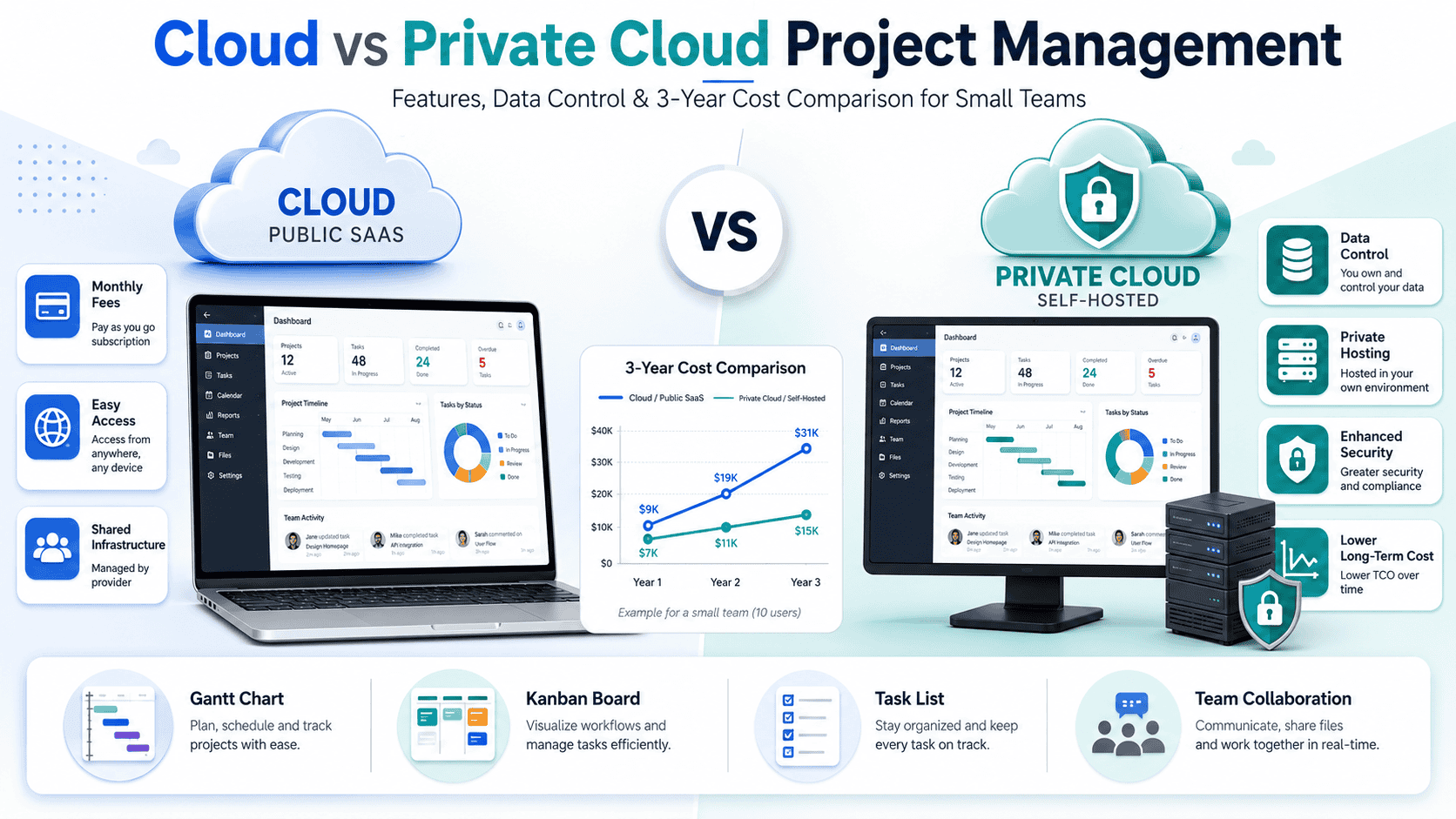
What Is Cloud-Based Project Management Software and Why Do Small Teams Need It in 2026?
Cloud-based project management software is a centralized digital platform hosted on remote servers that allows distributed teams to collaborate on tasks, track budgets, and manage resources in real-time. Small teams require these systems to eliminate fragmented communication across emails and spreadsheets, which historically leads to a 16% lower chance of timely project completion [2]. The 2026 operational landscape demands immediate access to project data from any location, making cloud accessibility a fundamental requirement rather than an optional feature.
Small businesses face unique constraints regarding budget predictability and data security. While public Software as a Service (SaaS) platforms offer rapid deployment, they often introduce escalating per-user costs and multi-tenant security vulnerabilities. Consequently, 31.5% of organizations have adopted hybrid or private cloud project management models to regain control over their digital assets [3]. Kendo Manager combines the accessibility of web-based project management software with the control of a self-hosted, on-premise, or private cloud deployment.
How Does Private Cloud Deployment Differ from Public SaaS for Project Management?
Private cloud deployment allocates dedicated server resources exclusively to a single organization, whereas public SaaS hosts multiple companies on shared infrastructure. This architectural distinction fundamentally alters how a company manages data security, regulatory compliance, and long-term software expenditures.
Why Is Data Sovereignty Critical for Small Business Compliance?
Data sovereignty dictates that digital information is subject to the laws of the country where the physical servers reside. Small businesses handling European client data must comply with the General Data Protection Regulation (GDPR), which imposes strict rules on cross-border data transfers [4]. Public SaaS providers often replicate data across global data centers, complicating compliance audits. Deploying self-hosted project management software in a private cloud or Windows VPS environment guarantees that sensitive project files remain within a defined geographic boundary. This isolation protects proprietary blueprints, financial records, and client communications from third-party exposure.
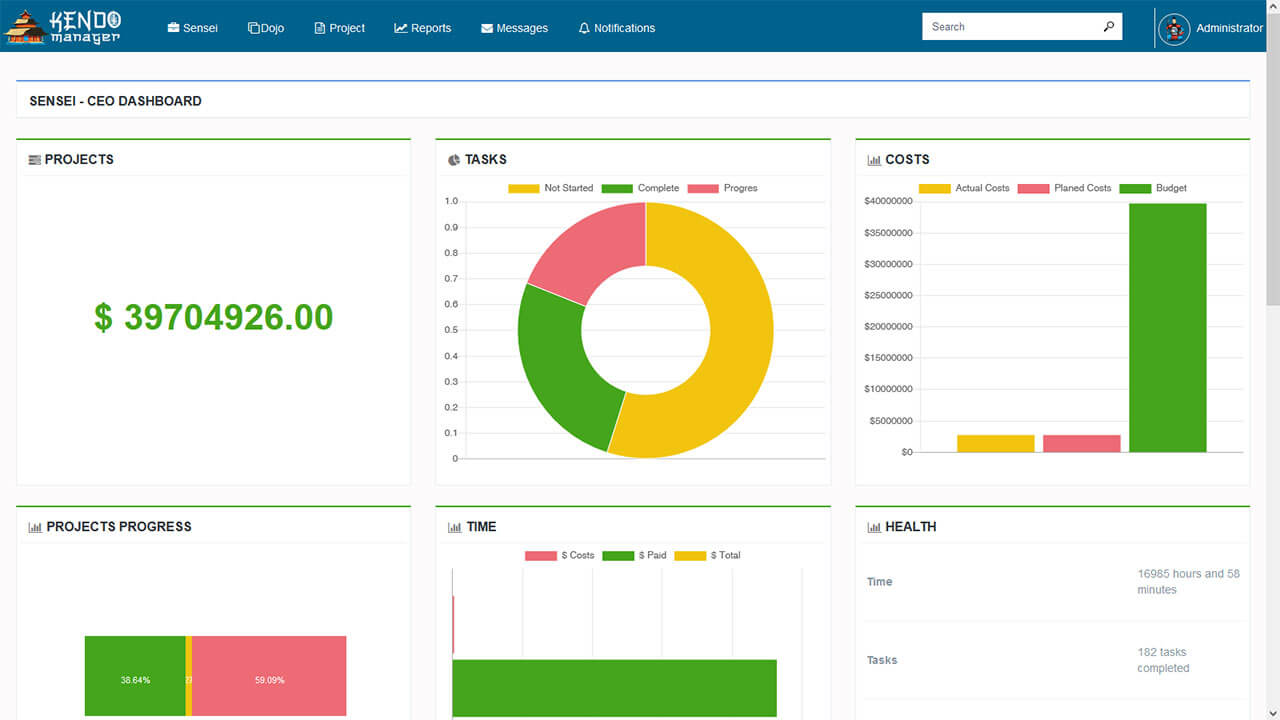
How Do Subscription Costs Compare Between Public and Private Cloud Models?
Public SaaS models utilize a per-user, per-month pricing structure that scales linearly as a team expands, while private cloud models typically involve a flat licensing fee plus predictable server hosting costs. A 10-person team using a $15/user/month SaaS tool will spend $1,800 annually, with costs increasing automatically upon hiring new staff. In contrast, a private cloud project management software deployment requires a fixed server cost (approximately $20/month for a VPS) and a perpetual software license.
| Cost Factor | Public SaaS Model | Private Cloud Model e.g., Kendo Manager |
|---|---|---|
| Initial Software Cost | $0 (Trial period) | $749 (Startup perpetual license) |
| Recurring User Fees | $10 – $25 per user/month | $0 (Unlimited users) |
| Infrastructure Cost | Included in subscription | $15 – $30 per month (VPS hosting) |
| 3-Year Total 10 Users |
$5,400 – $9,000 | $1,289 – $1,829 |
What Are the 7 Best Cloud-Based Project Management Tools for Small Teams in 2026?
The 7 best cloud-based project management tools for small teams in 2026 include Kendo Manager, Asana, ClickUp, Monday.com, Trello, Smartsheet, and Wrike. Each platform offers distinct deployment models and feature sets tailored to different operational requirements.
Why Is Kendo Manager the Optimal Private Cloud Solution for Small Teams?
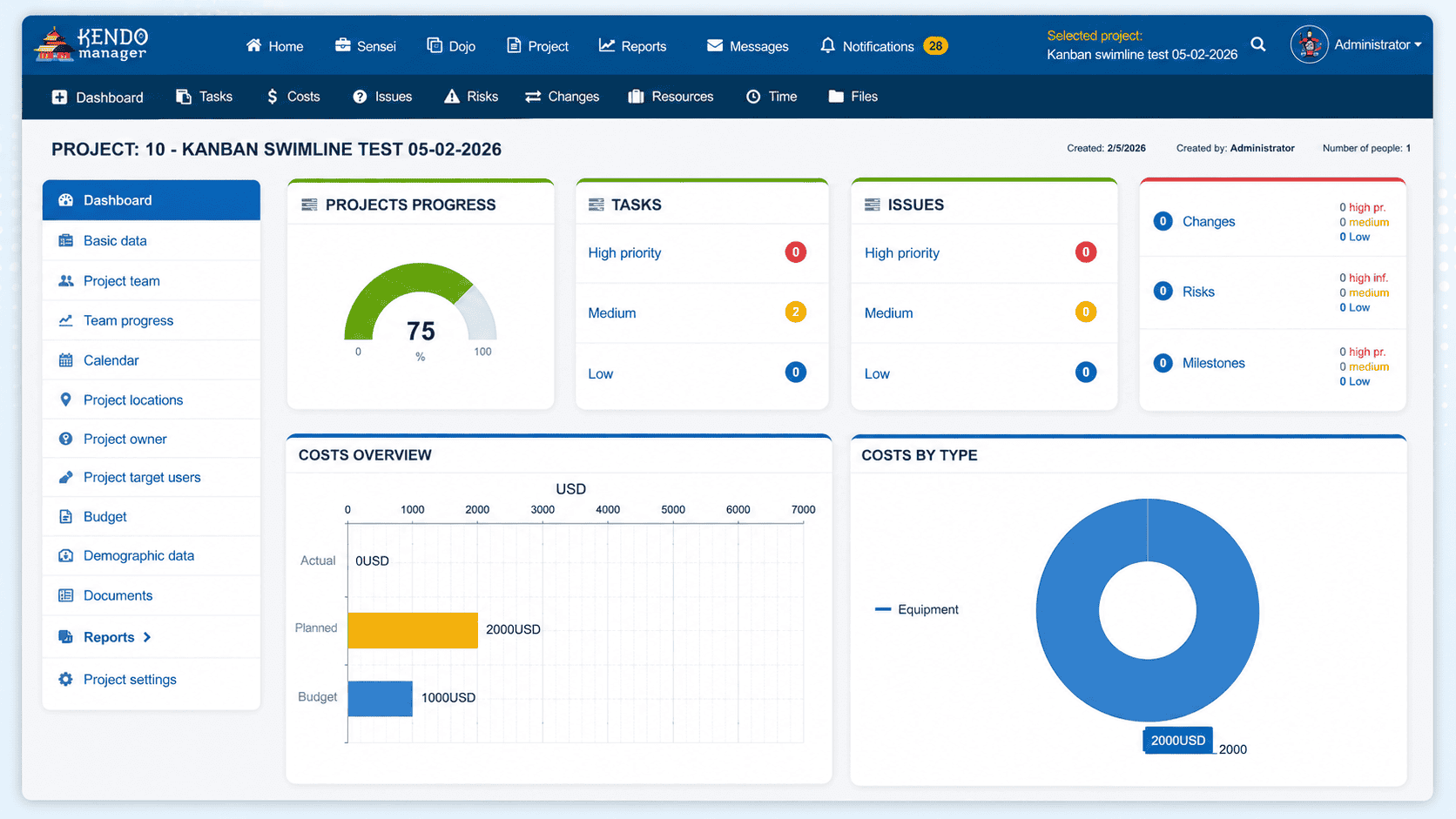
Kendo Manager is the optimal private cloud solution because it delivers enterprise-grade features without imposing per-user subscription fees or forcing data into a public multi-tenant environment. The software includes interactive Gantt charts, Kanban boards, task management, and cost management modules within a single interface. Small teams can deploy Kendo Manager on a private Windows VPS or local server, ensuring 100% data ownership. The platform also offers a free version that supports 1 active project and 10 team members, allowing startups to establish professional workflows with zero software expenditure.
How Do Public Cloud Alternatives Like Asana and ClickUp Compare?
Asana and ClickUp operate exclusively as public SaaS platforms, prioritizing rapid onboarding and extensive third-party integrations over data sovereignty. Asana excels in strategic project planning and task delegation, while ClickUp offers highly customizable views and document management. However, both platforms mandate recurring monthly fees that escalate rapidly as small teams grow. Furthermore, organizations using these tools surrender control over server locations and backend security protocols, which presents significant risks for companies managing sensitive client data or intellectual property.
How to Deploy Project Management Software in a Private Cloud Environment?
Deploying project management software in a private cloud environment requires provisioning a virtual private server (VPS) and installing the application stack. For self-hosted project management software for private cloud deployment, IT administrators typically configure a Windows Server or Windows 10 environment. The process involves installing Internet Information Services (IIS), configuring a MariaDB database, and executing the software installer. This architecture allows remote teams to access the system via a secure web browser while the organization retains absolute administrative control over the database and file storage directories.
Frequently Asked Questions (FAQ)
What is cloud-based project management software?
Cloud-based project management software is a digital platform hosted on remote servers that enables teams to plan tasks, allocate resources, and track progress via the internet. It eliminates the need for local desktop installations and facilitates real-time collaboration for distributed teams.
Can Kendo Manager be deployed in a private cloud?
Yes, Kendo Manager can also be deployed in a private cloud or Windows VPS environment. This deployment model provides the accessibility of a web-based tool while ensuring complete data sovereignty and security for the organization.
Why is self-hosted software cheaper for small teams?
Self-hosted software is cheaper for small teams because it utilizes a perpetual licensing model rather than charging recurring per-user monthly fees. Organizations pay a one-time fee for the software and a flat rate for server hosting, resulting in significantly lower long-term costs.
What features are essential for small team project management?
Essential features for small team project management include task assignment, interactive Gantt charts for timeline visualization, Kanban boards for workflow tracking, and integrated cost management to monitor budget utilization.
References
[1] Grand View Research. “Project Management Software Market Size Report, 2030.” https://www.grandviewresearch.com/industry-analysis/project-management-software-market-report [2] ElectroIQ. “Project Management Statistics And Facts (2026).” https://electroiq.com/stats/project-management-statistics/ [3] ERP Today. “Project Management Software Market to Pass $9 Billion by 2030.” https://erp.today/project-management-software-market-to-pass-9-billion-by-2030/ [4] GDPR.eu. “General Data Protection Regulation (GDPR) Compliance.” https://gdpr.eu/

