
What Is a PMO in Project Management? Definition, 3 Types, and Core Functions in 2026
Project Management Office
Updated June 16, 2026 · Kendo Manager
What Is a PMO in Project Management
What does PMO stand for in project management?
PMO stands for project management office, a central team or department that owns project governance, methodology, and reporting for an organization. It acts as the single home for templates, lessons learned, and performance metrics, sitting between executive strategy at the top and individual project delivery on the ground.
Think of it less as a checkpoint and more as connective tissue. One project manager knows their own project intimately. A PMO knows how 40 projects compare, where two teams are fighting over the same engineer, and which initiative quietly slipped two months without anyone raising a hand. That cross-project view is the reason the office exists.
What does a PMO do? 7 core functions
A PMO performs 7 core functions: governance, standardized methodology, portfolio prioritization, resource and capacity planning, consolidated reporting, risk and change control, and capability building. The mix shifts with company size, yet these seven recur across nearly every mature office.
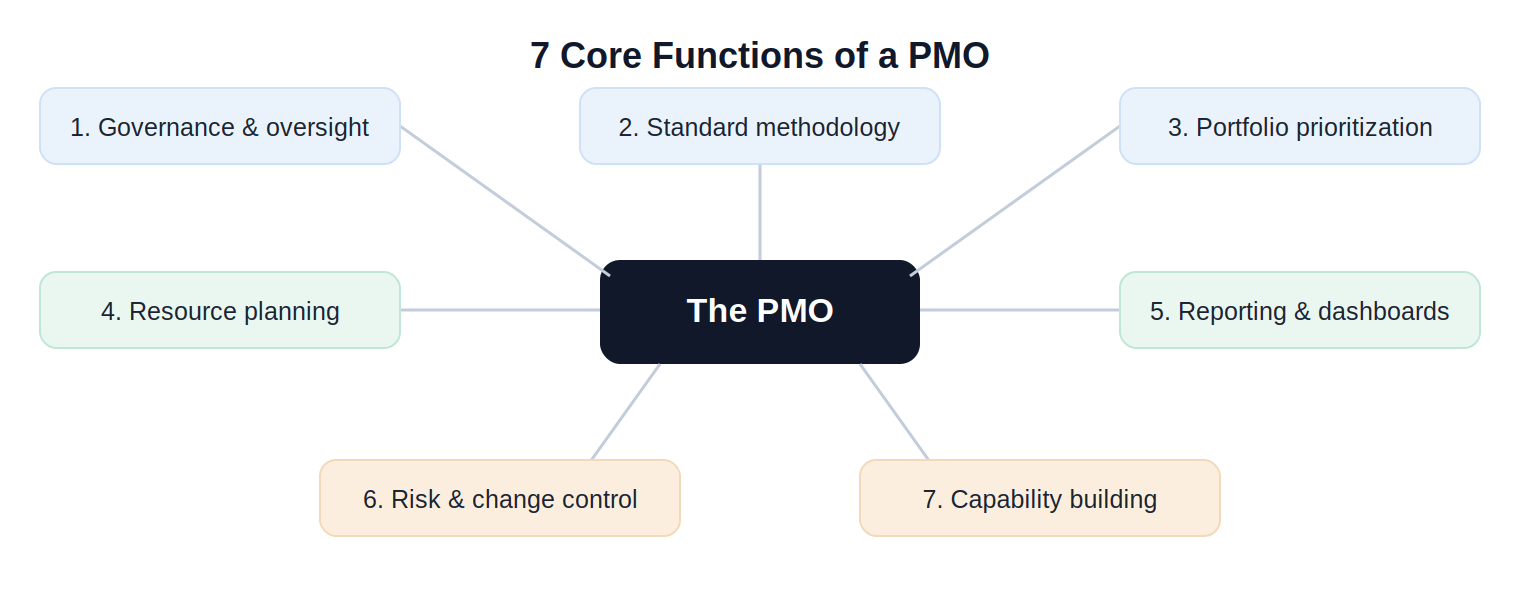
Figure 1. The seven recurring functions a PMO coordinates around one central view.
Which function matters most early on?
Consolidated reporting tends to deliver the fastest payback, because it kills the weekly scramble of stitching status from a dozen spreadsheets. Once leadership reads one dashboard instead of twelve emails, the office has already justified its seat.
What are the 3 types of PMO?
The PMBOK Guide names 3 types of PMO, separated by how much control each holds over projects: supportive, controlling, and directive. A supportive office advises, a controlling office enforces, and a directive office runs the work itself.
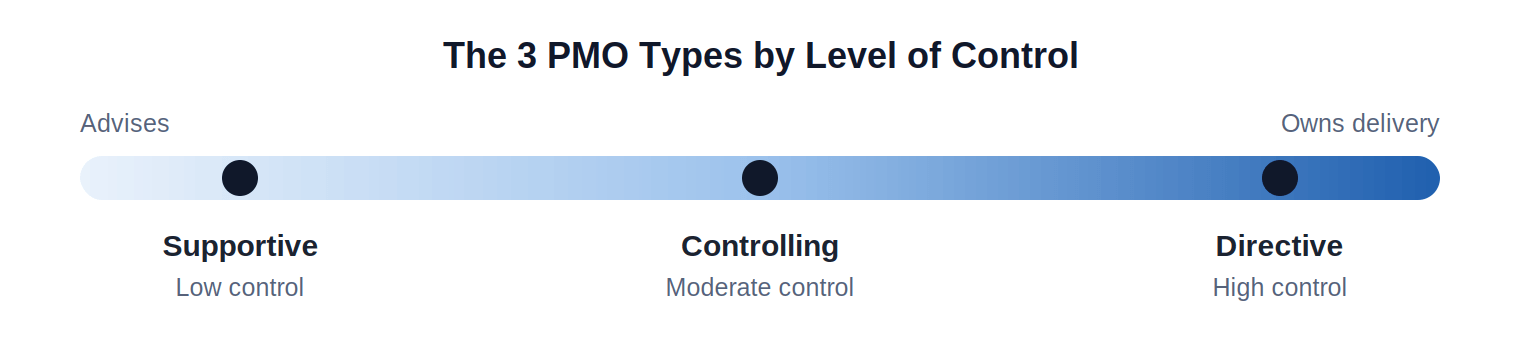
Figure 2. PMO authority rises across the three PMBOK models.
Table 1. The three PMBOK PMO types compared by authority and fit.
| PMO type | Control level | Primary role | Best fit |
|---|---|---|---|
| Supportive | Low | Supplies templates, training, and lessons learned as a knowledge hub | Functional or weak-matrix organizations |
| Controlling | Moderate | Requires compliance with set methods and audits adherence | Firms standardizing inconsistent practices |
| Directive | High | Assigns project managers and owns project outcomes directly | Lower-maturity or critical-project environments |
Real offices rarely sit cleanly in one box. A team may stay supportive for routine work yet turn directive for a regulated, high-stakes program. The model can be picked per portfolio, not stamped once across the whole company.
What is the difference between a PMO and a project manager?
A project manager delivers a single project on scope, schedule, and budget; a PMO governs the standards, portfolio, and shared resources across many projects at once. One role goes deep on a single deliverable. The other goes wide across the whole portfolio.
Table 2. PMO versus project manager at a glance.
| Dimension | Project manager | PMO |
|---|---|---|
| Scope | One project | Many projects and the portfolio |
| Focus | Delivery of a defined outcome | Governance, consistency, strategy fit |
| Time horizon | Project start to close | Continuous across initiatives |
| Owns | Tasks, milestones, the team | Methodology, reporting, capacity |
Why do organizations set up a PMO?
Organizations set up a PMO mainly to raise project success rates, which still hover at roughly 31% delivered on time, on budget, and on scope according to the Standish CHAOS dataset. When two of every three projects miss at least one target, a unit dedicated to consistency and early warning starts to pay for itself.

The strategic pull is now stronger than the administrative one. Wellingtone’s 2025 survey found that 72% of organizations expect the PMO’s role to grow, with the office moving from report generator toward strategic enabler. That shift explains why budgets for the function have held even when other support teams shrink.
How does a PMO run on project management software?
A PMO runs on project management software that pulls portfolios, resources, costs, and reporting into one system instead of scattered spreadsheets and email threads. Each of the seven functions above maps to a specific software capability, which is why tool choice shapes how well an office can actually operate.
One example is Kendo Manager self-hosted project management software, built by Spider Soft since 2010 to align with PMI standards. It bundles the modules a PMO leans on under one license, and because it is self-hosted on a company’s own Windows server or Azure tenant, the project data never leaves the organization’s security perimeter. The table below maps PMO functions to the matching modules.
Table 3. PMO functions mapped to project management software modules.
| PMO function | Software capability | Module in Kendo Manager |
|---|---|---|
| Portfolio prioritization | Multi-project view and dashboards | Sensei, Dojo, and project dashboards |
| Methodology & scheduling | Gantt charts and Kanban boards | Gantt, Kanban |
| Resource planning | Capacity and workload allocation | Resource Allocation |
| Cost governance | Budget and time tracking | Cost & Budget, Time Tracking |
| Risk & change control | Risk registers and change logs | Risk Management, Change Management |
On cost, Kendo Manager uses a one-time perpetual license rather than a per-user monthly fee, and a free tier covers up to 10 users and 1 project with the same six enterprise modules as the paid editions. Pricing for every tier is listed on the Kendo Manager pricing page. For teams above roughly 25 users, a perpetual license usually lowers the five-year total cost of ownership against subscription tools.
What trends are reshaping the PMO in 2026?
Two trends dominate the PMO in 2026: artificial intelligence in decision-making and the move to hybrid delivery. Both change what the office spends its time on, pushing routine reporting toward automation and freeing analysts for portfolio judgment.
- AI adoption is near-universal. Industry forecasts cited alongside PMI’s research expect about 80% of PMOs to use AI for decision support during 2026, even though only around 20% of project managers currently report strong practical AI skills (PMI Pulse of the Profession 2025).
- Hybrid is now the default. Adoption of hybrid project management models jumped 57% in a single year, so a modern PMO has to govern agile and waterfall side by side rather than picking one.
- Business acumen outranks technical skill. Only 18% of project professionals show high business acumen, yet their projects fail 8% of the time versus 11% for the rest (PMI Pulse of the Profession 2025). PMOs increasingly recruit and train for that gap.
PMO questions people also ask
What is a PMO in simple terms?
A PMO is a project management office: a central team that sets the rules, templates, and reporting every project follows. It keeps work consistent instead of each manager inventing a separate process.
What are the 3 types of PMO?
The three PMBOK types are supportive, controlling, and directive. A supportive PMO advises with low control, a controlling PMO enforces standards with moderate control, and a directive PMO runs projects directly with high control.
What is the difference between a PMO and a project manager?
A project manager delivers one project; a PMO governs the standards, portfolio, and shared resources across many projects. The manager works deep on a single outcome, while the office works wide across the whole portfolio.
Does a small business need a PMO?
A small business benefits from a lightweight, supportive PMO once it runs several projects in parallel and reporting drifts apart across teams. The structure can start as one shared toolkit before growing into a formal department.
What is the difference between a PMO and an EPMO?
A PMO governs project delivery, while an EPMO (enterprise PMO) sits at executive level and ties the entire portfolio to corporate strategy. The EPMO is the strategic layer above operational project offices.
What software does a PMO use?
A PMO uses portfolio and project management software that combines Gantt scheduling, resource planning, cost tracking, and dashboards in one system. Self-hosted options such as Kendo Manager add data control by keeping everything on the company’s own servers.
Sources
- Project Management Institute, Pulse of the Profession 2025 and PMBOK Guide — pmi.org
- Wellingtone, 2025 State of Project Management — PMO role expansion and change-management data.
- Standish Group, CHAOS dataset — project success rates.
- IBM, Cost of a Data Breach Report 2025 — data-control rationale for self-hosting

