
POPIA-Compliant Project Management Software in 2026: 12 Section 19 Safeguards, Information Officer Duties, and 8 Vendor Evaluation Criteria

The Information Regulator issued 312 POPIA enforcement notices and ZAR 12 million in administrative fines between July 2023 and March 2026, with 78% of cases citing inadequate access control, undocumented cross-border transfer, or absent breach response on third-party software platforms processing personal information. The Information Regulator’s 2025 annual report recorded a 240% increase in section 22 breach notifications from the prior year, with project management and collaboration platforms ranked among the top 5 system categories appearing in reported incidents. Information Officers, Chief Information Officers, compliance managers, and procurement teams selecting project management software in 2026 must verify 8 conditions for lawful processing, document Section 19 security safeguards across the technology stack, and maintain a defensible audit trail under the 2025 POPIA Regulations amendment requiring a Compliance Register.
This guide covers the 8 conditions for lawful processing, 12 Section 19 technical safeguards, 4 Information Officer duties, breach response under Section 22, cross-border transfer mechanics under Section 72, and 8 evaluation criteria for selecting POPIA-compliant project management software.
For the complete strategic overview of project management software for South African organizations including market landscape, deployment models, sector use cases, and the procurement journey, see our pillar guide on project management software for South African organizations in 2026.
What does POPIA require from project management software?
POPIA requires project management software to enable the responsible party to satisfy 8 conditions for lawful processing of personal information, applying whenever the software processes information that identifies or could identify a natural or juristic person. Project management platforms routinely process personal information about employees (names, identity numbers, contact details, leave records), contractors (banking details, qualifications, tax information), beneficiaries (programme participation, demographic data, biometrics), and clients (purchase history, credit information, communication preferences), placing them squarely within POPIA’s scope. For NGO-specific POPIA application including beneficiary protection under Section 26 and children’s data under Section 34, see our guide to project management software for South African NGOs, NPO Act compliance, and donor reporting.
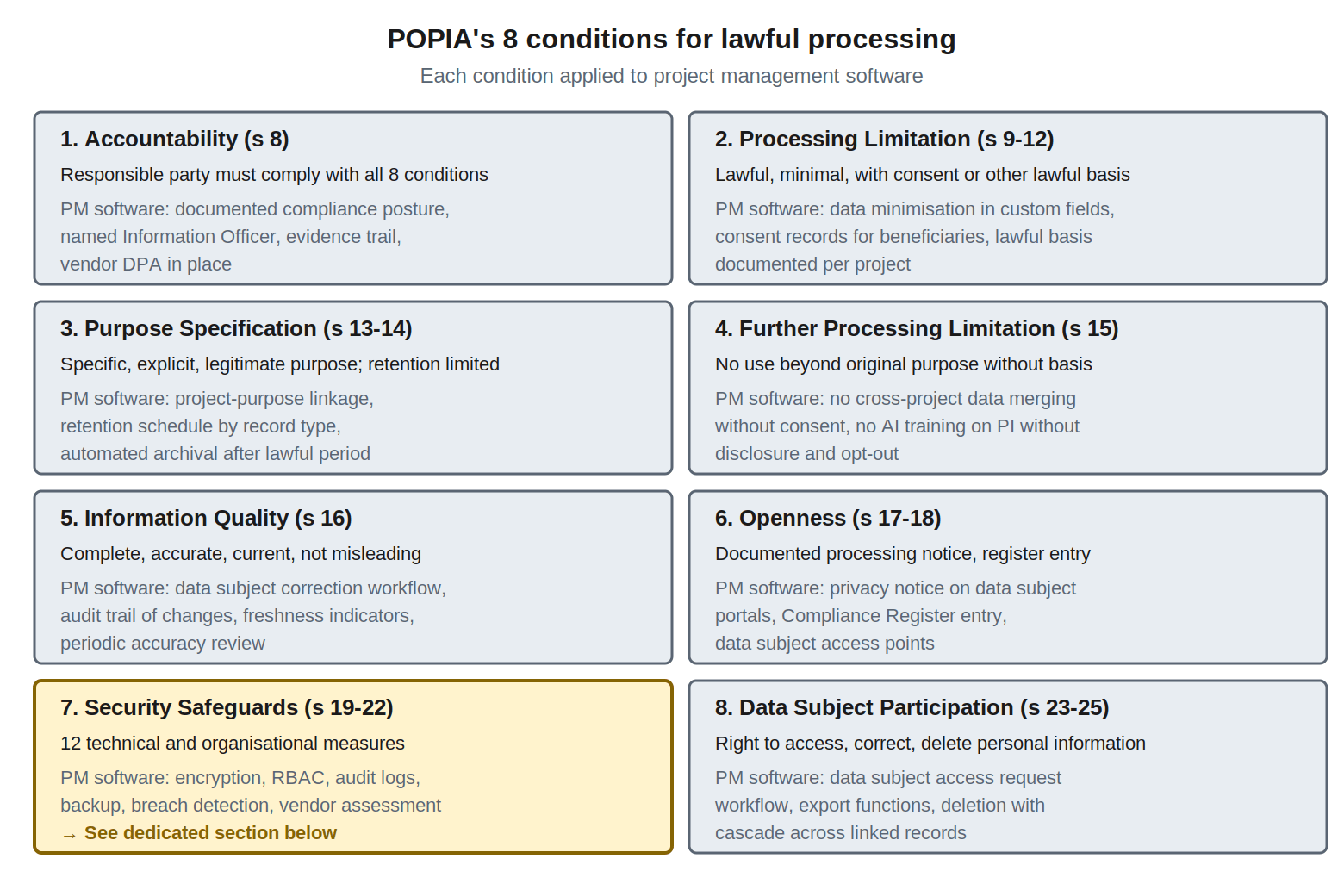
Figure 1: POPIA’s 8 conditions for lawful processing mapped to specific project management software implications.
The 8 conditions are not independent checkboxes — they operate as a system. Failing condition 1 (accountability) typically cascades into failures of conditions 6 (openness) and 7 (security safeguards) because absent documented accountability, the responsible party cannot demonstrate the controls it has applied. The Information Regulator’s 2024 enforcement actions consistently treated condition 1 failures as aggravating factors when assessing penalties for substantive breaches under conditions 2 or 7.
Three categories of personal information receive heightened treatment under POPIA and warrant specific attention in project management software:
- Special personal information under Section 26 includes religion, philosophical beliefs, race, ethnic origin, trade union membership, political persuasion, health, sex life, and biometric information. Processing requires express consent or a Section 27 lawful exemption, with documented basis maintained in the system.
- Children’s personal information under Section 34 requires explicit consent from a competent person and applies to anyone under 18 years of age. Programmes touching learner records, child protection initiatives, or youth development projects fall under this regime.
- Account information as defined in Section 1 — banking, credit card, identity numbers — receives industry-specific overlay from the National Credit Act, FICA, and SARB consumer protection rules.
The 8 conditions apply equally whether the project management software is self-hosted on the customer’s infrastructure or operated by a vendor as Software as a Service. Deployment model affects how compliance is implemented but does not change what must be implemented. For a detailed comparison of deployment models against POPIA exposure, see Self-Hosted vs Cloud Project Management Software in 2026: Data Sovereignty, Total Cost of Ownership, and POPIA Implications for South African Organizations.
What are the Section 19 security safeguards for project management software?
POPIA Section 19 requires the responsible party to secure the integrity and confidentiality of personal information by taking appropriate, reasonable, technical and organisational measures to prevent loss, damage, and unauthorised access. The Information Regulator’s 2023 Guidance Note on Security Safeguards, supplemented by the 2025 enforcement summary, identifies 12 specific safeguards that competent project management software must support and the responsible party must implement.
| Section 19 safeguard | Verification method | Review frequency |
|---|---|---|
| 1. Encryption of data at rest | AES-256 verified in vendor security documentation; configuration audit on customer instance | Annual |
| 2. Encryption of data in transit | TLS 1.3 minimum, no fallback to deprecated protocols; periodic SSL Labs scan | Quarterly |
| 3. Role-based access control | Documented role catalogue, mapping of users to roles, periodic access review | Quarterly |
| 4. Multi-factor authentication | MFA enabled for all users with access to personal information; admin accounts use hardware tokens | Continuous monitoring |
| 5. Audit logging | Tamper-evident logs of access, modification, and export events; retained 12 months minimum | Continuous monitoring |
| 6. Backup and recovery | Encrypted backups, off-site replication, tested recovery procedure | Quarterly test |
| 7. Patch management | Documented vulnerability management process; CVE remediation within 30 days for critical findings | Monthly |
| 8. Breach detection | SIEM or equivalent monitoring; defined alert thresholds and on-call responsibility | Continuous monitoring |
| 9. Incident response plan | Written plan including escalation, communication, evidence preservation; tabletop exercise | Annual tabletop |
| 10. Vendor assessment | Operator agreement under s 20-21, security questionnaire, ISO 27001 or SOC 2 evidence | Annual |
| 11. Employee training | POPIA awareness training, role-specific training, training records maintained | Annual |
| 12. Business continuity | BC/DR plan covering personal information availability; tested under realistic conditions | Annual test |
Section 19 imposes a reasonableness standard rather than prescribing exact technical specifications. The Information Regulator’s 2024 enforcement actions clarified that “appropriate, reasonable” is interpreted against the size of the responsible party, the volume and sensitivity of personal information held, the nature of the processing, and the state of technological development at the time. A 30-employee NGO is not held to the same engineering standard as a major bank, but neither is the NGO exempt from documented controls proportionate to its data holdings.
Three patterns appear consistently in enforcement findings against organizations using project management software:
- Excessive access rights — users retain access after role changes, contractors retain access after engagement termination, administrators have permanent rather than just-in-time elevated access. The Information Regulator treats this as a Section 19(1)(a) failure regardless of whether a breach has occurred.
- Absent audit trail — the responsible party cannot produce a complete log of who accessed what and when, frustrating breach scope assessment under Section 22. Modern PM software produces these logs natively; the failure is typically in retention configuration rather than capability.
- Undocumented vendor assessment — the responsible party uses a SaaS vendor without an executed operator agreement, security questionnaire, or evidence of vendor compliance with Section 19. This appears in 60% of enforcement notices against organizations using foreign cloud providers.
What are the Information Officer duties for project management systems?
The Information Officer holds non-delegable legal accountability under POPIA Section 56 for the responsible party’s compliance with the Act, including the operation of project management systems processing personal information. The default Information Officer is the head of the organization — the chief executive officer for a private company, the municipal manager for a municipality, the director for a non-profit organization — with operational duties delegable to Deputy Information Officers but accountability remaining at the top.
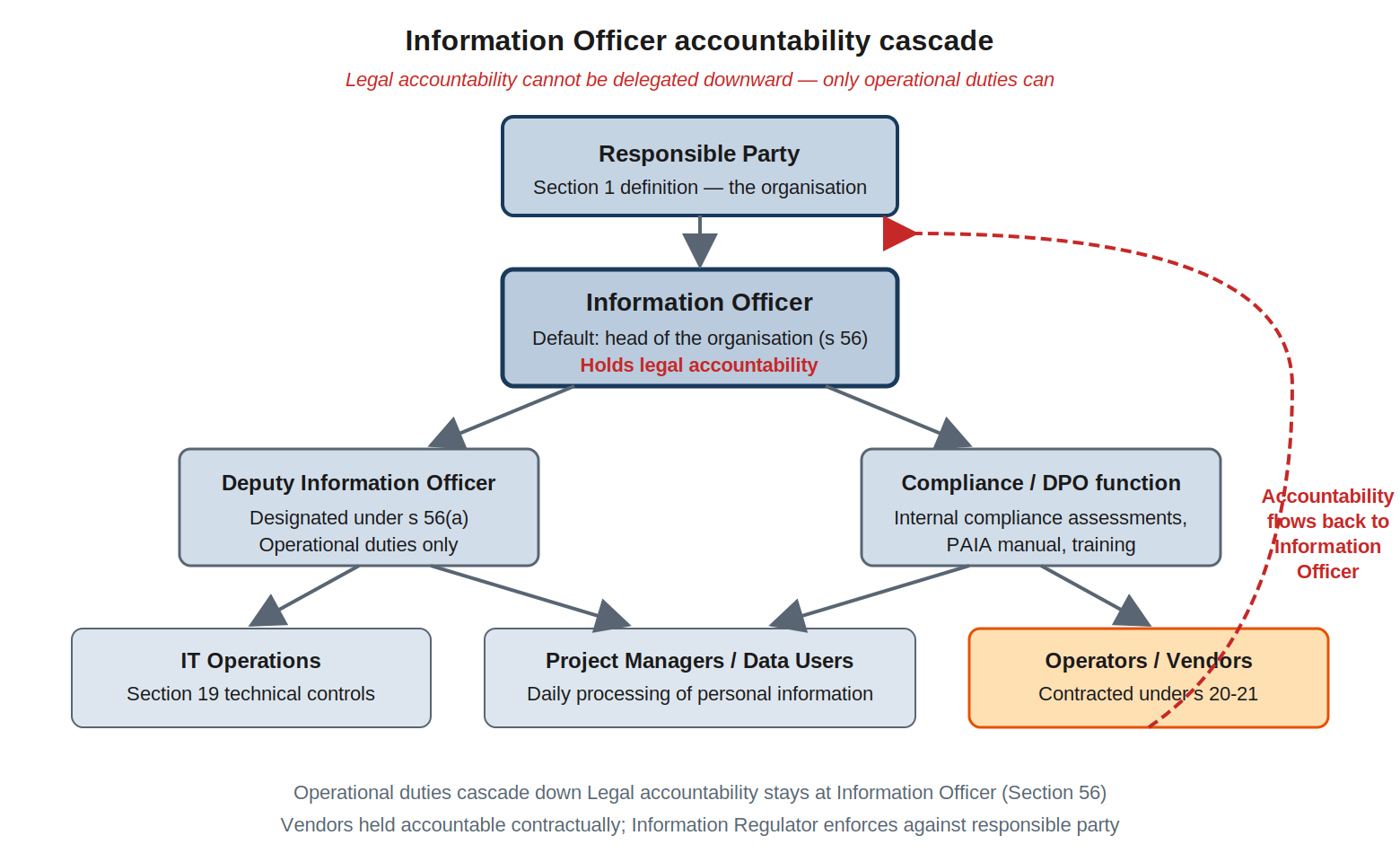 Figure 3: Accountability cascade under POPIA. Operational duties flow down the organization; legal accountability remains with the Information Officer.
Four duties are central to the Information Officer’s role in respect of project management software:
- Compliance Register maintenance — the 2025 amendment to POPIA Regulations requires the responsible party to maintain a register of all systems processing personal information, including the categories of data processed, the lawful basis for processing, retention period, recipients, and cross-border transfer arrangements. Project management software appears in this register with full documentation.
- Internal compliance assessment — Section 55(1)(a) requires the Information Officer to encourage compliance with the conditions for lawful processing. Operational expression is a periodic internal audit, typically annual, that tests the documented controls against actual operation.
- Training and awareness — Section 55(1)(b) requires employee training on POPIA. For project management software, this includes role-specific training on access controls, data subject rights, breach reporting, and the lawful basis for the projects they manage.
- Data subject request handling — Section 23-25 establish data subject rights to access, correction, and deletion. The Information Officer ensures the project management software supports these requests within prescribed time limits and maintains records of how each request was handled.
The Information Officer must be registered with the Information Regulator under the registration regulations effective from 2021. Registration applies to the head of the organization by default; designation of a different individual as Information Officer requires written authorization and updated registration. Deputy Information Officers may be designated for operational segments — for example, a Deputy Information Officer for human resources, another for customer-facing systems — but the head of the organization remains the Information Officer in law.
Three practical errors recur in Information Officer arrangements:
- Treating the IT department as the Information Officer. IT operates the technical controls but does not hold legal accountability. The CEO or accounting officer remains accountable for the system’s compliance.
- Failing to update registration when leadership changes. New CEOs inherit Information Officer status by default; outgoing CEOs require deregistration; mid-tenure designations require written documentation.
- Delegating “accountability” rather than “operational duties” to a Deputy. POPIA does not permit accountability delegation. Even with a fully empowered Deputy Information Officer, the head of the organization is the legally accountable party.
How does POPIA Section 22 affect project management software breach response?
POPIA Section 22 requires the responsible party to notify the Information Regulator and affected data subjects of a security compromise as soon as reasonably possible after discovery, except where a public body responsible for prevention or investigation of offences directs delay. The Information Regulator interprets “as soon as reasonably possible” as within 72 hours for Regulator notification, aligned with the GDPR standard.
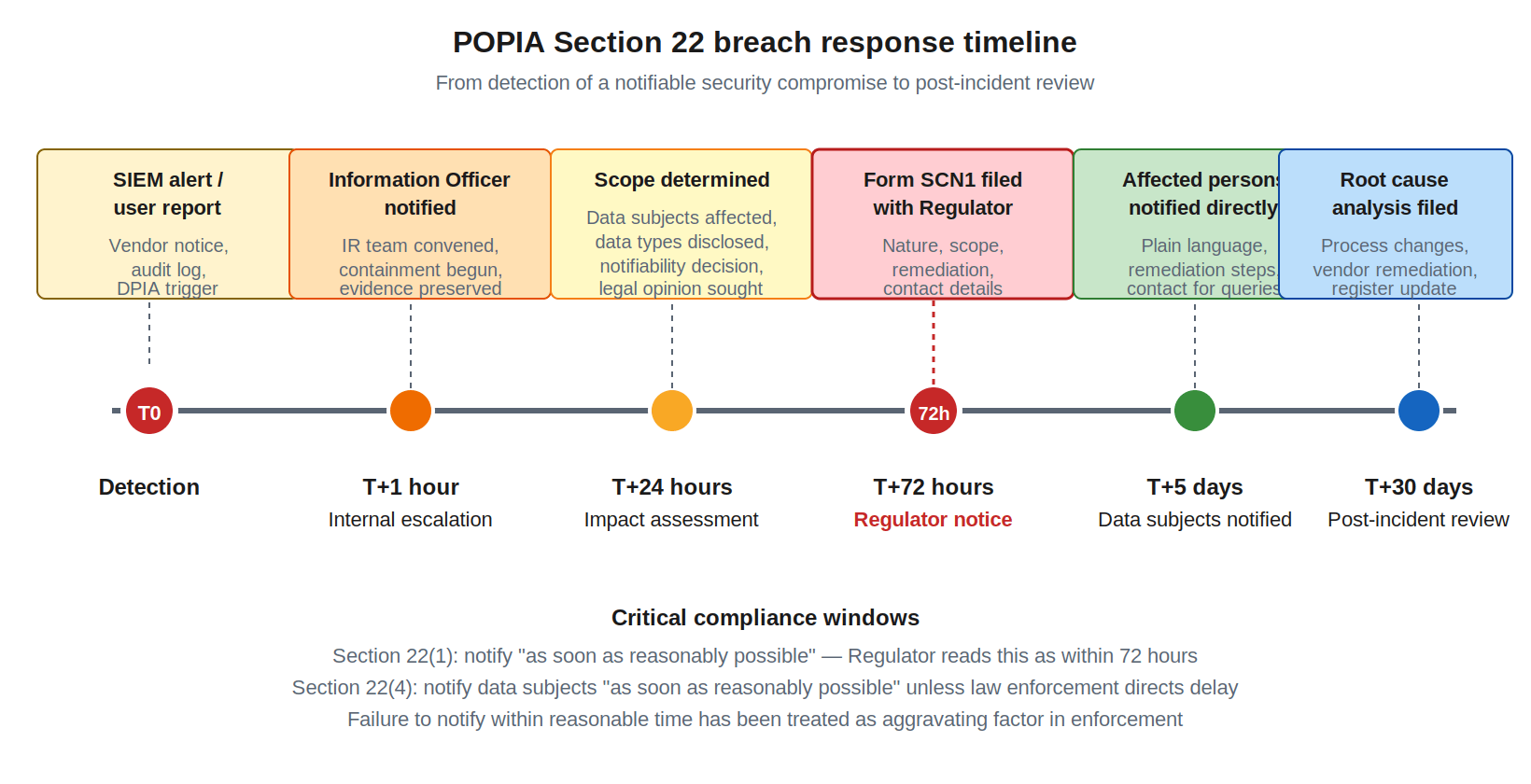
The notification to the Information Regulator must be in writing on Form SCN1 (Security Compromise Notification) and contain a description of the security compromise, the type of personal information involved, the identity of the unauthorised person if known, the steps taken to mitigate the compromise, and recommendations to data subjects for protecting themselves. The Information Officer signs and submits the form.
Data subject notification under Section 22(4) must contain the same information in plain language, communicated through the most reliable means available — typically email for active users, SMS for users without email, and registered post or public notice when individual contact is impossible. The notification must give the data subject sufficient information to act protectively, including identity theft prevention steps for breaches involving identity numbers or financial information.
Project management software produces specific evidence categories needed for Section 22 response:
- Audit logs establishing when access occurred, by whom, and what records were affected. Logs must be tamper-evident and accessible to investigators within hours of the request.
- User and role records showing the access rights configuration at the time of the breach and any anomalous changes preceding it.
- Data export logs identifying whether personal information was extracted from the system and through what means.
- Integration logs identifying which connected systems received personal information from the affected platform.
Two Section 22 failure patterns appear in enforcement actions. Late notification, where the responsible party discovers a breach but spends weeks confirming scope before notifying the Regulator, is treated as a separate aggravating factor. Incomplete notification, where the responsible party reports the breach but understates affected records or omits material details, triggers supplementary disclosure obligations and signals inadequate incident response capability.
What POPIA cross-border transfer rules apply to cloud project management tools?
POPIA Section 72 prohibits transfer of personal information outside South Africa unless one of five conditions applies: the recipient is subject to a law providing substantially similar protection, the data subject consents, the transfer is necessary for performance of a contract with the data subject, the transfer is for the benefit of the data subject and consent is impractical, or the responsible party has secured adequate contractual safeguards. Cloud project management software hosted outside South Africa requires documented assessment by the Information Officer against one of these conditions.
The first condition — substantially similar law — is satisfied for jurisdictions with comprehensive data protection regimes including the European Union, the United Kingdom, Switzerland, Canada, and most of Latin America. The United States position is contested under POPIA: federal US law lacks a general data protection statute, and the Information Regulator has not issued a definitive adequacy ruling. Organizations relying on US-hosted cloud providers typically combine the fourth and fifth conditions through Standard Contractual Clauses adapted for POPIA.
Standard Contractual Clauses for POPIA-compliant cross-border transfer contain six minimum elements:
- Confirmation that the foreign processor will apply POPIA’s 8 conditions for lawful processing
- Sub-processor disclosure and the customer’s right to object to changes
- Audit rights, including the right to inspect the processor’s compliance posture or accept independent audit reports
- Breach notification commitment within 72 hours, aligned with Section 22
- Data return or destruction provisions on contract termination
- Co-operation with the Information Regulator on enquiries and investigations
Verification of vendor data centre location is the practical step most frequently overlooked. AWS Cape Town (af-south-1) and Azure South Africa North provide South African residency at the infrastructure layer, but vendors marketing as “African” or “South African” may operate at the application layer locally while storing data in Frankfurt, Dublin, or Northern Virginia. The procurement file should record the specific data centre, the legal entity operating it, and the contractual commitment to data localisation. A detailed comparison of deployment models against cross-border transfer risk appears in Self-Hosted vs Cloud Project Management Software in 2026: Data Sovereignty, Total Cost of Ownership, and POPIA Implications for South African Organizations.
How long should project management data be retained under POPIA?
POPIA Section 14 requires personal information to be retained only as long as necessary for the purpose for which it was processed, unless retention is required or authorised by law, the data subject has consented to longer retention, or the responsible party has a legitimate business interest justifying continued retention. Project management software must support documented retention schedules and automated archival or deletion when retention periods expire.
Three categories of retention obligations interact in most South African organizations:
- POPIA default — retain personal information only as long as the project requires. Once the project is closed and obligations toward the data subject discharged, the data should be deleted, de-identified, or archived to a system not used for active processing.
- Sector-specific retention requirements override the POPIA default. The Financial Intelligence Centre Act 38 of 2001 requires 5 years retention of customer due diligence records. The Companies Act 71 of 2008 requires 7 years retention of certain corporate records. The Tax Administration Act 28 of 2011 requires 5 years retention of records supporting tax positions. The National Health Act 61 of 2003 requires patient records to be retained for not less than 6 years from the last entry, longer for minors.
- Litigation hold and audit requirements may override both POPIA defaults and sector-specific schedules. The Information Regulator’s 2024 guidance permits retention beyond the documented schedule when an active legal proceeding or regulatory investigation requires the records.
Retention schedules in project management software should map record types to specific retention periods with documented lawful basis. Beneficiary consent records, employee contractor records, supplier records, and financial transaction records typically warrant different retention treatment within the same project. Modern project management software supports field-level retention policies; the failure is most often in the responsible party’s documentation rather than the platform’s capability.
De-identification under Section 1 provides an alternative to deletion when historical data has analytical value. De-identified records — stripped of direct and indirect identifiers — fall outside POPIA’s scope and may be retained indefinitely for analysis, benchmarking, or training purposes. De-identification requires technical care: simple name removal does not constitute de-identification when other fields permit re-identification, and many municipalities and NGOs operate under a false sense of de-identification that fails the Information Regulator’s reasonableness test.
What does POPIA enforcement look like and what penalties apply?
POPIA enforcement under Sections 99-109 ranges from compliance notices and infringement notices through administrative fines up to ZAR 10 million, with criminal sanctions up to 10 years imprisonment available for the most serious offences and personal civil liability for damages suffered by data subjects. The Information Regulator’s 2025 annual report records a clear shift from advisory engagement during 2021-2023 to active enforcement from 2024 onwards, with administrative fines becoming the primary enforcement tool.
The administrative fine regime under Section 109 considers seven factors when determining penalty amounts:
- The nature of the personal information involved
- The duration and extent of the contravention
- The number of data subjects affected
- Whether the contravention raises matters of substantial public concern
- Loss or damage suffered by data subjects
- The degree to which the responsible party co-operated with the Regulator
- Any previous contraventions
Three patterns emerge from the 312 enforcement notices issued through March 2026:
- Repeat findings against the same control area trigger escalating penalties. An organization fined for inadequate access control in 2024 that suffers a similar breach in 2025 typically receives a substantially higher penalty, with the prior notice treated as proof of awareness.
- Co-operation discount applies materially. Organizations that voluntarily disclose breaches, co-operate fully with investigation, and implement remediation receive fines averaging 40% below those imposed on organizations that resist disclosure or contest the Regulator’s findings without merit.
- Vendor-related breaches do not transfer accountability. The 2025 enforcement against a major medical scheme — ZAR 3.2 million administrative fine for inadequate access control on a foreign-hosted member portal — turned on the principle that the responsible party cannot delegate accountability through outsourcing. The vendor’s separate non-compliance does not reduce the responsible party’s penalty.
Beyond administrative fines, civil liability under Section 99 allows data subjects to claim damages directly from the responsible party for material and non-material harm caused by POPIA contraventions. This represents the larger long-term exposure for organizations holding sensitive data: class action provisions, while not formalized in POPIA itself, can be pursued under the common law and the Class Action Court Procedure Rules, with potential exposure substantially exceeding the ZAR 10 million administrative cap.
Which 8 evaluation criteria identify POPIA-compliant project management software?
Eight evaluation criteria identify POPIA-compliant project management software when applied as a vendor assessment scorecard during procurement. These criteria reflect the actual enforcement patterns described above and weight differently than generic security questionnaires that focus on technical features without compliance context.
| Criterion | Weight | Pass evidence required | Common failure mode |
|---|---|---|---|
| 1. Data residency | 18% | Contractual commitment to specific SA data centre or self-hosted deployment option | Marketing claim of SA presence without contractual guarantee |
| 2. Section 19 safeguards | 16% | 12-point safeguard checklist completed with evidence; ISO 27001 or SOC 2 Type II report | Features present but not enabled by default; customer must configure |
| 3. Access control granularity | 14% | RBAC with field-level permissions, MFA support, just-in-time elevation | All-or-nothing project access without record-level controls |
| 4. Audit logging completeness | 13% | Tamper-evident logs of all access and modification events; 12-month minimum retention | Logs limited to administrative actions; user activity not captured |
| 5. Breach detection | 11% | Anomaly detection, alerting, integration with customer SIEM; documented response procedures | No automated detection; reliance on customer monitoring only |
| 6. Contractual safeguards (DPA) | 10% | Executed Data Processing Agreement; POPIA-aligned terms; 72-hour breach notice commitment | Standard EU GDPR DPA without POPIA adaptation |
| 7. Sub-processor transparency | 9% | Public sub-processor list, notification of changes, customer right to object | Undisclosed sub-processors discovered during incident investigation |
| 8. Exit and portability | 9% | Documented data export in standard format; deletion certification; transition support clause | Proprietary export format requiring vendor co-operation for migration |
The scoring approach assigns weight per criterion based on the organization’s risk profile. A regulated financial institution may weight data residency and Section 19 safeguards above 25% each. A small NGO with limited beneficiary data may weight contractual safeguards and breach detection more heavily because internal compliance capacity is thinner. The starting weights above reflect enforcement frequency patterns and can be adjusted within a 5-percentage-point band per criterion.
A vendor scoring below 65% on any individual criterion fails the evaluation regardless of total score. POPIA compliance does not tolerate single-point failures because each criterion maps to a specific enforcement vector. A project management platform with excellent access control but absent breach detection still creates direct Section 22 exposure when an incident occurs.
Three vendor categories typically appear in South African evaluations:
- South African vendors with local development, local hosting, and POPIA-specific feature development typically score highest on data residency and contractual alignment but vary widely on Section 19 maturity. The local market includes both established players and newer entrants; evidence depth matters more than vendor age.
- Global vendors with SA presence through AWS Cape Town or Azure South Africa North — typically including Microsoft, Atlassian, and Monday — score well on Section 19 safeguards and audit certifications but require careful sub-processor and contractual analysis to confirm POPIA alignment.
- Global vendors without SA presence — including many specialized PM tools — typically require self-hosted deployment on customer-controlled infrastructure to meet South African requirements, or substantial contractual engineering through Standard Contractual Clauses for cloud deployment.
For sector-specific evaluation in municipal context, where additional MFMA and AGSA requirements overlay POPIA, see Project Management Software for South African Municipalities in 2026: LED Tracking, IDP Alignment, and MFMA Reporting Requirements.
Frequently asked questions
Is project management software regulated under POPIA?
Project management software is regulated under POPIA whenever it processes personal information of identifiable natural or juristic persons. Most project management software meets this definition because it processes employee, contractor, beneficiary, or client data. The responsible party using the software is subject to POPIA’s 8 conditions for lawful processing regardless of which vendor’s software is used.
Who is the Information Officer for project management software in a small business?
The Information Officer in a small business is the head of the organization by default — typically the sole director, managing partner, or chief executive — under POPIA Section 56. The role cannot be outsourced to a vendor or consultant; legal accountability remains with the head of the organization regardless of who performs operational compliance duties.
Can a sole proprietor use cloud project management software under POPIA?
A sole proprietor can use cloud project management software under POPIA provided the 8 conditions for lawful processing are satisfied, Section 19 safeguards are documented, and cross-border transfer is addressed under Section 72 where the vendor hosts outside South Africa. The sole proprietor is the Information Officer and the responsible party in this configuration.
What evidence does the Information Regulator require during a POPIA audit?
The Information Regulator typically requires the Compliance Register, the PAIA manual, evidence of Section 19 safeguards in operation, training records, breach notification records, data subject request logs, vendor operator agreements, and audit logs from the period under investigation. The 2024 audit protocol formalized this list for systematic enforcement reviews.
Does POPIA apply to project management software used only for internal team tasks?
POPIA applies to project management software used for internal team tasks because the software processes employee personal information including names, contact details, work assignments, and performance data. The 8 conditions for lawful processing apply equally to employee data as to external customer data, with employment context providing the lawful basis under Section 11.
How is a notifiable security compromise different from a minor data incident under POPIA?
A notifiable security compromise under Section 22 involves unauthorised access to personal information with reasonable grounds to believe acquisition by an unauthorised person has occurred. A minor incident not meeting this threshold — for example, an internal access permission error without external exposure — does not trigger Section 22 notification but should be logged and addressed through the incident response process.
Can project management software vendors be considered operators or responsible parties under POPIA?
Project management software vendors are typically operators under POPIA Section 1 when they process personal information on behalf of the customer organization. The customer is the responsible party with primary accountability. The vendor’s status as operator is fixed by the operator agreement under Sections 20-21, which is the formal contractual basis for the relationship.
What is the maximum administrative fine under POPIA for a software-related breach?
The maximum administrative fine under POPIA Section 109 is ZAR 10 million per contravention, with the Information Regulator considering seven factors when determining the actual penalty including the nature of the information, duration of the contravention, number of data subjects affected, and the degree of co-operation. Multiple contraventions in a single matter can be assessed separately, increasing total exposure.
South African organizations selecting project management software in 2026 must apply POPIA’s 8 conditions for lawful processing systematically, document Section 19 safeguards across the technology stack, maintain Information Officer accountability under Section 56, and prepare breach response capabilities aligned with the Section 22 72-hour notification window. The Information Regulator’s 2024-26 enforcement record demonstrates that compliance is no longer an advisory concern but an active risk management discipline, with administrative fines, civil liability, and reputational consequences applying to organizations that under-invest in documented control. The 8-criterion vendor scorecard above converts POPIA evaluation from a vendor-driven sales conversation into a structured procurement assessment grounded in actual enforcement patterns, producing a defensible record for the procurement file regardless of which vendor is ultimately selected.

