
Self-Hosted vs Cloud Project Management Software in 2026: Data Sovereignty, Total Cost of Ownership, and POPIA Implications for South African Organizations
South African organizations operating across 14 regulated sectors received 312 POPIA enforcement notices and ZAR 12 million in collective administrative fines between July 2023 and March 2026, with deployment architecture cited in 67% of cases involving third-party data processing. BMI Research’s 2026 South African enterprise software study recorded a 41% shift toward self-hosted and hybrid deployment among organizations with more than 250 employees, reversing a decade of cloud-only growth as POPIA enforcement, rand depreciation, and connectivity constraints reshaped the buying calculation.
IT directors, Chief Information Officers, procurement managers, and compliance officers evaluating project management software in 2026 must compare deployment models against four overlapping pressures: POPIA Section 72 cross-border restrictions, 5-year total cost of ownership under rand depreciation, Stage 4-6 load shedding operational impact, and sector-specific regulatory expectations from the Financial Sector Conduct Authority, the South African Reserve Bank, and the Department of Mineral and Petroleum Resources. This guide covers 3 deployment architectures, 5-year TCO breakdown across 8 cost categories, sectoral requirements for 7 regulated industries, the shared responsibility model under POPIA Section 19, and a 5-question decision framework for selecting the right model.
For the complete strategic overview of project management software for South African organizations including compliance regimes, sector use cases, and the procurement journey, see our pillar guide on project management software for South African organizations in 2026.
What are the differences between self-hosted, cloud, and hybrid project management software?
The differences between self-hosted, cloud, and hybrid project management software lie in which party owns and controls each layer of the technology stack — infrastructure, operating system, application, identity, and data. Self-hosted means the customer owns and operates every layer on their own infrastructure. Cloud SaaS means the vendor owns and operates infrastructure, OS, and application, with the customer retaining only data and partial identity control. Hybrid combines elements of both, typically with sensitive data and core application on customer infrastructure and selected functions delegated to vendor infrastructure.
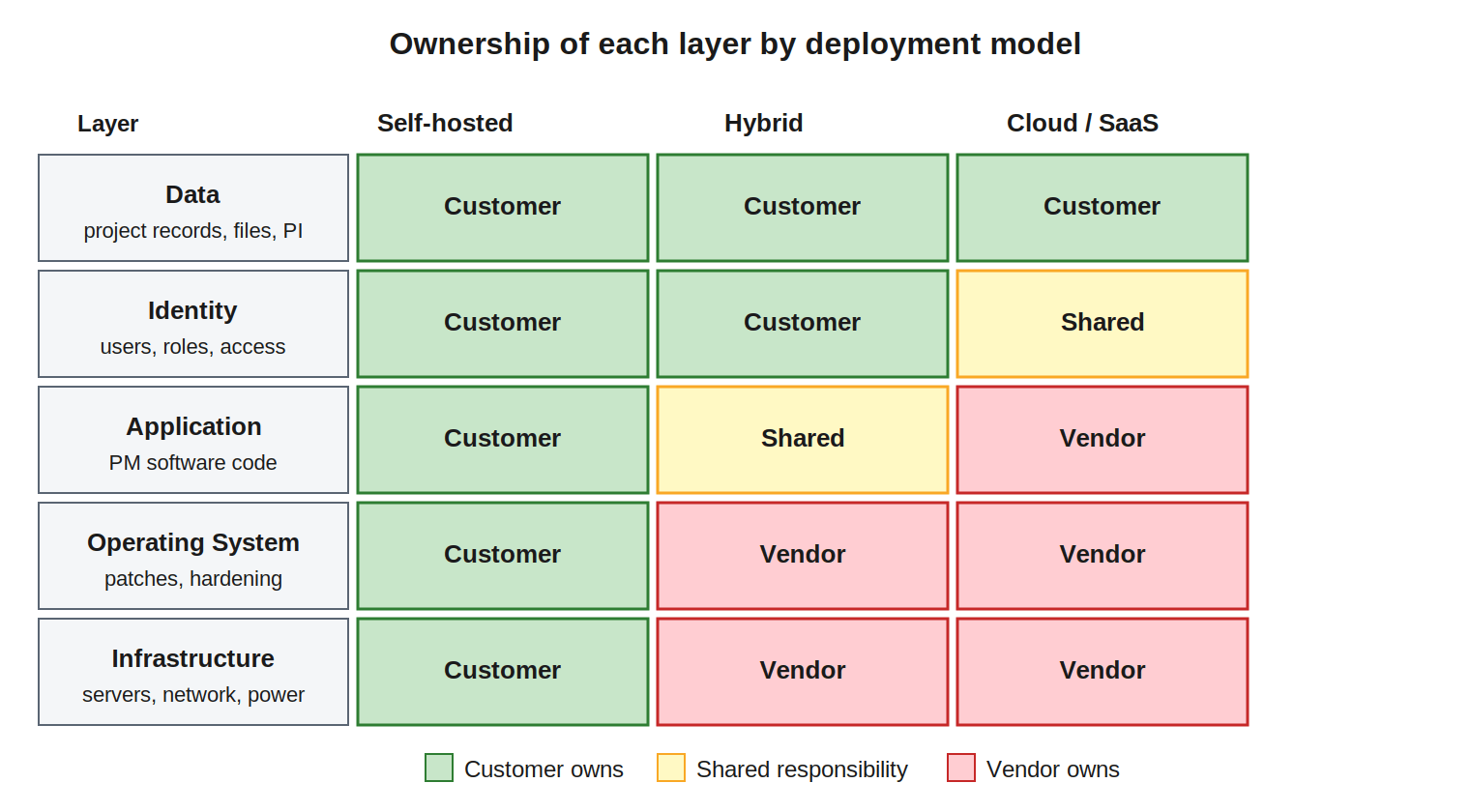
The NIST Special Publication 800-145 establishes the formal definitions used in most international procurement frameworks. Self-hosted, also called on-premise or private deployment, places all five layers under customer control, with the vendor providing licensed software and support but no operational responsibility. Cloud SaaS delegates infrastructure through application to the vendor, exposing the customer to vendor jurisdictional risk, dependency on vendor security practices, and limited customisation. Hybrid sits between the two and takes several forms in practice — most commonly a self-hosted core with cloud-based collaboration features, or self-hosted data with cloud-hosted application, or a primary self-hosted instance with cloud-based disaster recovery.
The terminology distinction between “cloud” and “SaaS” is often blurred in vendor marketing but matters legally. Cloud can mean any of three service models — Infrastructure as a Service (IaaS), Platform as a Service (PaaS), or Software as a Service (SaaS) — each with different ownership boundaries. For project management software the dominant offering is SaaS, where the vendor handles everything except identity and data. A self-hosted product running on customer-leased cloud infrastructure (for example, Kendo Manager deployed to an AWS instance owned and managed by the customer) is technically a private cloud or IaaS deployment, not SaaS, and carries different POPIA implications than vendor-hosted SaaS.
Why does data sovereignty matter for South African organizations in 2026?
Data sovereignty matters for South African organizations because POPIA places jurisdictional responsibility on the data controller regardless of where processing occurs, while foreign jurisdictions such as the United States and China assert reach over data held by their domiciled providers under laws including the US CLOUD Act and the PRC Data Security Law. An organization that places personal information on a vendor’s foreign infrastructure remains liable under POPIA while simultaneously exposing the data to the legal reach of the vendor’s home jurisdiction.
The 2020 Court of Justice of the European Union decision in Schrems II invalidated the EU-US Privacy Shield framework on the basis that US surveillance laws prevented adequate protection of EU personal data on US-domiciled providers. While South Africa is not bound by Schrems II, the underlying logic applies under POPIA Section 72: the receiving jurisdiction must offer protection substantially similar to South African law, and the Information Regulator has not issued an adequacy list to simplify this assessment.
Three operational realities follow from this position:
- An accountable Information Officer cannot transfer accountability to a foreign vendor’s compliance team. Section 56 of POPIA designates the Information Officer as the legally accountable person, with non-delegable obligations under the eight conditions for lawful processing.
- Standard Contractual Clauses are available but limited. The Information Regulator’s 2024 guidance allows contractual safeguards as one route to lawful cross-border transfer, but the contract cannot override the foreign jurisdiction’s legal demands on the vendor.
- Sub-processor risk compounds. A SaaS vendor based in South Africa may itself use cloud infrastructure from a US-domiciled hyperscaler, creating onward transfer that the South African customer may not be aware of and that requires its own POPIA assessment.
For organizations holding large volumes of personal information — including beneficiary records, employee performance data, customer credit information, or patient health records — self-hosted deployment eliminates cross-border analysis entirely because the data remains within South African borders and under South African legal authority. This advantage shrinks as data volumes and sensitivity decline, which is why blanket recommendations against cloud deployment are over-stated for many organizations.
How does POPIA Section 72 affect cross-border data transfer in cloud project management tools?
POPIA Section 72 prohibits transfer of personal information outside South Africa unless one of five conditions applies: the recipient is subject to a law providing substantially similar protection, the data subject consents to the transfer, the transfer is necessary for performance of a contract with the data subject, the transfer is for the benefit of the data subject and consent is impractical to obtain, or the responsible party has secured adequate contractual safeguards. Cloud project management vendors hosting data outside South Africa rely most often on the first or fifth condition, requiring documented assessment by the customer’s Information Officer.
The first condition — substantially similar law — is satisfied for jurisdictions with comprehensive data protection regimes such as the European Union, the United Kingdom, Switzerland, Canada, and most of Latin America. The United States position is contested: federal law lacks a general data protection statute, and the Information Regulator has not issued a definitive ruling on US adequacy. Organizations transferring to US-hosted cloud must rely on contractual safeguards or data subject consent rather than the adequacy route.
The fifth condition — adequate contractual safeguards — typically takes the form of a Data Processing Agreement modelled on the European Standard Contractual Clauses, adapted for POPIA terminology. The minimum content under Information Regulator 2024 guidance includes:
- Confirmation that the foreign processor will apply POPIA’s eight conditions for lawful processing
- Sub-processor disclosure and customer right to object
- Audit rights, including the right to inspect the processor’s compliance posture
- Breach notification commitment within 72 hours, aligned with Section 22
- Data return or destruction provisions on contract termination
- Co-operation with the Information Regulator on enquiries and investigations
Verification of vendor data centre location is a practical step often overlooked. AWS Cape Town (af-south-1) and Azure South Africa North (Johannesburg) provide South African residency, but vendors marketing as “African” or “South African” may operate at the application layer locally while storing data in Frankfurt, Dublin, or Northern Virginia. The procurement file should record the specific data centre, the legal entity operating it, and the contractual commitment to data localisation.
POPIA enforcement actions through 2025 confirm the Information Regulator treats cross-border transfer as a high-priority enforcement area. Of the ZAR 12 million in fines issued between July 2023 and March 2026, 78% involved inadequate access controls or undisclosed cross-border transfer on cloud platforms — typically discovered during breach investigations rather than proactive audits.
What is the 5-year total cost of ownership comparison between deployment models?
The 5-year total cost of ownership comparison shows self-hosted higher in year 1 due to capital outlay, then lower in years 2-5 due to absence of recurring subscription, while cloud SaaS shows lower year 1 cost but escalating cumulative cost driven by per-user pricing, annual price increases, and rand depreciation against the vendor’s billing currency. The break-even point typically occurs between year 2 and year 3 for organizations of 50 or more users.
| Cost category (250-user organization, ZAR thousands) | Self-hosted | Cloud SaaS | Hybrid |
|---|---|---|---|
| Software licence (5 years) | 450 | 1,950 | 980 |
| Server hardware (year 1, refresh year 4) | 280 | 0 | 180 |
| UPS and backup infrastructure | 95 | 0 | 65 |
| Implementation and integration | 220 | 140 | 280 |
| Internal IT operations (5 years) | 560 | 120 | 380 |
| Training and change management | 85 | 85 | 95 |
| Rand depreciation factor (USD-billed) | 45 | 320 | 175 |
| Exit cost (migration, data export) | 25 | 180 | 110 |
| 5-year total (ZAR thousands) | 1,760 | 2,795 | 2,265 |
hree cost categories systematically favour self-hosted as the organization grows beyond 100 users. Software licence cost in SaaS scales linearly with seat count and typically escalates 8-12% annually under contract; perpetual self-hosted licences include a once-off licence and a 15-22% annual support fee that scales more slowly. Rand depreciation against USD averaged 6.4% per year between 2020 and 2025 according to South African Reserve Bank data, compounding USD-billed SaaS costs by approximately 36% over five years.
Two categories favour cloud SaaS. Internal IT operations cost is materially higher for self-hosted because the customer absorbs server administration, patching, backup, and incident response. Implementation cost is lower for SaaS because vendor infrastructure is already provisioned and standard integrations are pre-built.
The hybrid model TCO sits between the two extremes and is sensitive to the boundary chosen. Self-hosted core with cloud-based notifications and external collaboration produces TCO close to self-hosted. Cloud core with self-hosted data layer produces TCO close to SaaS plus self-hosted infrastructure cost.
Three factors are routinely under-modelled and warrant explicit attention:
- Exit cost is often invisible until contract termination. SaaS data export charges, format conversion, and historical record retention can absorb several months of subscription fees.
- Bandwidth cost for cloud deployment scales with usage and is rarely captured in initial TCO estimates. Heavy document workflows can add 5-15% to total cloud cost.
- Compliance audit cost rises with cloud deployment because each external auditor engagement requires vendor co-operation, which is contractually limited and may attract additional fees.
How do load shedding and connectivity constraints affect deployment choice?
Load shedding and connectivity constraints affect deployment choice because cloud-based project management software depends on continuous internet connectivity to vendor infrastructure, while self-hosted software on UPS-backed local servers operates independently of external network availability. NERSA’s 2025 annual performance report recorded an average national load shedding intensity of Stage 3.2 across the year, with extended Stage 5-6 windows during winter demand peaks in 2026.
The operational impact depends on what users are trying to do. Read-only document access continues on cached cloud data even during outages. Real-time collaboration, search across project history, dashboard updates, and integration synchronisation all fail during cloud outage windows. Self-hosted systems on UPS supply maintain full functionality through outage windows, with mobile clients reconnecting and synchronising when individual devices come back online.
Three architectural patterns respond to the load shedding reality:
- Full on-premise — server in customer data centre on dedicated UPS and generator backup, no internet dependency for core functions. Highest resilience, requires IT capacity.
- Hybrid with local primary — primary self-hosted instance with optional sync to a cloud secondary for inter-site coordination. Internet-tolerant rather than internet-dependent.
- Cloud with offline-capable client — SaaS primary with desktop or mobile clients that queue updates during outages. Resilience depends on cache scope, which is typically limited to recently-accessed records.
For organizations in Gauteng, Western Cape, and KwaZulu-Natal metro zones with reliable fibre connectivity and Stage 2-3 average load shedding, cloud SaaS with a competent offline client provides adequate continuity. For organizations operating in non-metro grids — including Eastern Cape, Limpopo, Mpumalanga, and Northern Cape — where Stage 4-6 events are routine and ISP failover is unreliable, self-hosted or hybrid deployment provides materially better continuity.
Which South African sectors require self-hosted deployment by regulation or practice?
Seven South African sectors apply regulatory or practical pressure toward self-hosted deployment for systems holding sensitive data: financial services, healthcare, government and state-owned entities, mining, legal practice, defence and security, and intelligence-related research. The regulatory pressure ranges from explicit on-premise requirements to risk-based guidance that effectively excludes foreign cloud providers.
Financial services sit under the Financial Sector Conduct Authority and the South African Reserve Bank Prudential Authority. SARB Joint Standard 2 on IT governance, effective from June 2024, requires regulated financial institutions to demonstrate documented control over data residency, sub-processor chains, and breach response capability. The FSCA Cybersecurity Notice 2024 sets similar expectations for non-banking financial institutions. While neither instrument explicitly mandates self-hosted deployment, the documentation burden for compliant cloud deployment is sufficient that most regulated financial institutions elect self-hosted or hybrid models.
Healthcare data is governed by the National Health Act, POPIA’s special personal information provisions for health records, and the Health Professions Council of South Africa rules of professional conduct. Patient information under HPCSA Booklet 12 must be stored in a manner that allows the practitioner to demonstrate control over access. SaaS deployment with US-domiciled providers creates documentation difficulties that practical healthcare IT increasingly resolves through self-hosted or South African cloud deployment.
Government and state-owned entities fall under the State Information Technology Agency Act 88 of 1998, which establishes SITA as the preferred ICT procurement channel for government bodies. SITA transversal contracts increasingly favour solutions deployable on government infrastructure. The National Treasury Cybersecurity Strategy 2024 reinforces this orientation through specific guidance on data residency for state systems. Municipalities operate under an additional layer of compliance covered in our dedicated guide to municipal project management software, LED tracking, and MFMA reporting.
Mining operations under the Mine Health and Safety Act and the Mineral and Petroleum Resources Development Act process worker biometric data, contractor records, and operational data that intersect POPIA, environmental compliance, and security obligations. The Minerals Council South Africa Cybersecurity Guidance 2025 recommends self-hosted or private cloud deployment for systems holding mining production and worker health data, particularly for operations in conflict-sensitive jurisdictions.
Legal practice under the Legal Practice Act 28 of 2014 and Legal Practice Council Rules requires lawyers to maintain client confidentiality with documented care. The LPC has not issued an explicit cloud prohibition, but several large firms have policies requiring self-hosted or private cloud for matter management systems holding privileged client information, particularly for litigation matters involving foreign parties.
Defence, security, and intelligence-related research are governed by the National Strategic Intelligence Act and Protection of Information Act, with practical effect of excluding foreign cloud providers from any system touching restricted information.
Three sectors do not face equivalent pressure: education at most levels, non-regulated retail and hospitality, and small to mid-size NGOs not handling sensitive beneficiary data. Cloud SaaS is generally appropriate for these contexts, with verification of South African data centre location remaining a reasonable precaution.
For NGO-specific deployment considerations including donor funding cycles and POPIA beneficiary protection, see our guide to project management software for South African NGOs.
What are the security responsibilities under each deployment model?
Security responsibilities under each deployment model follow a shared responsibility framework in which the customer remains accountable under POPIA Section 19 regardless of which party performs the technical work. This distinction between accountability and operation is the most consistently misunderstood aspect of cloud security and the source of most enforcement findings against South African organizations relying on cloud providers.
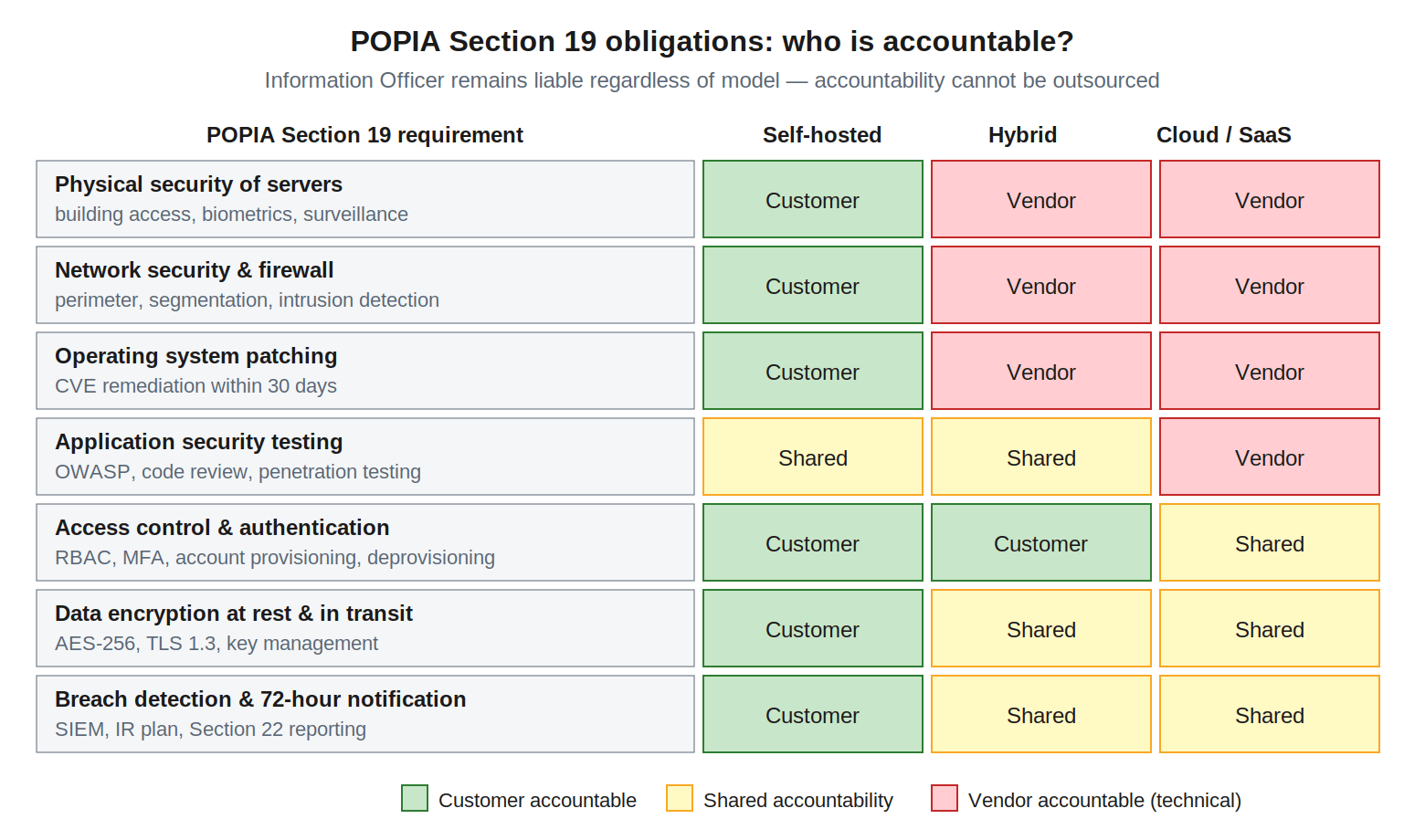
Figure 3: POPIA Section 19 security control accountability across deployment models. The Information Officer remains legally accountable for all controls regardless of who performs the technical work.
The Information Regulator’s 2024 enforcement actions establish a clear pattern: even where the vendor was technically responsible for a failed control, the customer organization received the enforcement notice and the administrative fine. The 2025 finding against a major medical scheme — ZAR 3.2 million administrative fine for inadequate access control on a foreign-hosted member portal — turned on the principle that the responsible party cannot delegate accountability through outsourcing.
Three security control areas warrant specific attention when comparing deployment models:
- Access control under POPIA Section 19(1)(a) remains the customer’s responsibility in all models because user provisioning, role assignment, and deprovisioning are inherently business decisions. Cloud platforms can technically enforce policies but cannot decide who should have access.
- Encryption key management divides differently in each model. Self-hosted gives the customer full key custody. Cloud SaaS typically offers customer-managed keys only at enterprise tiers, with default keys held by the vendor. Hybrid models can preserve customer key custody for the most sensitive data.
- Breach detection and 72-hour notification under Section 22 requires monitoring across the full stack. In cloud deployment the customer depends on the vendor’s detection capability and notification commitment, which is contractually limited. In self-hosted deployment the customer controls the SIEM and incident response timing.
ISO/IEC 27001:2022 certification by the vendor provides assurance over the vendor’s controls but does not transfer accountability to the vendor. SOC 2 Type II reports are operational evidence of vendor controls but require the customer’s auditor to map them to POPIA requirements, which typically requires additional documentation in the procurement file.
How should organizations evaluate self-hosted vs cloud for their specific context?
Organizations should evaluate self-hosted vs cloud through a structured 5-question framework that weighs regulatory exposure, data sensitivity, internal IT capacity, infrastructure reality, and planning horizon. The framework produces one of four outcomes ranging from clear self-hosted through hybrid to clear cloud, with the answer driven by the organization’s specific risk profile rather than vendor marketing.
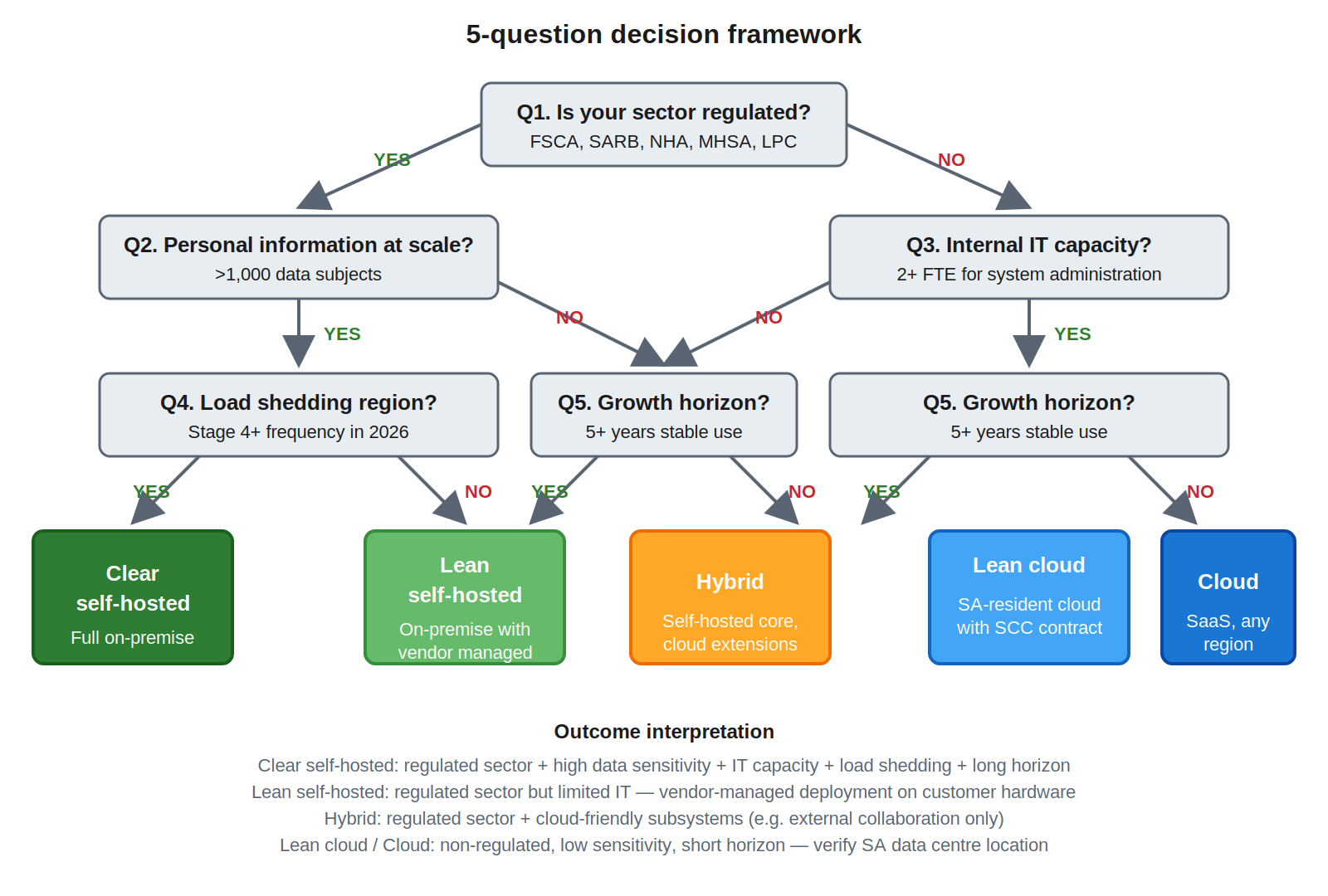
figure 4: 5-question decision framework for selecting between self-hosted, hybrid, and cloud deployment models in the South African context.
The five questions are designed to surface specific operational facts rather than preferences:
- Question 1: Is your sector regulated? Financial services under FSCA or SARB, healthcare under NHA and HPCSA, mining under MHSA, legal practice under LPC, and government under SITA all create documentation burden for cloud deployment that materially favours self-hosted unless other factors override.
- Question 2: Personal information at scale? Organizations processing personal information of more than 1,000 data subjects face higher POPIA exposure and gain proportionally more from data localisation. Below this threshold, the enforcement profile is lower.
- Question 3: Internal IT capacity? Self-hosted deployment requires at least 2 full-time equivalent personnel for system administration over the contract term, with related skills in backup, security monitoring, and incident response. Organizations without this capacity must either build it, procure managed services, or choose cloud.
- Question 4: Load shedding region? Organizations in zones experiencing Stage 4+ load shedding more than 100 days per year benefit materially from self-hosted operation through outages. Organizations in zones with reliable power and connectivity face less differentiation on this dimension.
- Question 5: Growth horizon? Stable organizations with 5+ year planning horizons amortise self-hosted capital cost effectively. High-growth organizations with rapid scale changes benefit from cloud elasticity, accepting the TCO penalty.
Four outcome categories emerge:
- Clear self-hosted for regulated organizations with high data sensitivity, adequate IT capacity, exposure to load shedding, and long planning horizons. Typical: financial institutions, healthcare providers, government departments, mining operators, large law firms.
- Lean self-hosted for regulated organizations with limited IT capacity, addressed through vendor-managed deployment on customer-owned infrastructure. Typical: mid-size hospitals, regional government, mid-tier law firms.
- Hybrid for regulated organizations with cloud-friendly subsystems alongside sensitive core operations. Typical: financial institutions using cloud collaboration with self-hosted core systems, NGOs with sensitive beneficiary data but cloud-based external partner portals.
- Lean cloud or cloud for non-regulated organizations with limited personal information, short planning horizons, or distributed teams without central infrastructure. Typical: small to mid-size technology companies, consulting firms, retail and hospitality, education at most levels.
The framework deliberately avoids treating self-hosted as universally preferable. Cloud SaaS with verified South African data residency and adequate Standard Contractual Clauses is appropriate for many organizations and represents the lower-friction option for those whose risk profile permits it. The cost of getting the deployment choice wrong — either over-investing in unnecessary infrastructure or under-protecting sensitive data — is high in both directions, making the structured assessment worth the procurement time it absorbs.
Frequently asked questions
Can South African organizations legally use overseas cloud project management software?
South African organizations can legally use overseas cloud project management software provided POPIA Section 72 is satisfied through one of five mechanisms: adequacy of the destination jurisdiction, data subject consent, contract necessity, data subject benefit, or adequate contractual safeguards. The Information Officer must document the assessment and the contract should include Standard Contractual Clauses adapted for POPIA.
What is a Standard Contractual Clause for POPIA-compliant cloud deployment?
A Standard Contractual Clause is a contractual safeguard between the South African data controller and a foreign data processor that commits the processor to apply POPIA’s eight conditions for lawful processing, allow audit rights, disclose sub-processors, notify breaches within 72 hours, and co-operate with the Information Regulator. The Information Regulator’s 2024 guidance provides minimum content requirements.
Does the South African Reserve Bank require self-hosted deployment for project management systems?
The South African Reserve Bank does not explicitly require self-hosted deployment but applies SARB Joint Standard 2 on IT governance to regulated financial institutions, which requires documented control over data residency, sub-processor chains, and incident response. Many institutions interpret these requirements as favouring self-hosted or hybrid deployment over foreign cloud providers.
How does the cost of self-hosted project management software change after year 5?
The cost of self-hosted project management software typically reaches a hardware refresh cycle in year 4-5 with capital expenditure equivalent to 50-70% of the original infrastructure cost. Annual support fees continue at 15-22% of the original licence cost. Cloud SaaS continues escalating at 8-12% annual price increases plus rand depreciation against vendor billing currency.
What is the difference between cloud and SaaS project management software?
Cloud is a delivery model that includes three service types: Infrastructure as a Service, Platform as a Service, and Software as a Service. SaaS specifically refers to vendor-hosted, vendor-operated software accessed through the browser. Self-hosted software running on customer-leased cloud infrastructure is private cloud or IaaS, not SaaS, and carries different POPIA implications than vendor-hosted SaaS.
Can a hybrid deployment combine self-hosted and cloud project management features?
A hybrid deployment can combine self-hosted core systems with cloud-based features such as external partner collaboration, mobile notifications, or disaster recovery. The boundary placement matters for POPIA compliance: sensitive personal information should remain on self-hosted infrastructure while non-sensitive collaboration and metadata can operate in cloud.
Are all data centres in South Africa POPIA-compliant by default?
Data centres in South Africa are not automatically POPIA-compliant. POPIA compliance is a function of the controls applied to personal information, not the geographic location of the infrastructure. South African data centres including Teraco, Vantage Data Centers, and Africa Data Centres provide compliant physical and infrastructure layers, but application and data layer compliance remains the responsibility of the controller.
Does AWS Cape Town or Azure South Africa North make cloud project management software POPIA-compliant?
AWS Cape Town and Azure South Africa North provide South African data residency at the infrastructure layer, which satisfies POPIA Section 72 location requirements. They do not automatically make the application POPIA-compliant. The customer remains accountable for access control, encryption configuration, breach response, and the eight conditions for lawful processing applied to the data stored on the infrastructure.
South African organizations evaluating project management software in 2026 face a deployment decision shaped by tighter POPIA enforcement, rand depreciation against vendor billing currencies, and operational reality of Stage 4-6 load shedding. Self-hosted deployment offers data sovereignty, predictable long-term cost, and continuity through power outages, at the price of internal IT capacity requirements and higher year 1 investment. Cloud SaaS offers operational simplicity, elastic scale, and lower entry cost, at the price of jurisdictional risk and escalating subscription cost. Hybrid models give organizations the flexibility to place each workload according to its specific risk profile rather than applying a single architecture across all data. The 5-question framework above produces a defensible recommendation grounded in the organization’s regulatory exposure, data sensitivity, IT capacity, infrastructure reality, and planning horizon — converting deployment selection from a vendor-driven discussion into a structured procurement decision.

