
Project Management Software for South African NGOs in 2026: NPO Act Compliance, Donor Reporting, and 8 Vendor Evaluation Criteria
The Department of Social Development’s NPO Directorate registered 268,000 non-profit organizations in South Africa as of March 2026, with approximately 41,000 active NGOs receiving donor funding from sources including USAID, the European Union, GIZ, the Global Fund, PEPFAR, the Bill & Melinda Gates Foundation, the Ford Foundation, and SA corporate funders, processing project records on personal information of beneficiaries protected under POPIA. The 2025 South African NGO Sustainability Index recorded that 67% of medium and large NGOs operate project management workflows through spreadsheets and email, with only 23% using dedicated project management software, producing systematic risk against donor reporting requirements and POPIA Section 19 safeguards.
NGO directors, programme managers, monitoring and evaluation officers, finance officers, and donor compliance staff selecting project management software in 2026 face overlapping requirements from the Nonprofit Organisations Act 71 of 1997, donor-specific reporting frameworks, POPIA beneficiary protection, BBBEE qualification for South African corporate funding, and operational realities including field-based programme delivery, Stage 4-6 load shedding, and constrained operating budgets that favour one-time acquisition over recurring subscription. This guide covers the NPO Act compliance baseline, 4 major donor reporting frameworks, POPIA beneficiary protection for special personal information, offline operation in field conditions, 3 funding scenarios for software acquisition, and 8 evaluation criteria for selecting fit-for-purpose project management software for South African NGOs.
For the complete strategic overview of project management software for South African organizations including compliance regimes, deployment models, and other sector use cases, see our pillar guide on project management software for South African organizations in 2026.
Why do South African NGOs need dedicated project management software?
South African NGOs need dedicated project management software because the sector’s combined scale, donor reporting expectations, and POPIA exposure exceed what spreadsheet and email workflows can sustain at programme scale. A typical mid-size NGO running three concurrent donor-funded programmes processes records on 800-3,000 beneficiaries, manages 4-12 staff and contractor roles, files quarterly narrative and financial reports against each donor’s results framework, and maintains an audit trail expected to survive both internal review and external donor evaluation conducted 12-36 months after project completion.
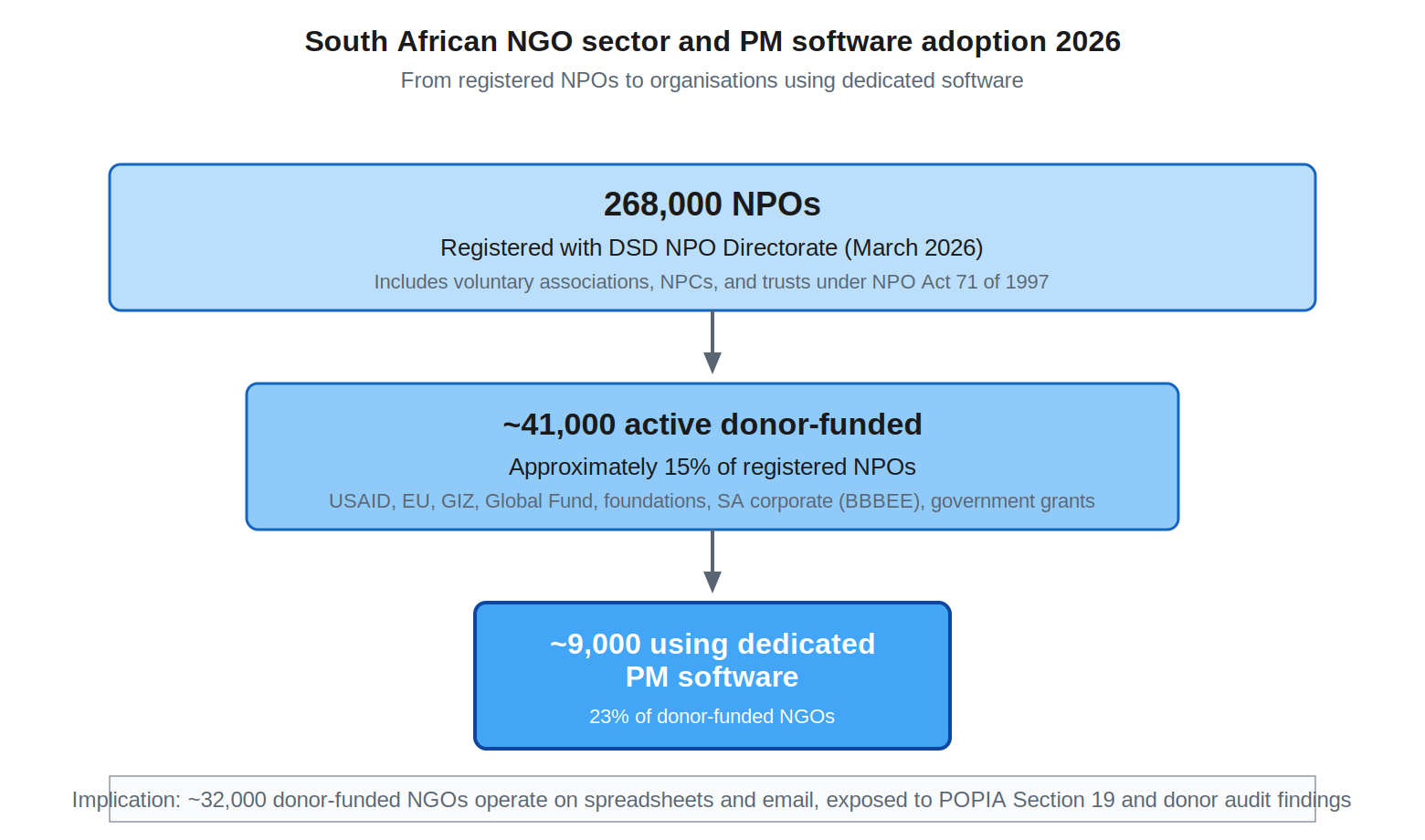
The adoption gap is consequential. Approximately 32,000 donor-funded NGOs operate without dedicated project management infrastructure, exposing themselves to three predictable failure modes: donor audit findings that result in cost disallowance and reduced renewal probability, POPIA enforcement when beneficiary data is mishandled in email threads or shared spreadsheets, and operational disruption when staff turnover or device failure eliminates institutional knowledge held only in personal files.
Three operational scenarios consistently expose the limits of spreadsheet workflows in South African NGO context:
- Multi-donor programmes with different reporting periods — a single NGO programme funded by USAID (quarterly reporting), the EU (six-monthly reporting), and an SA corporate donor (annual BBBEE-aligned reporting) generates three concurrent reporting timelines drawn from the same underlying data, with manual consolidation absorbing 15-25% of programme officer time when handled in spreadsheets.
- Field-based data collection — beneficiary registration, attendance, and outcome data captured in rural areas with intermittent connectivity requires offline capability with later synchronisation. Paper forms transferred to office spreadsheets introduce transcription error, lose audit trail, and complicate POPIA compliance for the inevitable lost or damaged forms.
- Staff transitions in contract-funded roles — programme officers funded through donor lines are commonly contracted to project duration, with handover periods of 1-2 weeks at most. Email-based institutional memory does not survive these transitions; dedicated software with role-based access does.
The economic argument for dedicated project management software in NGO context rests on three measurable savings: reduced staff time on report consolidation and data wrangling (typically 10-20% of M&E officer time), reduced audit and compliance risk costs (cost disallowance on a single USAID finding can exceed ZAR 500,000), and improved donor renewal probability (NGOs that demonstrate systematic project management measurably outperform peers in subsequent funding cycles per the 2025 NGO Sustainability Index).
What NPO Act compliance requirements affect project management systems?
The Nonprofit Organisations Act 71 of 1997 establishes the foundational compliance framework for South African NGOs, with project management systems supporting three obligations: registration maintenance with the NPO Directorate, annual narrative and financial reporting under Sections 17 and 18, and governance documentation that demonstrates compliance with the founding document and board duties. The Department of Social Development NPO Directorate’s 2024 compliance enforcement increased materially, with non-compliant deregistration of approximately 18,000 organizations between 2023 and 2025.
Three legal forms operate under the NPO Act with different documentation requirements:
- Voluntary Association — the simplest form, governed by constitution, with members and a governing body. Registration is voluntary but provides legal standing and donor eligibility. Most small community-based organizations (CBOs) take this form.
- Non-Profit Company (NPC) — incorporated under the Companies Act 71 of 2008 with Section 21 designation, providing limited liability and board accountability. Most medium and large NGOs take this form, particularly those handling significant donor funding or requiring contractual standing.
- Non-Profit Trust — established under the Trust Property Control Act, governed by trust deed and trustees. Less common but used for specific funding structures including endowed foundations.
Public Benefit Organisation (PBO) status under Section 30 of the Income Tax Act 58 of 1962 operates separately from NPO registration. PBO status enables Section 18A tax-deductible donor receipts, which materially affects domestic SA fundraising capacity. PBO compliance requires SARS Tax Exemption Unit registration, ongoing IT3(a) certificate issuance to donors, and annual income tax return submission. Project management software supporting PBO obligations must produce donor receipt records, track tax-deductible vs non-deductible income streams, and maintain evidence of public benefit activities aligned with the registered objects.
The NPO Act Section 17 narrative report requires annual submission to the NPO Directorate covering activities, beneficiaries served, governance changes, and material events. Section 18 financial reporting requires audited financial statements for organizations above the audit threshold and reviewed statements for smaller organizations. Both reports feed into the NPO Directorate’s public register, which donors increasingly consult before grant approval. Project management software that produces audit-ready narrative and financial data substantially reduces preparation effort and improves accuracy of statutory submissions.
What donor reporting frameworks apply to NGO project management software?
South African NGOs receiving international donor funding work within results frameworks that prescribe indicator structures, reporting frequencies, and audit requirements. The four largest donor frameworks affecting South African NGOs are USAID’s Automated Directives System, EU NEAR and INTPA frameworks, GIZ standards, and the Global Fund Performance Framework. Project management software supporting these frameworks must produce indicator-aligned outputs, maintain evidence linking individual beneficiary records to aggregate indicators, and demonstrate adherence to donor-specific cost principles.
| Donor framework | Results structure | Reporting frequency | Audit expectation |
|---|---|---|---|
| USAID | ADS 320 Performance Plan and Report, Standard Foreign Assistance Indicators | Quarterly progress, annual report, end of project | 2 CFR 200 cost principles, OIG audits, NICRA negotiation |
| EU NEAR / INTPA | Logical Framework Matrix, Results-Oriented Monitoring, EU global indicators | Six-monthly progress, annual interim, final report | EU Financial Regulation, ROM mission reviews, court of auditors |
| GIZ | Capacity WORKS framework, results model, OECD DAC indicators | Annual progress, mid-term review, final evaluation | BMZ guidelines, external evaluation, German federal audit |
| Global Fund / PEPFAR | Performance Framework, modular indicators, MER 2.0 (PEPFAR) | Monthly site data, quarterly PR, semi-annual progress | Local Fund Agent verification, OIG audits, site visits |
| SA corporate (BBBEE) | Socio-Economic Development indicators, SED scorecard alignment | Annual SED report, BBBEE verification | BBBEE Verification Agency audit, SARS Section 18A audit |
Three cross-cutting reporting requirements appear across multiple donor frameworks and warrant specific software support:
- Disaggregated indicators by sex, age, and disability status — required by USAID, EU, GIZ, and most foundation donors. Software must capture disaggregation at beneficiary registration and aggregate accurately for reporting, with audit trail linking aggregate figures to individual records.
- Cost-share and matching fund tracking — USAID and EU agreements often require documented cost-share or matching contributions from the recipient organization. Software must distinguish project-funded costs from organization-contributed costs at transaction level.
- Sub-grantee reporting consolidation — primary recipients of donor funding frequently sub-grant to smaller organizations and must consolidate sub-grantee data into primary reports. Software supporting this requires multi-tenant or hierarchy-aware data architecture rarely available in generic project management tools.
Donor reporting requirements interact with POPIA in ways that affect software design. Beneficiary disaggregation typically requires processing of special personal information under POPIA Section 26 (disability status, sometimes gender identity), triggering enhanced consent and safeguard requirements. Cross-border data transfer to donor systems requires Section 72 compliance unless the donor operates under adequacy or contractual safeguards. These intersections are covered comprehensively in our guide on POPIA-compliant project management software, Section 19 safeguards, and Information Officer duties.
How does POPIA apply to NGO beneficiary data?
POPIA applies to NGO beneficiary data with heightened protection requirements because much beneficiary information falls under Section 26 special personal information (health status, sex life, biometric information) or Section 34 children’s information, both requiring stricter lawful basis and security safeguards than ordinary personal information. NGOs frequently process exactly these categories — patient information in health programmes, learner records in education programmes, child protection case files, gender-based violence survivor records — placing them at the highest end of POPIA exposure.
Section 27 provides limited exemptions from Section 26’s general prohibition on processing special personal information. The exemptions most relevant to NGO operations include processing necessary for medical treatment, with appropriate confidentiality safeguards; processing in compliance with international public law obligations; processing necessary for fulfilling public interest functions where adequate safeguards exist; and processing with the data subject’s express consent. Each exemption requires documented assessment recorded against the specific data subject category and processing activity.
Section 34 children’s personal information rules apply to anyone under 18 years of age and require express consent from a competent person (parent or legal guardian). NGO programmes serving young people — youth development, school-based interventions, child protection, foster care, HIV/AIDS programmes with adolescent components — must document this consent with sufficient detail to demonstrate informed agreement to specific processing activities. Verbal consent in field conditions, while practically common, requires careful documentation in the project management system to satisfy POPIA’s evidentiary standard.
Three operational implications follow from POPIA’s heightened protection of vulnerable beneficiary data:
- Consent records must travel with data — when a beneficiary’s records are accessed for reporting, the consent record proving lawful basis must be inspectable in the same workflow. Software that stores consent records separately from the data they authorise creates audit difficulty.
- Field-collected consent requires synchronisation — beneficiary consent captured on a mobile device during field registration must synchronise to the central system with audit-resistant timestamping. Reconstruction of consent dates after the fact is treated as a Section 19 failure by the Information Regulator.
- Aggregation does not eliminate POPIA scope — donor reports typically present aggregated figures, but the underlying beneficiary records that produce those figures remain personal information under POPIA. Software must demonstrate that aggregation occurs without exposing source records to unauthorised access.
NGO Information Officer accountability follows the same Section 56 framework as other organizations: the head of the organization is the Information Officer by default, with Deputy Information Officers designated for operational segments. For small NGOs, this means the executive director carries POPIA accountability personally. Vendor accountability cannot substitute — even when the project management software is operated by a foreign cloud provider, the NGO remains the responsible party under POPIA. The Information Regulator’s 2025 enforcement actions against three foundation-funded NGOs confirmed this principle, with penalties ranging from ZAR 280,000 to ZAR 1.4 million per organization for inadequate beneficiary data protection.
What field operation requirements affect NGO project management software?
Field operation requirements for NGO project management software include offline data capture in rural areas with intermittent connectivity, mobile synchronisation when devices reconnect, multi-language support for beneficiary registration in 11 official South African languages, low-bandwidth optimisation for cellular operation, and increasingly biometric or photo-based beneficiary verification for fraud prevention in cash transfer and food security programmes. These requirements substantially narrow the field of suitable software because most generic project management tools optimised for office-based use fail in field conditions.
Stats SA’s 2025 ICT Access and Use Survey recorded that 41% of South African households in non-metro areas have unreliable or absent fixed internet connectivity, with mobile data as the primary access method. Programme delivery in rural Eastern Cape, KwaZulu-Natal, Limpopo, and Mpumalanga routinely operates outside reliable network coverage, requiring software that captures data locally and synchronises later. Software that requires continuous connectivity for basic data entry forces field officers to either skip immediate capture (introducing transcription error later) or carry connectivity equipment that may not function in remote locations.
Three field operation patterns appear in NGO software requirements:
- Mobile-first beneficiary registration — programme intake captured on tablet or phone at the point of contact, with offline-capable forms supporting complex data including consent, demographic details, household composition, and initial assessment scores.
- Periodic synchronisation patterns — devices synchronise when they reach connectivity zones (typically at end of day at a field office or community hub), with conflict resolution for cases where multiple devices have updated the same record.
- Multi-modal verification — beneficiary identity verification combining identity number lookup, photo capture, and increasingly biometric scanning to prevent duplicate registration and fraud, while maintaining POPIA Section 26 safeguards on biometric data.
Load shedding affects NGO field operations less than office operations because field devices typically operate on battery during data collection, with synchronisation occurring when battery is recharged at offices with UPS backup or generators. However, central office synchronisation servers that go offline during load shedding can backlog field data and create reporting delays. Self-hosted deployment on local UPS-backed infrastructure addresses this constraint better than cloud-based systems dependent on external connectivity.
EPWP (Expanded Public Works Programme) and CWP (Community Work Programme) participating NGOs face additional integration requirements with government reporting systems. The Department of Public Works and Infrastructure provides EPWP reporting templates that must align with NGO project management data, particularly for work-opportunity creation, training delivery, and wage payment records. Software that produces EPWP-aligned outputs natively reduces parallel data entry effort.
How should NGOs fund project management software acquisition?
South African NGOs fund project management software through three primary mechanisms matched to organization size, donor relationship, and operational strategy: reserves-funded acquisition treating software as a 5-year capacity-building asset, donor-funded acquisition as a project line item with indirect cost recovery, and pro bono or discounted acquisition through NGO vendor programmes including TechSoup South Africa and major vendor NGO tiers. Each path carries trade-offs that affect long-term sustainability of the investment.
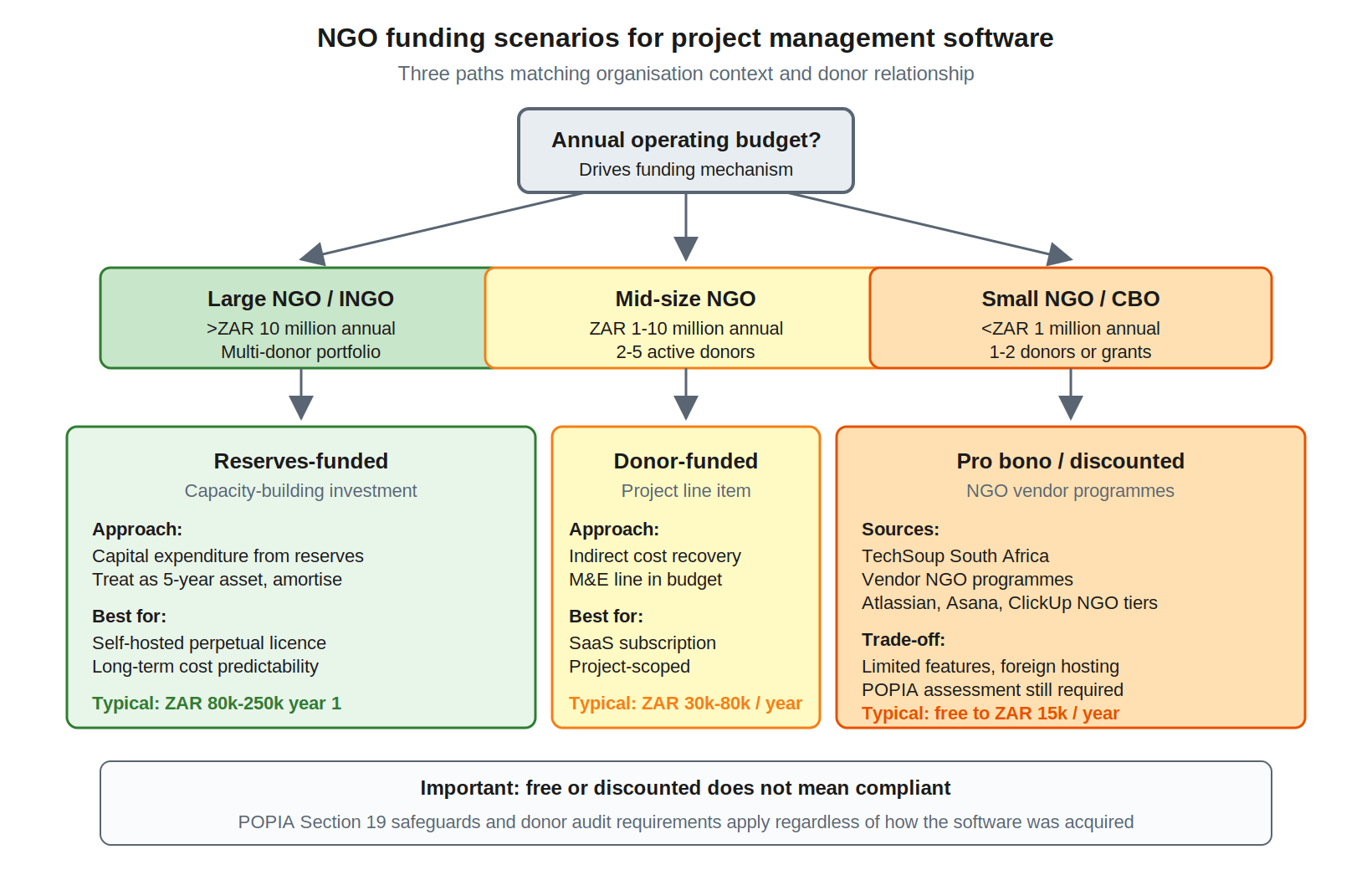
Reserves-funded acquisition treats project management software as a capacity-building investment from the organization’s reserves, typically structured as a 5-year amortised asset. This path suits large NGOs and INGOs with reserves above ZAR 10 million annual budget, multi-donor portfolios where software costs cannot be cleanly attributed to a single project, and long-term programme horizons that justify capital investment. Self-hosted perpetual licence purchases fit this funding model cleanly because the one-time cost matches the capital expenditure framing.
Donor-funded acquisition through project line items distributes software cost across funded projects, typically as monitoring and evaluation line items or indirect cost recovery. USAID accepts indirect cost recovery through Negotiated Indirect Cost Rate Agreements (NICRA) that can cover software costs as part of overheads. EU and GIZ accept similar arrangements with documented allocation methodologies. SA corporate donors typically accept software costs as direct M&E line items in approved budgets. This path suits mid-size NGOs with stable donor portfolios and works particularly well for SaaS subscription models where annual cost matches funding cycles, though it creates risk of service interruption when donor projects end.
Pro bono or discounted acquisition through NGO vendor programmes provides access to enterprise software at zero or substantially reduced cost for qualifying non-profit organizations. TechSoup South Africa provides validation and access to vendor programmes from Microsoft (Office 365 for Non-profits), Adobe, Atlassian (Jira Service Management, Confluence), and others. Direct vendor NGO programmes include Asana for Nonprofits (50% discount), ClickUp for Nonprofits (discount on paid plans), and several specialised PM tools. This path suits small NGOs and CBOs below ZAR 1 million annual budget, with the explicit trade-off that discounted access typically applies to cloud SaaS deployment hosted internationally, requiring POPIA Section 72 assessment by the recipient organization.
Three implementation considerations apply regardless of funding path:
- POPIA assessment applies equally — free or discounted access does not exempt the NGO from POPIA Section 19 safeguards documentation or Section 72 cross-border transfer assessment. The Information Officer responsibility persists regardless of how the software was acquired.
- Donor cost principles vary — USAID’s 2 CFR 200 cost principles, EU Financial Regulation, and GIZ guidelines each treat software costs differently. Organizations with multiple donors must confirm that software costs can be allocated lawfully across funding sources.
- Sustainability beyond initial funding — software acquired through a specific project must be sustainable beyond project end. Self-hosted perpetual licences continue operating; SaaS subscriptions require continued payment from a different source. The organization’s 3-year strategic plan should explicitly address software sustainability beyond initial donor cycles.
Why does self-hosted deployment fit South African NGO contexts?
Self-hosted deployment fits many South African NGO contexts because the one-time acquisition cost matches reserves-funded capacity investment more cleanly than recurring SaaS subscriptions match unpredictable donor cycles, POPIA jurisdictional control eliminates cross-border transfer assessment burden for beneficiary data, multi-donor data segregation is technically simpler on customer-controlled infrastructure, and load shedding resilience supports field synchronisation patterns. However, the choice is context-dependent — small NGOs with limited IT capacity and cloud-friendly programme designs may legitimately prefer SaaS deployment.
Three structural advantages favour self-hosted deployment for NGO contexts:
- Funding-cycle independence — self-hosted perpetual licences continue operating without recurring payment, decoupling software availability from donor project cycles. An NGO that loses a major donor in year 3 of a 5-year licence retains full software access while seeking replacement funding, avoiding service disruption during the most vulnerable organizational period.
- Multi-donor data segregation — programme data from different donors must remain logically separable for audit, with each donor able to access only the records relating to their funded activities. Self-hosted deployment provides clear data residency and access control within the NGO’s infrastructure boundary.
- Beneficiary data protection — sensitive beneficiary records, particularly health and child protection data, gain meaningful protection from foreign jurisdictional reach when hosted on South African infrastructure under POPIA jurisdiction. This consideration applies more strongly to NGOs working in politically sensitive areas or with donor relationships that may attract attention.
For comprehensive comparison of self-hosted versus cloud deployment including TCO analysis, security responsibility allocation, and decision framework, see our guide on Self-Hosted vs Cloud Project Management Software in 2026: Data Sovereignty, Total Cost of Ownership, and POPIA Implications for South African Organizations.
Two patterns argue against self-hosted deployment for specific NGO contexts. Small NGOs without internal IT capacity face a real operational gap that vendor-managed cloud services fill more effectively than attempting to manage self-hosted infrastructure with limited expertise. Programmes serving exclusively cloud-native populations (urban professional advocacy work, university-based research projects, international networks coordinating remote work) gain less from self-hosted offline capability and more from cloud collaboration features.
Which 8 evaluation criteria identify project management software for South African NGOs?
Eight evaluation criteria identify project management software fit for South African NGO context when applied as a procurement scorecard. These criteria reflect the actual operational and compliance pressures NGO programme managers face and weight differently than generic non-profit software evaluation rubrics that often originate in North American or European contexts.
| Criterion | Weight | Pass evidence required |
|---|---|---|
| 1. Donor reporting outputs | 18% | Configurable indicators, disaggregation by sex/age/disability, USAID/EU/GIZ template export |
| 2. POPIA beneficiary protection | 16% | Section 19 safeguards documented, Section 26 special PI handling, Section 34 children’s data workflow |
| 3. Offline field operation | 14% | Mobile data capture, offline forms, conflict-resolving sync, low-bandwidth optimisation |
| 4. Multi-donor data segregation | 12% | Project-level access control, donor-specific views, cost allocation across funding sources |
| 5. NPO Act and PBO compliance | 11% | Section 17 narrative reporting, Section 18 financial outputs, Section 18A donor receipt records |
| 6. Total cost of ownership | 11% | 5-year TCO calculation including licences, infrastructure, support, training, exit costs |
| 7. Vendor BBBEE status | 10% | BBBEE Level 4 or better for SA corporate donor alignment |
| 8. Exit and portability | 8% | Standard format data export, deletion certification, migration support clause |
The scoring approach adjusts weights by organization context. NGOs operating large programmes serving children should weight POPIA beneficiary protection above 20%. Organizations with extensive USAID funding may weight donor reporting outputs at 25% or higher. Field-intensive programmes weight offline operation more heavily; urban office-based research NGOs less. The starting weights above reflect the average enforcement frequency and operational pain patterns across the SA NGO sector and can be adjusted within a 5-percentage-point band per criterion.
A vendor scoring below 65% on any individual criterion fails the evaluation regardless of total score, because NGO compliance does not tolerate single-point failures any more than for-profit sectors. Software that excels at task management but fails donor reporting creates direct funding risk; software with strong reporting but absent offline capability creates field operation risk. The most common failure mode in NGO vendor evaluations is strong technical features paired with weak POPIA documentation, since the documentation burden is the actual compliance work and most vendors under-invest in producing it.
Frequently asked questions
Does the NPO Act require South African NGOs to use project management software?
The NPO Act does not require project management software specifically, but Sections 17 and 18 require narrative and financial reporting that becomes substantially harder to produce accurately without dedicated software at organization scale. The DSD NPO Directorate’s 2024 enforcement materially increased deregistration of non-reporting NGOs, making consistent reporting infrastructure functionally necessary.
Can a South African NGO use international project management software for donor-funded programmes?
A South African NGO can use international project management software for donor-funded programmes provided POPIA Section 72 is satisfied through documented assessment, the vendor accepts a Data Processing Agreement adapted for POPIA, and beneficiary consent covers cross-border transfer where applicable. Many SA NGOs use international software successfully with proper compliance documentation.
How much does project management software cost for a typical South African NGO?
Project management software for a typical South African NGO costs ZAR 30,000-80,000 per year for cloud SaaS at mid-size scale, ZAR 80,000-250,000 year 1 for self-hosted with annual support thereafter for mid-large NGOs, and free to ZAR 15,000 per year through NGO vendor programmes for small organizations. Total 5-year costs vary by deployment model and organization size.
What is the difference between POPIA requirements for NGOs and for-profit organizations?
POPIA requirements for NGOs and for-profit organizations are largely identical under the 8 conditions for lawful processing. NGOs face heightened practical exposure because they more frequently process Section 26 special personal information (health, biometric) and Section 34 children’s data than typical commercial organizations, requiring more rigorous consent, safeguard, and documentation practices.
Can NGO project management software handle multi-donor projects with different reporting requirements?
Capable NGO project management software handles multi-donor projects through configurable indicator frameworks per donor, project-level cost allocation across funding sources, separate reporting workflows for each donor’s cycle and format, and audit trail demonstrating which costs and outputs aligned with which funder. Generic project management tools rarely provide this natively without customisation.
Are there free or discounted project management software options for South African NGOs?
Free or discounted project management software is available to South African NGOs through TechSoup South Africa validation, direct vendor NGO programmes from Microsoft, Asana, ClickUp, and Atlassian, and open-source self-hosted options. POPIA Section 19 safeguards and Section 72 cross-border transfer assessment still apply regardless of whether the software was acquired commercially or through non-profit programmes.
How should NGOs handle beneficiary data on personal information of children?
NGOs handling personal information of children under 18 must obtain express consent from a competent person under POPIA Section 34, document the consent with sufficient evidentiary detail, apply Section 19 safeguards with enhanced care, and design data retention to minimise the period during which children’s records are held. Field-collected consent requires audit-resistant timestamping in the project management system.
What audit trail does USAID require from NGO project management systems?
USAID requires an audit trail demonstrating that reported indicator values are supported by underlying source records, that financial costs comply with 2 CFR 200 cost principles, that beneficiary records exist for claimed outputs, and that the system maintains tamper-evident records of access and modification. The trail must support OIG audits conducted 2-7 years after project completion.
South African NGOs selecting project management software in 2026 navigate a more complex evaluation environment than typical commercial procurement: NPO Act compliance, multiple donor reporting frameworks, heightened POPIA exposure on beneficiary data, field operation realities, and budget constraints that favour different funding models for different organization sizes. The 8-criterion vendor scorecard above converts software selection from a feature-driven vendor conversation into a structured procurement assessment defensible against donor audits, DSD compliance reviews, and Information Regulator inquiry. Self-hosted deployment fits many NGO contexts particularly well because the one-time acquisition cost matches capacity-building investment framing and POPIA jurisdictional control protects sensitive beneficiary data — but the choice is context-dependent and small NGOs may legitimately prefer SaaS or pro bono cloud deployment with proper compliance documentation.

