Free Self-Hosted Project Management Software in 2026: Kendo Manager, 6 Enterprise Modules, and 5 Pricing Tiers
Free self-hosted project management software in 2026 is on-premise project planning software installed on a company-owned Windows server under a perpetual zero-cost license, capped at 10 active users and 1 active project. The 2024 IBM Cost of a Data Breach Report documents that on-premise deployments save an average of $1.02 million per breach versus public cloud tools, which reframes the build-vs-buy calculation for any startup holding sensitive client data or intellectual property [1]. For seed-stage and Series A teams in SaaS, fintech, biotech, and consulting — where every dollar of runway funds product instead of subscriptions — a perpetual on-premise license replaces three years of recurring SaaS fees with a one-time zero-cost install. This guide compares the Kendo Manager free tier against 5 paid plans, lists the 6 enterprise modules included at zero cost, breaks down the Windows installation stack (IIS, .NET, MariaDB), and maps the upgrade path from $0 to $6,299.
What Does the Kendo Manager Free Tier Include in 2026?
The Kendo Manager free tier includes 1 active project, 10 active team members, every application module, technical support, and mobile access at $0 license cost. It is not a 30-day trial, a feature-gated demo, or a watermarked preview — it is a perpetual license tier built into the same binary the paid customers install. Project files created on the free tier carry over to any paid tier without export, conversion, or re-import.
How does the free tier compare to the 5 paid tiers in 2026?
The free tier matches the 5 paid tiers feature-for-feature and differs only on the user count, project count, and post-year-1 support model. The pricing table below maps every tier against its user cap, project cap, and one-time license fee as listed on the official kendomanager.com pricing page [2].
| Tier | License Fee | Active Users | Active Projects | Best Fit |
|---|---|---|---|---|
| Kendo Free | $0 | 10 | 1 | Pre-seed / MVP teams |
| Startup | $749 | 10 | Unlimited | Seed-stage startups |
| Office | $1,249 | 20 | Unlimited | Series A teams |
| Business | $2,499 | 50 | Unlimited | Scale-ups |
| Business Pro | $3,799 | 100 | Unlimited | Mid-market |
| Professional | $6,299 | Unlimited | Unlimited | Enterprise |
Source: kendomanager.com/prices — perpetual one-time licenses, software keeps running permanently if maintenance is not renewed.
Which 6 Enterprise Modules Ship With the Free Self-Hosted Plan?
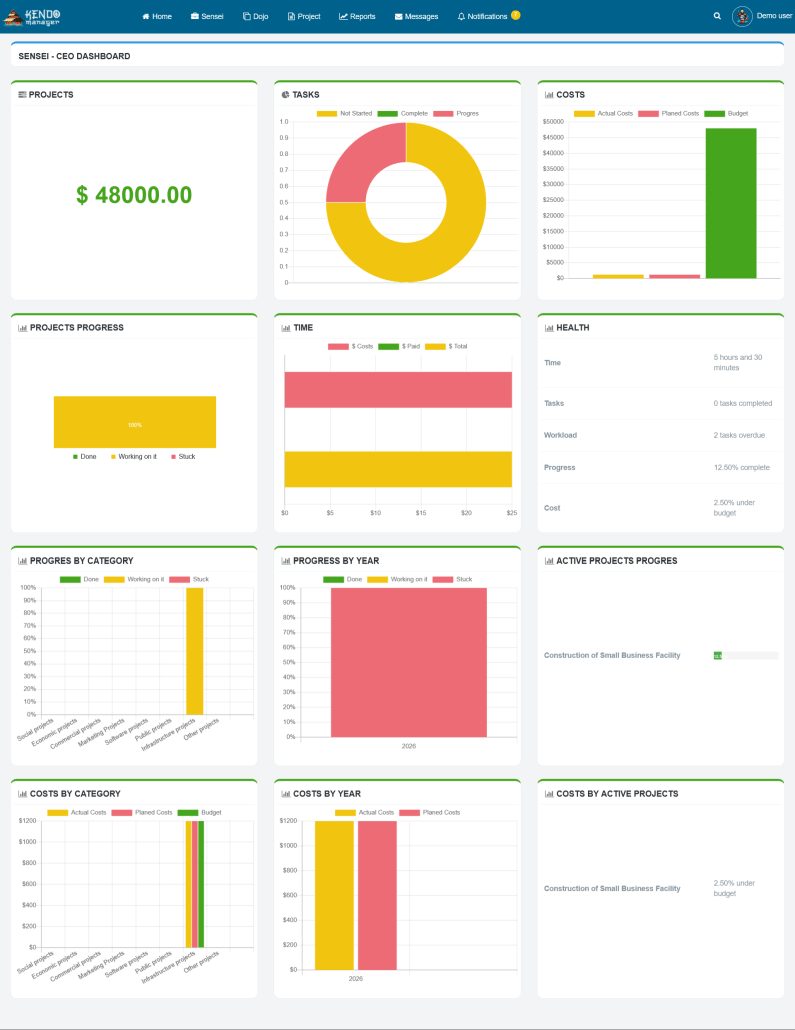
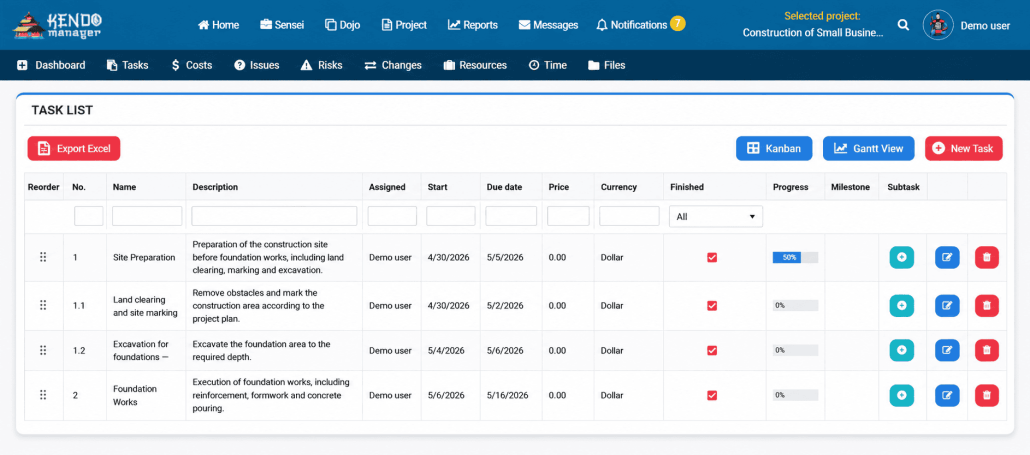
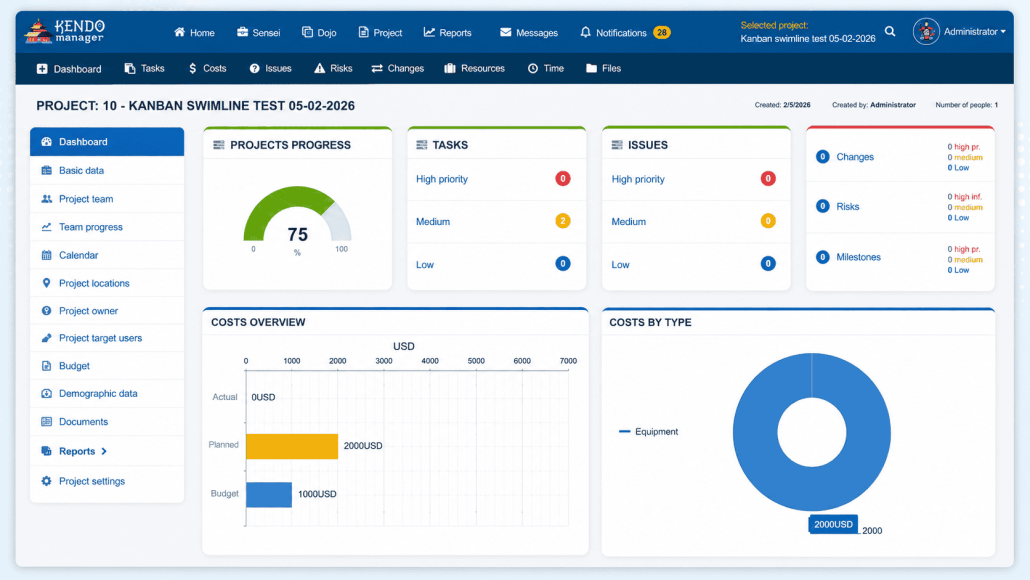
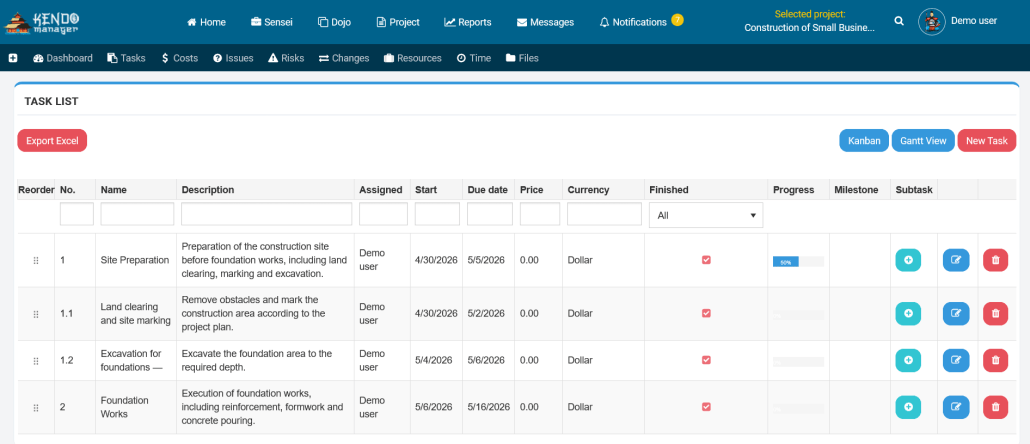
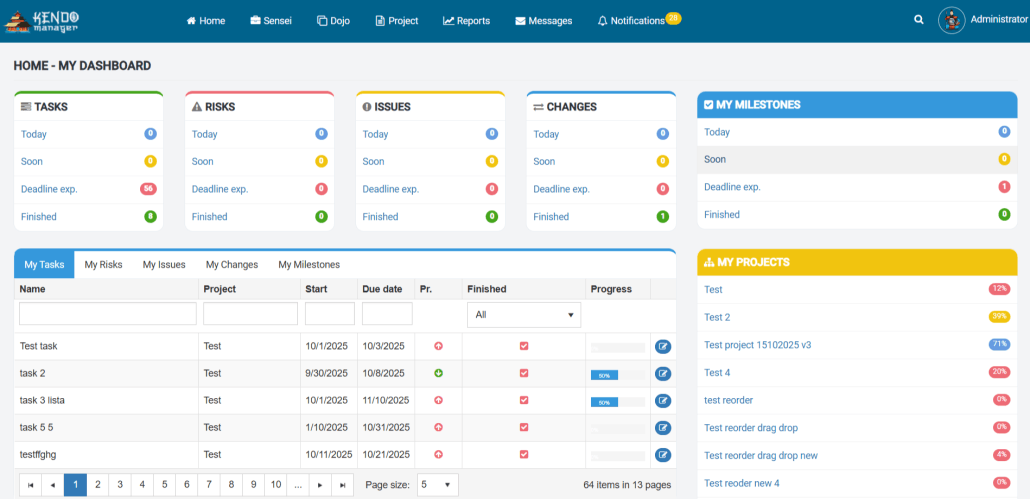
The free self-hosted plan ships with 6 enterprise project management modules: Gantt, Kanban, Cost & Budget, Time Tracking, Resource Allocation, and Risk Management. These modules are not lite versions, sandboxes, or read-only previews — they share the exact codebase with the $6,299 Professional tier. The feature grid below describes how each module addresses a concrete startup workflow.
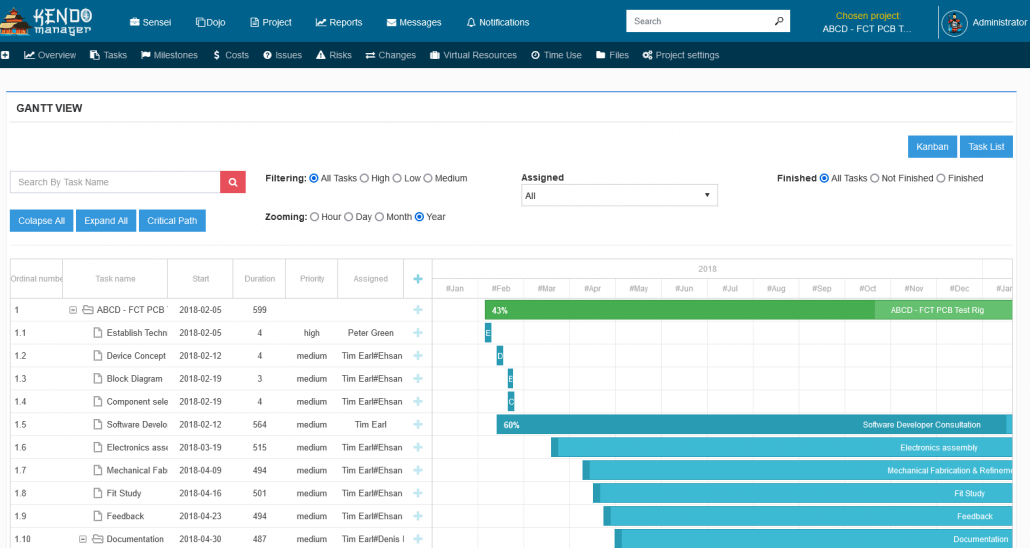
📊 Interactive Gantt
Drag-and-drop timelines with task dependencies, critical path highlighting, and milestone markers. Replaces MS Project for fixed-scope work.
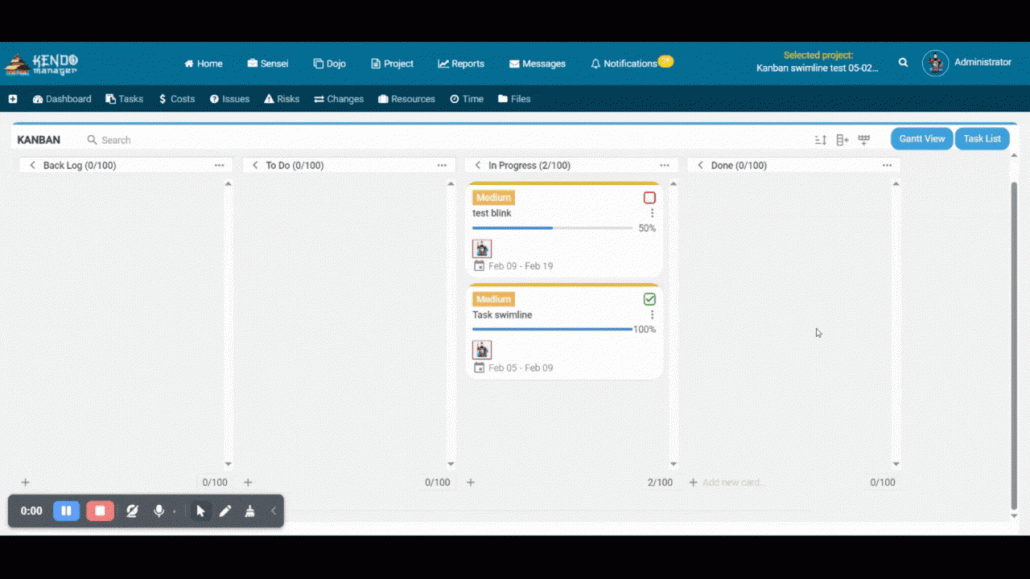
📋 Kanban Board
WIP-limited columns for Scrum sprints and continuous-delivery pipelines. Drag cards across To Do → In Progress → Done with audit history.
💰 Cost & Budget
Earned Value Management with planned-vs-actual reports. Logs hours × resource rate automatically; tracks fixed costs, material, and travel.
⏱ Time Tracking
Per-task hour logs feed billing and post-mortem estimates. Per-user weekly timesheets export to CSV for accounting hand-off.
👥 Resource Allocation
Heat-map view of team workload prevents over-booking. Reassigns tasks when one engineer approaches the 40 h/week ceiling.
⚠ Risk Management
Risk register with probability × impact scoring, mitigation owner, and review date. Aligns with PMBOK 7th Edition risk practice.
How does cost management work inside the free tier?
Cost management inside the free tier multiplies logged hours by predefined resource rates to calculate actual labor cost in real time, then compares the figure against a planned budget using the Earned Value Management formula. Project managers add fixed costs, material expense, and travel directly to the task or the project header. The Cost module sits on the same MariaDB instance as the rest of the application, so financial data never leaves the customer's network — useful when payroll and contractor rates count as confidential under GDPR Article 32.
How Does Kendo Manager Compare to OpenProject, Redmine, and Taiga for Startups?
Kendo Manager differs from OpenProject, Redmine, and Taiga on installation stack, included modules, and licensing model. The three Linux-native alternatives ask startups to deploy Ruby, Java, or Python environments and frequently to write or buy plugins for budget and cost tracking. Kendo Manager runs natively on Windows with .NET and MariaDB and includes cost, budget, and risk modules in every tier including the free one.
| Criterion | Kendo Manager Free | OpenProject Community | Redmine | Taiga CE |
|---|---|---|---|---|
| License Fee | $0 perpetual | $0 (GPLv3) | $0 (GPLv2) | $0 (MPL 2.0) |
| OS Stack | Windows + IIS | Linux + Apache | Linux + Apache | Linux + Docker |
| Database | MariaDB | PostgreSQL | MySQL / PostgreSQL | PostgreSQL |
| Runtime | .NET Framework 4+ | Ruby on Rails | Ruby on Rails | Python / Django |
| Gantt Charts | ✓ Included | ✓ Included | ✓ Included | ✗ Plugin needed |
| Kanban Board | ✓ Included | ✓ Included | Plugin | ✓ Included |
| Cost & Budget | ✓ Included | Paid plan only | Plugin | ✗ |
| Time Tracking | ✓ Included | ✓ Included | ✓ Included | ✗ |
| User Cap (Free) | 10 | Unlimited | Unlimited | Unlimited |
| Setup Time | ~2 hours | ~4 hours | ~6 hours | ~3 hours |
The trade-off is direct: OpenProject, Redmine, and Taiga offer unlimited free users but assume a Linux administrator on the team and ask for plugin development to reach feature parity on cost and budget tracking. Kendo Manager caps users at 10 on the free tier but ships every module pre-built and runs on the Windows infrastructure most early-stage startups already own through their Microsoft 365 subscription.
Why Does Windows-Native Installation Reduce IT Costs for Small Teams?
Windows-native installation reduces IT costs for small teams because it removes the need for a dedicated Linux administrator, which Glassdoor 2026 wage data places at $98,000–$135,000 per year in the United States. A 5-person startup can install Kendo Manager on a Windows 11 desktop, a Windows Server VM, or a Microsoft Azure D2 instance using the same skills the team already uses to manage Active Directory and Microsoft 365.
Figure 1 — The 5-layer Kendo Manager installation stack. Every layer except the application binary is free or already part of a standard Microsoft 365 / Windows Server license.
Which 4 Windows installation targets does Kendo Manager support?
Kendo Manager supports 4 Windows installation targets, ranked here from lowest to highest production capacity:
- Windows 10 / 11 desktop — for solo founders piloting the tool before team rollout. Installs in roughly 90 minutes on 8 GB RAM.
- On-premise Windows Server — for teams of 5–50 working from a single office or warehouse with an internal LAN.
- Windows VPS / ASP hosting with Plesk panel — for distributed teams accessing the tool over the public internet.
- Microsoft Azure D-series VM — for startups already inside the Microsoft cloud ecosystem with Azure credits from Microsoft for Startups [3].
Which 3 Startup Constraints Does Free Self-Hosted Project Management Solve?
Free self-hosted project management solves 3 measurable startup constraints: runway depletion from SaaS subscriptions, vendor-side data exposure, and per-user fee escalation as hiring accelerates. Each constraint maps to a specific Kendo Manager mechanism, documented below.
How does it slow runway depletion in a seed-stage budget?
A typical seed-stage startup running on a $15-per-user-per-month SaaS project tool spends $1,800 per year on a 10-person team and $5,400 on a 30-person team — figures verified against published Asana and Monday.com 2026 rate cards. The Kendo Free tier removes that line item entirely until the team passes 10 active users. Even after upgrading to the $749 Startup tier, the 3-year total cost of ownership is roughly $1,500 including a $250/year Windows VPS, against $5,400 for the same 10-user SaaS plan over the same 3 years.
Figure 2 — A 10-user startup running Kendo Free pays $0 over 3 years; the same team on a $15/user/month SaaS plan pays $5,400 — a 3.6× spread. Based on published 2026 SaaS rate cards.
How does it close vendor-side data exposure?
Vendor-side data exposure closes when the project database, file attachments, and audit log live inside the customer's own network rather than on a third-party multi-tenant cloud. The Kendo Free tier keeps every byte on customer-controlled hardware in the customer's chosen country — useful for GDPR Article 32 ("security of processing") compliance and for ISO/IEC 27001:2022 Annex A.5.23 controls on supplier relationships [4]. A 2026 enterprise IT survey cited by industry analyst Gartner shows that 62% of IT leaders cite data control as the primary reason for choosing on-premise project tools over SaaS.
How does it stop per-user fee escalation during hiring sprints?
Per-user fee escalation stops when the license is one-time and perpetual instead of monthly and per-seat. A startup adding 5 engineers in a hiring sprint on a $15/user/month SaaS tool adds $900 to annual cost immediately and $2,700 over 3 years — before any vendor-side price hike. The same hiring sprint on Kendo Manager triggers either a tier change once at the 10/20/50/100-user mark or zero additional cost if it stays within the current tier. Asana raised Business-tier pricing twice between 2023 and 2025; perpetual licenses absorb zero impact from those moves.
How Does a Startup Upgrade From the Free Tier to Paid Plans Without Data Loss?
A startup upgrades from the free tier to paid plans by purchasing a license key and applying it to the same Kendo Manager binary. No database migration, no data export, no file re-import, no re-training. The 5-step upgrade path below completes in under 15 minutes for any team that has already installed the free version.
Figure 3 — The 5-step upgrade path. The database, users, projects, and bookmarks survive the transition unchanged.
What happens to existing project files during the upgrade?
Existing project files stay on the same MariaDB instance during the upgrade because the license key controls only the user-count and project-count caps inside the application, not the underlying database schema. Gantt charts, Kanban cards, cost entries, time logs, file attachments, risk registers, and audit history remain in place. Internal URLs and bookmarks continue to resolve. End-user accounts keep their passwords, role assignments, and notification preferences. Teams that hit the 10-user cap on a Tuesday at 4:47 pm can be running 50 users by 5:02 pm.
What Hardware Does the Free Kendo Manager Installation Require in 2026?
The free Kendo Manager installation requires 4 GB RAM minimum (8 GB recommended), 20 GB disk space, and a 64-bit Windows OS. The footprint stays small because the application binary is roughly 200 MB, MariaDB consumes 600 MB, and the rest of the disk allocation covers project files and database growth. The table below maps the 3 most common 2026 hardware scenarios for a 10-user startup.
| Scenario | CPU | RAM | Disk | Monthly Cost |
|---|---|---|---|---|
| Windows 11 desktop (office) | 4 cores | 8 GB | 256 GB SSD | $0 (existing) |
| Windows VPS (shared workload) | 2 vCPU | 4 GB | 80 GB SSD | $15–$25 |
| Azure D2s_v5 (production) | 2 vCPU | 8 GB | 120 GB SSD | $70–$95 |
Free Self-Hosted Project Management Software FAQ for 2026
What is free self-hosted project management software?
Free self-hosted project management software is on-premise project planning software installed on company-controlled servers under a perpetual zero-cost license. It removes per-user SaaS fees and keeps all task, cost, and resource data inside the organization's network perimeter.
How many users does the Kendo Manager free version support?
The Kendo Manager free version supports 10 active team members and 1 active project at $0 license cost. All enterprise modules — Gantt, Kanban, cost, time, resource, risk — remain fully available, with technical support and mobile access included.
Which Windows components does Kendo Manager require?
Kendo Manager runs on Windows Server or Windows 10/11 PC with IIS web server, .NET Framework 4.0 or higher, and MariaDB 10.1 to 10.5. The stack installs in under 2 hours on a standard 8 GB RAM machine and accepts Microsoft Azure or any Windows VPS as a hosting target.
Is Kendo Manager suitable for Scrum and Kanban startups?
Kendo Manager fits Scrum and Kanban startups through sprint planning views, backlog management, burndown reports, and a dedicated Kanban board module. Hybrid teams running waterfall and agile in parallel use Gantt for fixed-scope work and Kanban for iterative work inside the same project.
How does the free Kendo Manager version protect startup data?
The free Kendo Manager version keeps every byte of project data on customer-controlled hardware in the customer's chosen country, which aligns with GDPR Article 32 and ISO/IEC 27001:2022 Annex A controls. No external vendor stores task lists, cost figures, or team identities.
What happens to project data when a startup upgrades to a paid plan?
Project data stays on the same MariaDB instance when a startup upgrades from free to paid Kendo Manager. Applying the new license key removes the 10-user and 1-project caps without database migration, file re-import, or user re-training. The upgrade completes in under 15 minutes.
How much does Kendo Manager cost after the free tier?
Kendo Manager paid tiers run from $749 (Startup, 10 users) to $6,299 (Professional, unlimited users) as one-time perpetual licenses. Every paid tier includes 12 months of upgrades and technical support; optional annual maintenance is 25% from year two.
How does Kendo Manager compare to OpenProject and Redmine?
Kendo Manager differs from OpenProject and Redmine by running natively on Windows with .NET and MariaDB instead of Linux with Ruby or PostgreSQL. It includes cost, budget, and risk modules in the free tier, while OpenProject Community and Redmine require self-coded plugins for the same coverage.
Related reading on Kendo Manager: Self-Hosted Project Management Software: What Are the 7 Best Tools, 5 Deployment Models, and Real Enterprise Costs in 2026? · Self-Hosted Project Management Software for Small Business in 2026 · Self-Hosted Asana Alternative in 2026: Kendo Manager On-Premise License, ISO 27001 Compliance, and 7 Enterprise Features · The Complete Guide to Self-Hosted Project Management for 2026 · Kendo Manager Prices
- IBM Security. (2024). Cost of a Data Breach Report 2024. ibm.com/reports/data-breach
- Kendo Manager. (2026). Pricing — Perpetual License Tiers. kendomanager.com/prices
- Microsoft Corporation. (2026). Microsoft for Startups — Azure Credits Program. microsoft.com/startups
- International Organization for Standardization. (2022). ISO/IEC 27001:2022 Information Security Management Systems. iso.org/standard/27001
- European Union. (2016). GDPR Article 32 — Security of Processing. gdpr-info.eu/art-32-gdpr